How many pallets fit in a van: counting by internal dimensions
Published:
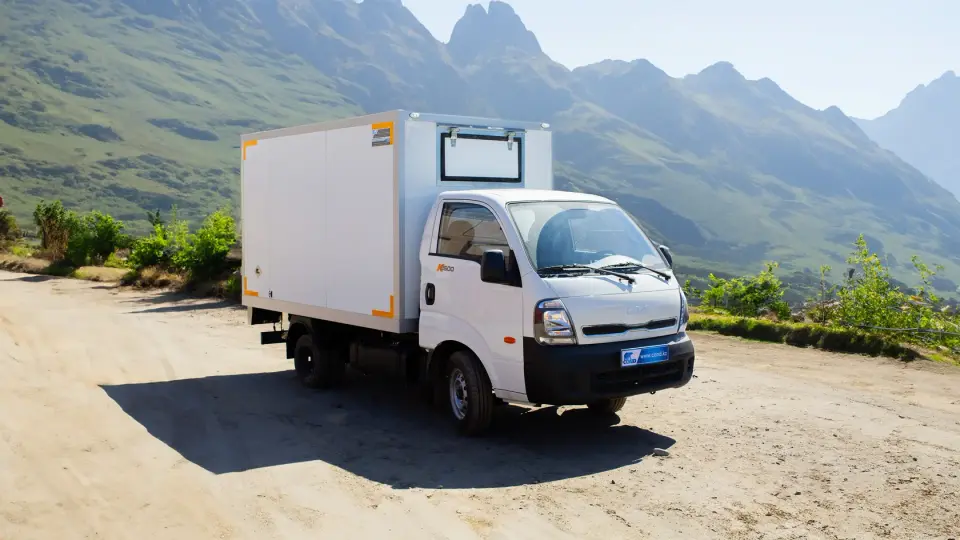
The short answer: count by the internal dimensions of the body, not the external ones, and always in both pallet orientations. Below is the rule that does it in a minute, and a ready table for the bodies we build.
Quote is based on body, chassis and temperature range.
The calculation rule
It takes three steps. First: convert the external dimensions into internal ones — subtract twice the panel thickness from the length, width and height. Second: divide the internal width by the pallet dimension across the body — that is how many fit in a row. Third: divide the internal length by the pallet dimension along the body — that is the number of rows. Multiply.
Panel thickness is taken from the body type: 100 mm on a refrigerated or insulated van, 25 mm on a dry-freight one. The difference matters: a hundred millimetres on each side eats 200 mm of width, and a row of three pallets turns into a row of two.
Two loading schemes, not one
A europallet is not square: 1200 × 800 mm. So it can be placed two ways, and the numbers come out different.
Short side across
Across the body a pallet takes 800 mm, along it 1200 mm. This is the main scheme: it puts more units in a row and leaves the rows wide enough to work with a forklift.
Long side across
Across it takes 1200 mm, along it 800 mm. The scheme only wins in very wide bodies and almost always loses in narrow ones: at an internal width below 2400 mm only one pallet fits in a row.
The classic illustration is the 13.6-metre tilt trailer. The internal width of a euro-trailer, 2480 mm, is made exactly for three europallets short side across: 3 × 800 = 2400 mm, eleven rows, 33 pallets in total. The arithmetic for the second scheme gives thirty-four, but nobody loads that way: the rows come out too narrow for a forklift.
A table for our bodies
Internal dimensions and pallet counts are calculated by the rule above, panel thickness by body type. The dimensions are taken from real projects.
| Body outside, mm | Type | Inside, mm | Europallets | Finnish | Chassis |
|---|---|---|---|---|---|
| 3,000 × 1,900 × 1,900 | dry freight | 2,950 × 1,850 | 4 | 2 | Kia Bongo K2500 |
| 4,200 × 1,900 × 1,900 | dry freight | 4,150 × 1,850 | 6 | 4 | Kia Bongo K4000 |
| 4,200 × 2,200 × 2,200 | insulated, refrigerated | 4,000 × 2,000 | 6 | 3 | Hino 300 615 |
| 5,200 × 2,200 × 2,200 | insulated, refrigerated | 5,000 × 2,000 | 8 | 4 | Iveco Daily 50C15 |
| 5,300 × 2,500 × 2,200 | dry freight | 5,250 × 2,450 | 12 | 10 | Foton Aumark |
| 6,200 × 2,200 × 2,200 | insulated, refrigerated | 6,000 × 2,000 | 8 | 5 | Iveco Daily 70C15 |
| 6,200 × 2,400 × 2,400 | insulated, refrigerated | 6,000 × 2,200 | 11 | 8 | Iveco Daily 70C15 |
The figures in the table are the mixed layout with a 50 mm handling allowance; the same calculation gives the capacity shown on the vehicle pages and in the configurator. The all-crosswise and all-lengthwise schemes from the section above are the limiting cases of a single orientation, and each on its own yields less.
Work it out for your size:Body calculator
What is the body volume of a GAZelle
GAZelle body volume is calculated from the internal dimensions. 3.2 m body: dry freight van 3,150 × 1,950 × 2,150 mm — 13.2 m³, 4 Euro pallets. 4.2 m body: dry freight van 4,150 × 2,050 × 2,350 mm — 20.0 m³, 8 Euro pallets; an insulated or refrigerated body with a 100 mm panel — 4,000 × 2,000 × 2,200 mm, 17.6 m³, 6 Euro pallets.
How many pallets fit in a GAZelle
The GAZelle is bodied at 3.2 or 4.2 metres — there is no five-metre body on this chassis, and 5 metres starts with the GAZon NEXT. The figures below are calculated by mixed stacking from the internal dimensions of actual projects.
| Body | Inside, mm | Europallets |
|---|---|---|
| Dry freight van on a GAZelle Business 3302 | 3,150 × 1,950 × 2,150 | 4 |
| Reefer on a GAZelle Business 3302 | 3,000 × 1,900 × 2,000 | 4 |
| Refrigerated body on a GAZelle Business 330202 (4.2 m) with LPG | 4,000 × 2,000 × 2,200 | 6 |
| Bread van on GAZelle Next chassis | 2,992 × 1,892 × 1,592 | 4 |
| Isothermal body on a GAZelle Next A21R32 (4.2 m, diesel) | 4,000 × 2,000 × 2,200 | 6 |
| Multi-temperature reefer on a GAZelle Next A21R23 | 2,992 × 1,892 × 1,992 | 4 |
| Dry freight van on a GAZelle Next A21R23 (3.2 m body) | 3,150 × 2,050 × 2,350 | 5 |
| Dry freight van on a GAZelle Next — 4,200 × 2,100 × 2,100 mm body | 4,150 × 2,050 × 2,050 | 8 |
| Dry-freight body on a GAZelle Next A21R35 (4.2 m) with LPG | 4,150 × 2,050 × 2,450 | 8 |
| Dry-freight van on GAZ Gazelle Next chassis | 4,150 × 2,050 × 2,350 | 8 |
| Refrigerated van on a GAZelle Next A21R25 | 3,000 × 1,800 × 1,800 | 4 |
| Refrigerated GAZelle Next A21R35 with a Carrier CITIMAX 350 | 4,000 × 1,850 × 1,800 | 6 |
| GAZelle Next A21R35 premium FRP reefer for pharmaceuticals | 4,050 × 2,050 × 2,200 | 8 |
A 4.2-metre dry-freight van takes eight europallets, a refrigerated body of the same length — six. The panel makes the difference: 25 mm against 100 mm is 150 mm off every internal dimension, and the mixed layout of a 1,200 mm strip plus an 800 mm strip no longer fits across the width.
The Finnish pallet eats capacity
The Finnish pallet, also called the industrial one, is 1200 × 1000 mm. Two hundred extra millimetres on the short side look like a trifle until they run into the width of the body.
In a narrow body 1850 mm wide inside, europallets stand two per row, a Finnish one only one. Capacity halves exactly. So if goods arrive on Finnish pallets, the width of the body has to be chosen for them from the start, not discovered after assembly.
What else eats space
The calculation on a clean rectangle is the upper bound. In a real body several more things are subtracted from it.
The refrigeration unit evaporator
In a refrigerated body the evaporator hangs under the ceiling by the front wall and takes some height, sometimes some length too. That usually does not change the pallet count on the floor, but it does change the stacking height.
Load-securing rails and posts
Cargo-securing rails are fitted on the side walls and eat a few centimetres of width on each side. If a row is calculated to the millimetre, they are exactly what stops the pallet from fitting.
The door opening
The opening is always narrower than the body. A pallet that fits inside still has to pass through the doors — that is a separate check, especially on bodies with a side door.
Body options:Dry-freight body
Volume is not the only limit
The second limit is weight. The payload of the chassis after the body is fitted drops by the weight of the body itself, and what is left is divided between the pallets.
Calculate both limits and take the smaller one. If a pallet weighs 800 kg and 1500 kg is left for the load, two pallets go into the vehicle regardless of how much room there is in the body. The opposite case is just as common: light bulky goods run into the dimensions long before the payload.
One more limit, the one remembered last, is the axle load. Cargo shifted towards the rear wall can overload the rear axle at a formally permissible gross weight.
Chassis specifications:Chassis comparison by payload
FAQ
How do you work out the cubic capacity of a truck body?
Cubic capacity is worked out from the internal dimensions, not the external ones: two panel thicknesses are subtracted from every dimension, floor and ceiling included, and the three figures multiplied. A 4,200 × 2,200 × 2,200 mm body with a 100 mm panel leaves 4,000 × 2,000 × 2,000 mm inside — that is 16 m³, not the 20.3 m³ the external size suggests.
How does cubic capacity differ from usable volume?
Cubic capacity is the geometric volume inside the body. Usable volume is smaller: the evaporator, lashing rails and shoring bars take up part of it, and stacking pallets leaves gangways. Pallet capacity is therefore worked out separately, not by dividing the cubic capacity by the volume of a pallet.
How do I calculate how many pallets will fit in a body?
First convert the external dimensions into internal ones: subtract twice the panel thickness from each dimension. Then divide the internal width by the pallet dimension across — that gives how many fit in a row; divide the internal length by the pallet dimension along — that gives the number of rows. Multiply. Both orientations have to be counted: for a 1200 × 800 europallet these are two different figures.
How many europallets fit in a 4.2-metre van?
Six europallets fit a dry-freight body of 4200 × 1900 × 1900 with a 25 mm panel: 4150 × 1850 is left inside, that is two units per row short side across and three rows. An insulated body of the same 4.2 metres but 2200 mm wide with a 100 mm panel also takes six: the width inside is 2000 mm, a third pallet does not fit in the row.
How many pallets fit in a GAZelle?
A 3.2-metre body takes four europallets, five in the widest dry-freight version. A 4.2-metre body takes six in a refrigerated or insulated van and eight in a dry-freight one. The spread comes from panel thickness: 25 mm in a dry van against 100 mm in a refrigerated one — 150 mm off every internal dimension, and at that width the second stacking strip disappears.
How many pallets fit in a 3-metre GAZelle?
Four europallets in a single tier: the internal width of a 3.2-metre body is 1,800–1,950 mm — two pallets short side across and two rows along the length. A dry-freight body 2,050 mm wide inside takes five: an 800 mm strip is added to the 1,200 mm one.
How many pallets fit in a 4.2-metre GAZelle?
Eight europallets in a dry-freight van and six in a refrigerated or insulated one. The dry-freight body is 4,150 × 2,050 mm inside: the 1,200 mm strip takes five pallets along the length and the remaining 800 mm strip another three. The refrigerated body is 4,000 × 2,000 mm inside, where the mixed layout no longer works, leaving two pallets per row and three rows.
How many pallets fit in a 5-metre GAZelle?
There is no five-metre body on the GAZelle: the standard lengths are 3.2 and 4.2 metres, and above that comes the GAZon NEXT. The GAZon’s 5.2-metre insulated body takes ten europallets (4,992 × 2,292 mm inside).
How many pallets fit in a 13.6-metre tilt trailer?
Thirty-three europallets. The internal width of a euro-trailer, 2480 mm, is chosen precisely for three pallets per row short side across: 3 × 800 = 2400 mm. That gives eleven rows. Loading long side across, the arithmetic gives thirty-four, but nobody loads that way — the rows come out too narrow to work with a forklift.
How does a europallet differ from a Finnish one?
A europallet, EUR or EPAL, is 1200 × 800 mm; a Finnish one, also called industrial, is 1200 × 1000 mm. The 200 mm difference on the short side decides a lot: in a body 1850 mm wide inside, one Finnish pallet fits per row instead of two europallets, and capacity halves.
Why does the external size suggest more?
Because the wall eats space on every side. A refrigerated or insulated body has a 100 mm panel, a dry-freight one 25 mm. A body of 6200 × 2400 outside is 6000 × 2200 inside, and a third pallet no longer fits in the row, even though the external width suggests it should.
Which matters more — how many pallets fit or the payload?
Whichever runs out first. Light bulky goods run into the dimensions of the body, heavy ones into the payload of the chassis and the axle load. Calculate both limits: if a pallet weighs 800 kg, two go into a vehicle with 1500 kg left after the body is fitted, however much room remains.
If the size of the body has not been chosen yet, it is easier to count from the other end: tell us how many pallets and of which type you need to carry, and we will pick the length and width of the body for that and check that the chassis can take the weight. COND bodies are built in Almaty on the customer chassis.
See also:Types of van body: what bodies there are
Manufacturing:Custom van bodies built to order
Our work:Completed COND projects