Retroreflective tape, side guards and rear underrun protection on trucks: requirements and fines in Kazakhstan (2026)
Published:
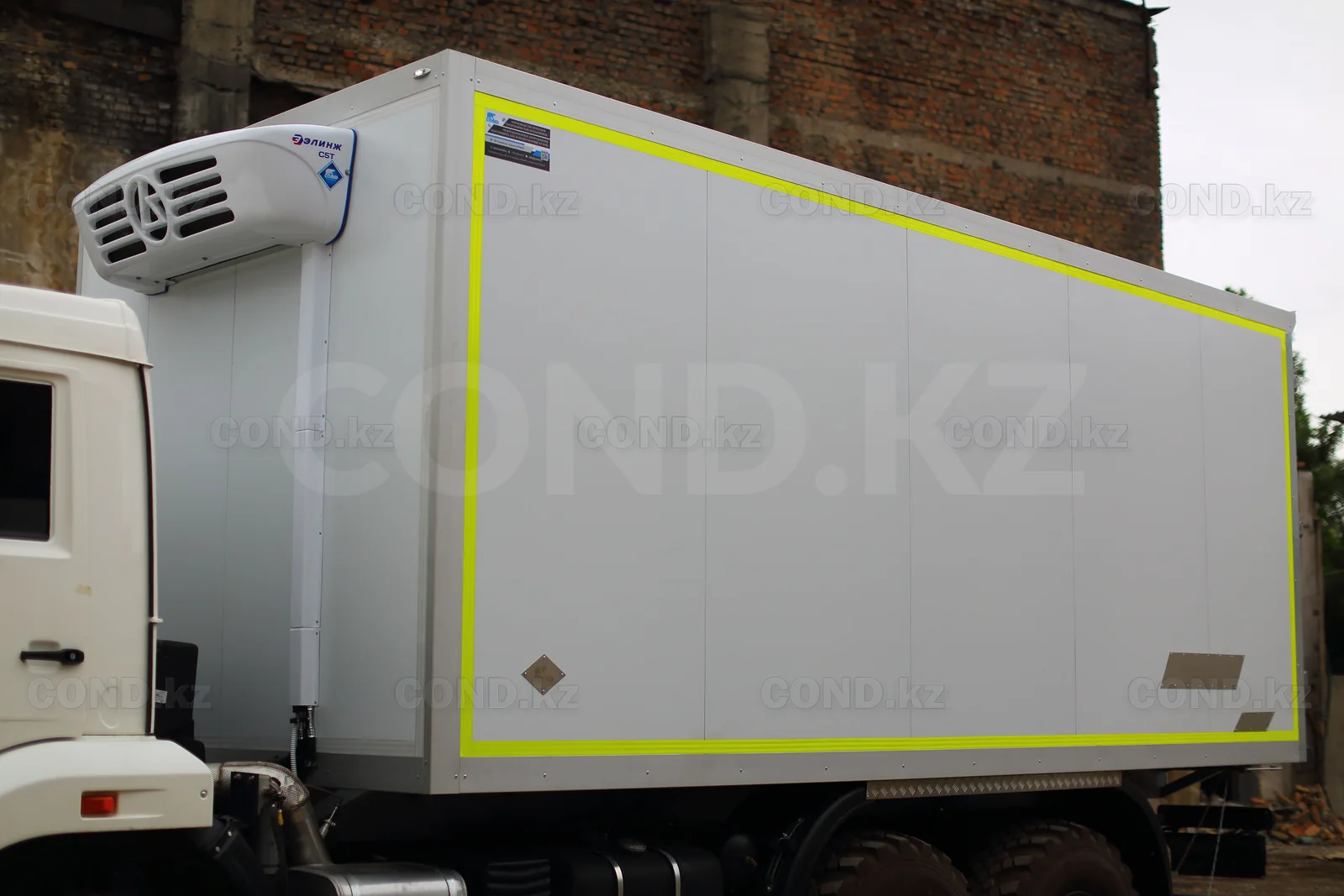
Retroreflective contour marking, side underrun protection devices and a rear underrun bar on trucks and trailers are mandatory design elements, not options. Their absence or damage is grounds for prohibiting the operation of a vehicle and for a fine under Article 590 of the Administrative Offences Code of the Republic of Kazakhstan. Below are the rules in force for 2026, the documents that establish them, and what has changed in the roadworthiness testing procedure.
Quote is based on body, chassis and temperature range.
Where the requirements come from
| Document | What it establishes |
|---|---|
| Customs Union Technical Regulation (CU TR) 018/2011 "On the safety of wheeled vehicles" — adopted by Customs Union Commission Decision No. 877 of 09.12.2011, in force since 01.01.2015, as currently amended | Requirements for vehicles in service — Annex 8: clause 3.7 — "Damage to and peeling of retroreflective marking is not permitted"; clause 8.1 — "Removal of, or change to the position of, the rear and side underrun protection devices provided by the manufacturer is not permitted" |
| Road Traffic Rules of Kazakhstan — approved by Government Resolution No. 1196 of 13.11.2014 | Section 19, clause 4 — the obligation to mark vehicle contours with retroreflective material; the List of faults and conditions under which vehicle operation is prohibited (Section 7, clauses 7 and 9) |
| Rules of compulsory roadworthiness testing — Order No. 329 of 26.03.2015 of the Acting Minister for Investment and Development | The procedure and frequency of testing; amended by Orders No. 38 of 07.02.2025 (in force from 05.04.2025) and No. 58 of 16.03.2026 (in force from 29.03.2026) |
| Article 590 of the Administrative Offences Code | Fines for operating a defective vehicle and for driving without a valid roadworthiness test |
The underlying technical documents are UNECE Regulations No. 104 — retroreflective marking (equivalent: state standard GOST R 41.104-2002), No. 48 — placement of marking, No. 73 — side protection (GOST R 41.73-99), and No. 58 — rear protection (GOST R 41.58-2001).
Which vehicles are covered
Categories under Annex 1 to CU TR 018/2011:
| Category | Vehicle |
|---|---|
| N2 | Goods vehicles with a technically permissible maximum mass over 3.5 t and up to 12 t inclusive |
| N3 | Goods vehicles with a maximum mass over 12 t |
| O2 | Trailers and semi-trailers with a maximum mass over 0.75 t and up to 3.5 t |
| O3 | Trailers and semi-trailers with a maximum mass over 3.5 t and up to 10 t |
| O4 | Trailers and semi-trailers with a maximum mass over 10 t |
Retroreflective marking. Under Section 19, clause 4 of the Kazakh Road Traffic Rules, the side and rear contours of vehicles in categories M2, M3 (buses), N2, N3, O2, O3 and O4 are marked with retroreflective material in accordance with standards ST RK GOST R 51253 and ST RK GOST R 41.104 (ST RK denotes a national standard of Kazakhstan). The exceptions are technological vehicles operating on closed sites and in-farm vehicles of peasant and farming enterprises. The Kazakh list is broader than UNECE Regulation No. 48: under Regulation No. 48, contour marking is mandatory for new category N2 vehicles with a gross mass over 7.5 t and for N3 vehicles (excluding tractor units and incomplete vehicles or chassis), and for O3 and O4 trailers.
Side and rear protection. Mandatory for categories N2, N3, O3 and O4. Exceptions: tractor units; trailers specially designed to carry indivisible long loads; vehicles on which such protection is incompatible with their intended use.
Retroreflective (contour) marking: the figures
| Parameter | Requirement |
|---|---|
| Material | Class C film (contour or strip marking) bearing an "E" type-approval mark; classes D and E are for distinctive and graphic marking only (logos, advertising) |
| Colour at the side | White or yellow |
| Colour at the rear | Yellow or red |
| Strip width | 50 mm (+10/−0), i.e. 50–60 mm |
| Mounting height | Lower edge 250–1500 mm above the road |
| Coverage | At least 80 % of the overall length (side) or overall width (rear) |
| Distance from the outer edge | No more than 600 mm |
Under UNECE Regulation No. 48, rear marking is applied where the vehicle is more than 2100 mm wide (full contour marking, or partial where full is not possible), and side marking where the vehicle is more than 6000 mm long (at least partial contour marking). Partial contour marking is a horizontal line along the lower part of the body plus the upper corners indicated by two mutually perpendicular segments of 250 mm each.
For vehicles in service, clause 3.7 of Annex 8 to CU TR 018/2011 applies: damage to and peeling of the marking is not permitted. Faded, torn or partially detached tape counts the same as no tape at all — the offence is identical.
Side underrun protection devices (UNECE Regulation No. 73 / GOST R 41.73-99)
A side underrun protection device prevents a pedestrian, cyclist or motorcyclist from falling under the wheels through the gap between the axles. The main dimensions:
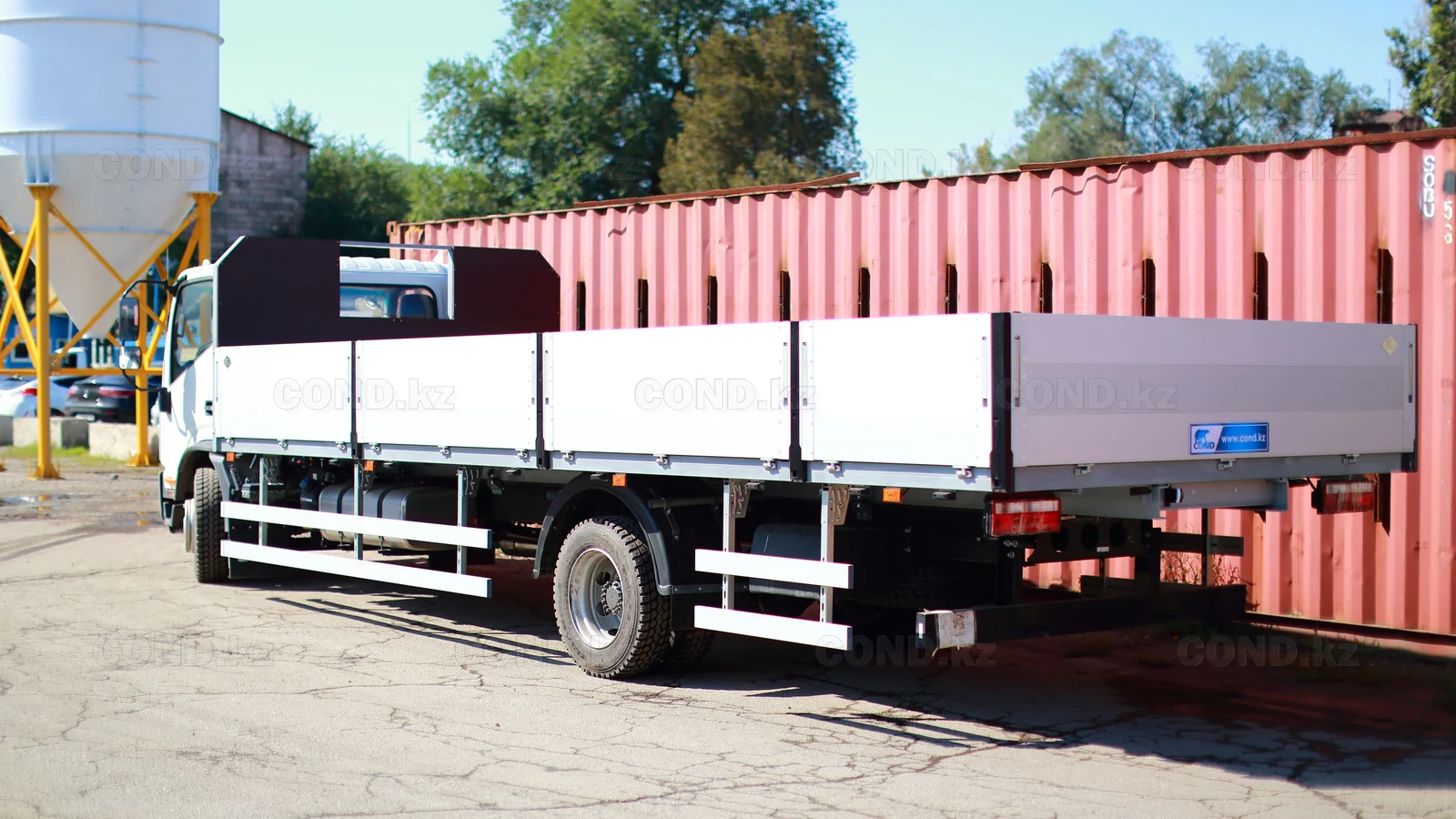
| Parameter | Requirement |
|---|---|
| Lower edge | No more than 550 mm above the ground at any point (clause 7.6) |
| Upper edge | No more than 350 mm below the plane tangential to the outer tyre surface; where the vehicle structure does not intersect that plane, at the level of the load platform or 950 mm above the ground, whichever is lower; where the plane lies above 1.3 m, the upper edge must be no lower than 950 mm (clause 7.7) |
| Rail profile | Height at least 50 mm for N2 and O3, at least 100 mm for N3 and O4; the gap between rails no more than 300 mm (clause 7.3) |
| Longitudinal gaps | From the front tyre to the front edge of the device: no more than 300 mm on a truck, 500 mm on a trailer, 250 mm on a semi-trailer; from the rear edge of the device to the rear tyre, no more than 300 mm (clauses 7.4–7.5) |
| Position across the width | The device must not increase the overall width of the vehicle; the main part of its outer surface must lie no more than 120 mm inboard of the plane of maximum width (clause 7.1) |
| Strength | A horizontal static force of 1 kN (ram 220±10 mm in diameter); deflection no more than 30 mm over the rearmost 250 mm of length and no more than 150 mm over the remainder (clause 7.8) |
Removing or repositioning side underrun protection fitted by the manufacturer is prohibited by clause 8.1 of Annex 8 to CU TR 018/2011.
Rear underrun protection — the underrun bar (UNECE Regulation No. 58 / GOST R 41.58-2001)
Rear underrun protection stops a passenger car from sliding under the frame of a truck or trailer in a rear-end collision.
| Parameter | Requirement |
|---|---|
| Lower edge | No more than 550 mm above the ground (unladen vehicle) across the full width |
| Height of the cross-member profile | At least 100 mm |
| Width | No wider than the rear axle measured at the outermost points of the wheels, and no more than 100 mm shorter on either side; with several axles, measured against the widest |
| Longitudinal position | No more than 400 mm from the rear face of the device to the rearmost point of the vehicle |
| Test loads | 100 kN or 50 % of the force corresponding to the vehicle's maximum mass, whichever is lower — applied in sequence at two points symmetrical about the vehicle centreline and 700–1000 mm apart; 25 kN or 12.5 %, whichever is lower — at two points 300±25 mm from the longitudinal planes tangential to the outer edges of the rear wheels, and at the centre point between them. The load is applied no higher than 600 mm |
Under the List of faults in the Kazakh Road Traffic Rules (Section 7, "Other design elements", clause 7), operation is prohibited where "the rear underrun protection device, mudguards or mudflaps provided for in the design are missing".
Side guard brackets and rails for vans are in the catalogue: van side guards.
Tankers and dangerous goods
For road tankers, tanker trailers and semi-trailers, vehicles carrying demountable tanks and battery vehicles used for dangerous goods, clause 20.1 of Annex 8 to CU TR 018/2011 requires side or rear protection around the whole perimeter of the tank. Rear protection is not required on tipping tankers discharged through the rear wall where the rear fittings of the shell perform that function. The distance between the rear wall of the tank and the rear of the protection device must be at least 100 mm (clause 20.2).
How it is checked: roadworthiness testing and roadside enforcement
One point is worth getting right. The rules of compulsory testing (clause 32, the main stage) do not name retroreflective marking as a separate item; the closest entry on the inspection sheet is "presence and condition of bumpers and wheel mudguards". The prohibition on operating a vehicle without marking or protection devices works through a different chain: Annex 8 to CU TR 018/2011 + Section 19, clause 4 of the Road Traffic Rules + the List of faults → prohibition of operation → a fine under Article 590. In other words, a vehicle can be stopped and fined on the road for missing tape or a removed bar regardless of how its roadworthiness test went.
Where a vehicle fails to meet the requirements, the test is recorded as not passed and an inspection sheet listing the faults is issued (clause 43). On a retest at the same centre within 10 calendar days of the first inspection, only the items that failed are checked and charged for (clauses 46 and 48), and the operator may not refuse a retest (clause 47). After 10 days the vehicle is tested in full.
What changed in 2025–2026. The technical requirements for marking and protection devices themselves did not change; enforcement of the testing procedure was tightened:
- from 29.03.2026 (Order No. 58 of the Minister of Transport of 16.03.2026, clause 53-1 of the rules as amended) the unified information system automatically refuses to generate and issue an inspection sheet where vehicle data is not legitimate, and automatically detects the issue of a fraudulent sheet;
- cancellation of inspection sheets has applied since 2023 (clause 43-1, introduced by Order No. 298 of 26.04.2023 as amended by Order No. 38 of 07.02.2025): where the testing procedure has been breached, the system operator cancels the sheet and notifies the owner that a retest is required — the notice arrives by SMS from number 1414.
Testing frequency
Under Annex 2 to the testing rules (as amended by Order No. 38 of 07.02.2025):
| Vehicle category | Frequency |
|---|---|
| Goods vehicles N1–N3, trailers O1–O4 and motorcycles L1–L7 more than 1 year old, counting the year of manufacture | Every 12 months |
| Special and specialised vehicles, other than those intended for dangerous goods | Every 12 months |
| Passenger cars M1 over 7 years old and not used for business purposes | Every 12 months |
| M1 used for business purposes (taxis and similar) | Every 6 months |
| M2, M3 and category N vehicles equipped to carry people | Every 6 months |
| M1, N1–N3 and O1–O4 intended and equipped for dangerous goods, more than 1 year old | Every 6 months |
New vehicles in categories N1–N3, O1–O4 and L1–L7 are not tested in their first year, counting the year of manufacture. Privately used M1 cars under 7 years old are not subject to compulsory testing.
Fines: Article 590 of the Administrative Offences Code
The monthly calculation index used for fines is 4,325 tenge from 01.01.2026 (Law No. 239-VIII of 08.12.2025 on the republican budget for 2026–2028).
| Provision | Offence | Fine |
|---|---|---|
| Art. 590 (5) | Driving a vehicle that does not meet technical regulations and national standards, or that has faults or conditions under which operation is prohibited (other than the cases in part 6). Missing retroreflective marking and missing rear underrun protection fall under this provision | 5 MCI = 21,625 KZT |
| Art. 590 (6) | Faults in the braking system, steering or coupling device | 15 MCI = 64,875 KZT |
| Art. 590 (9) | Driving a vehicle that has not passed state or compulsory roadworthiness testing | 5 MCI = 21,625 KZT |
| Art. 590 (10) | Acts under parts 1, 5, 6, 7 and 9 repeated within one year of a penalty being imposed | 20 MCI = 86,500 KZT |
What this means for commercial vehicle owners
Contour marking, side underrun protection and a rear underrun bar are easier to get right while the body is being built or repaired than to retrofit after a roadside stop or a failed test. When an insulated, refrigerated or dry freight van, a flatbed platform or a curtain-side body is ordered, these elements are designed in from the start, with the dimensions and materials set by the rules above. The COND plant in Almaty builds bodies on goods chassis and upgrades vehicles already in service, including fitting protection devices and applying contour marking during body repair and conversion.
Side guards, the underrun bar and markings are also fitted to bodies already in service — van body repair and retrofitting.
FAQ
Is retroreflective tape required on a van under 3.5 tonnes (category N1)? The List of faults and Section 19, clause 4 of the Road Traffic Rules name categories M2, M3, N2, N3, O2, O3 and O4. Category N1 — goods vehicles up to 3.5 t inclusive — is not on that list, so there is no mandatory requirement for it.
Can side protection or the underrun bar be removed if it gets in the way? No. Clause 8.1 of Annex 8 to CU TR 018/2011 states that removal of, or change to the position of, the rear and side underrun protection devices provided by the manufacturer is not permitted. A missing rear underrun device that the design provides for means operation is prohibited under the List of faults.
The tape has faded or partly peeled off — is that an offence? Yes. Clause 3.7 of Annex 8 to CU TR 018/2011: damage to and peeling of retroreflective marking is not permitted. The liability is the same as for missing marking: Article 590 (5), 5 MCI — 21,625 KZT in 2026.
The vehicle failed the test on these points — what happens next? An inspection sheet listing the faults is issued. On a return visit to the same centre within 10 calendar days, only the failed items are rechecked and charged for, and the operator may not refuse the retest. After 10 days the vehicle is tested in full.
Source legislation
Full texts in the official Kazakh legal database Adilet:
- https://adilet.zan.kz/rus/docs/V1500011333 — Rules of compulsory roadworthiness testing (Order No. 329 of 26.03.2015): clauses 6, 29-2, 31–32, 43, 43-1, 46–48, 53-1 and Annex 2 (frequency)
- https://adilet.zan.kz/rus/docs/K1400000235 — Administrative Offences Code, Article 590 (parts 5, 6, 9, 10)
- https://adilet.zan.kz/rus/docs/P1400001196 — Road Traffic Rules: Section 19, clause 4; List of faults, Section 7, clauses 7 and 9 (sub-clause 4)
- https://adilet.zan.kz/rus/docs/Z2500000239 — Law No. 239-VIII of 08.12.2025: MCI for 2026 = 4,325 KZT