Types of van body: what exists and how to choose for your cargo
Published:
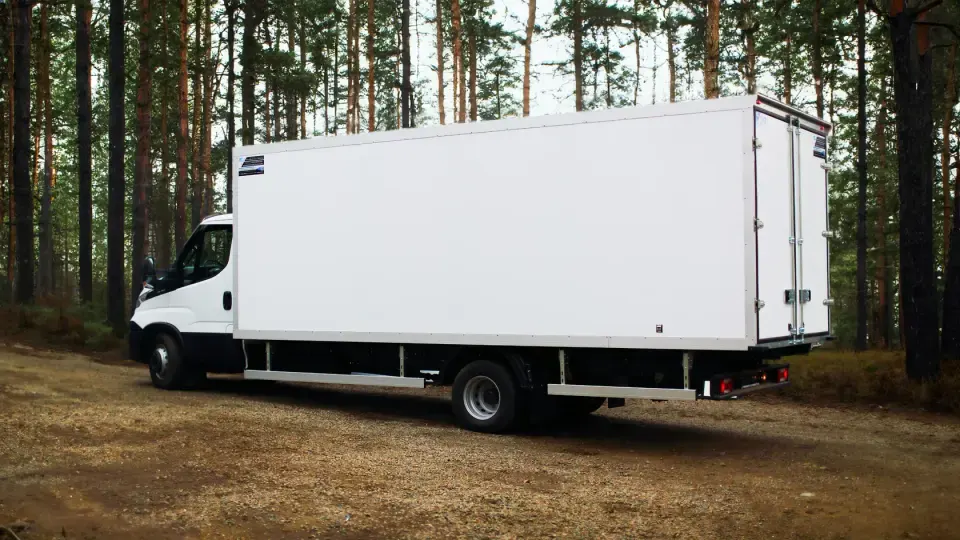
A “van body” is not one thing but a dozen different structures. One holds −20 °C, another merely keeps the rain off, a third opens along its whole side in five seconds. Here is what the types are, how they differ and how to pick yours.
Quote is based on body, chassis and temperature range.
The first split: does it need a temperature range
The whole classification of truck bodies starts with one question: must the body hold a temperature? The answer splits vehicles into two large groups, each with its own variants.
- Without a temperature range — dry-freight van, flatbed platform, tarpaulin-over-flatbed, eurotent and sliding tarpaulin. Their job is to keep the load safe from rain, dust and prying eyes.
- With a temperature range — insulated van, refrigerated body, eutectic body (ice-cream van), plus the narrowly specialised bread van and bottle carrier.
A mistake at this step costs most: a thin dry body will not hold cold with any unit fitted, while a thick insulated panel on a dry-freight round eats useful volume and payload for nothing.
Dry-freight van
Dry-freight body — a closed body with no temperature control. The panel is thin, about 25 mm, because there is nothing to insulate: inside are furniture, packaging, appliances and goods for retail chains and marketplaces.
What matters here is not insulation but strength and volume: a floor of laminated plywood or treadplate aluminium, lashing tracks at two levels, kick protection along the bottom of the walls. The same body is called a furniture van when it is fitted with straps and soft lining for moving furniture.
An insulated van
An insulated van — a thermos on wheels: walls of 50–100 mm sandwich panel with polyurethane foam, but no refrigeration unit. The body does not cool anything; it only slows heat transfer, holding the temperature for a few hours if loaded cold.
That is enough for short legs and for goods that do not need a strict range: baked goods, groceries, drinks, chilled products within the city. On a long haul or in the heat an insulated body loses — the load warms up gradually.
Refrigerated body
Refrigerated body — the same insulated body plus a refrigeration unit. The compressor takes heat out of the body and dumps it outside, so the vehicle does not merely hold cold but creates and maintains a set range: from 0…+6 °C for dairy down to −20 °C for frozen goods.
The lower the temperature required, the thicker the panel — for −20 °C you take 100 mm.
We match the unit to body volume and temperature range:Refrigeration equipment installation · Carrier · Elinge · Kaida
Insulated, refrigerated and eutectic — what is the difference
These three words are confused more often than any others, though the difference is simple: who actually produces the cold, and where it comes from.
| Insulated | Refrigerated body | Eutectic | |
|---|---|---|---|
| Source of cold | none, insulation only | engine-driven or self-powered refrigeration unit | plates charged overnight from the mains |
| Range | holds whatever was loaded | sets and maintains anything within its range | down to −24 °C, with no unit running en route |
| Doors open | warms up fast | recovers, but not instantly | cold is released continuously, pauses do not matter |
| Panel thickness | 50–80 mm | 80–100 mm | 100 mm and thicker |
| Where it wins | short legs, mild range | long hauls, any cargo | ice-cream delivery rounds |
Hence a practical rule: if the doors open more than ten times a shift and the load is deep-frozen, look at a eutectic body rather than at a more powerful unit.
How such a body is built:Ice-cream van
Specialised bodies
Some bodies are built for one particular product and are recognisable from outside.
- Bakery van — a sectioned body with runners for bread trays and four to six hatches along the sides. Trays slide in from outside; the body is never opened as a whole.
- Bottle carrier — a honeycomb body for water bottles and crates: the load sits in cells and does not knock about on the move.
- Ice-cream van — a eutectic body with 3+3 to 6+6 door sections: only the section the goods come from is opened.
- Mobile shop van — a shop on wheels: a serving window, display cases, lighting and a place for the seller.
- Crew bus — a passenger module instead of a cargo body, on an all-wheel-drive chassis.
Open and tarpaulin bodies
When the load does not mind the weather, or will not fit in a closed space, a platform is fitted.
- Dropside platform — a flat deck with drop sides. Loaded by crane from above and by forklift from any side.
- Drop-side with tilt — the same platform with a frame and a removable sheet. Cheap protection from the weather, but the side opens only by untying the tarpaulin.
- Curtainsider — a tarpaulin superstructure with rear swing doors: loading from the side, from above and from the rear.
- Sliding (curtain) tarpaulin — the sheet runs on rollers along a rail and opens the whole side in seconds. Fitted where there are many side loadings.
How to choose: four questions
1. What temperature does the cargo need? That determines the body type and the panel thickness. If there are two ranges — say freezing and chilling on the same trip — you need a multi-temperature body with a bulkhead.
2. How much of what do you carry? Work from the internal dimensions and the pallet layout, not the external size: an extra five centimetres of width is sometimes a whole extra row.
Check your own dimensions:Van configurator
3. How is it loaded and unloaded? Rear frame, side door, tail lift, sliding tarpaulin — both the construction and the payload that is left depend on this.
4. Which chassis? The body length sets the wheelbase required, and the gross weight sets the licence category: up to 3,500 kg a category B licence is enough, above that you need C.
Choosing a chassis for the job:Chassis comparison for vans
Working out capacity:Calculating body capacity in pallets
COND builds every body listed here at its own works in Almaty, to the customer's chassis — each project shows the body dimensions and the equipment fitted: Projects delivered by COND.