An insulated van or a refrigerated van: how they differ and which to choose
Published:
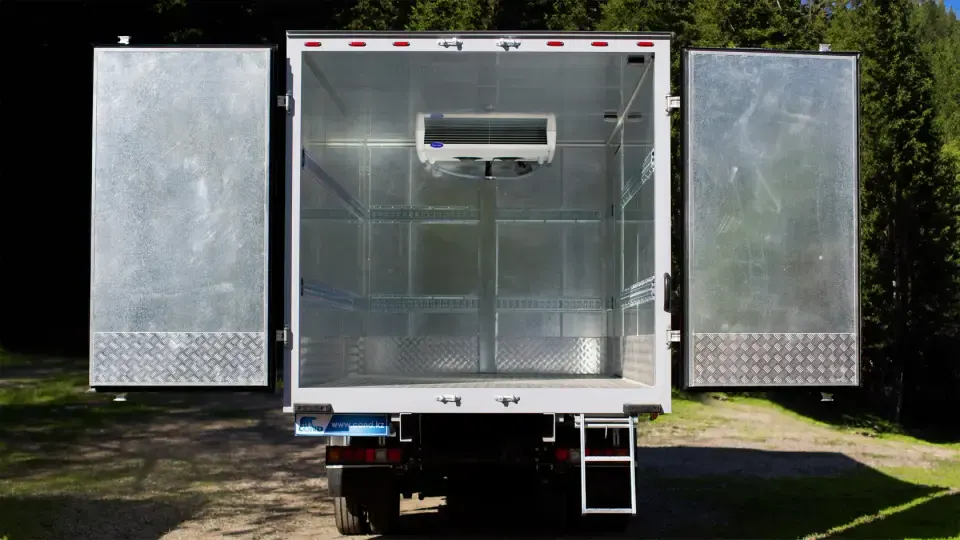
The short answer: an insulated van does not create cold itself — it only slows the warming or cooling of the cargo, while a refrigerator creates and maintains the temperature. Their bodies are built the same way — the same sandwich panel; the difference is whether a refrigeration unit is fitted. Below we explain what that means in practice and which body to choose for your cargo.
Quote is based on body, chassis and temperature range.
An insulated van: a thermos without a unit
An insulated van is a sandwich-panel body: two sheets of lining with insulation between them, usually extruded polystyrene. The wall is 50, 80 or 100 mm thick. There is no equipment inside — the body simply exchanges heat with the outside slowly.
Load chilled goods from the warehouse and they stay chilled for several hours. Load warm goods and they arrive warm: an insulated van does not cool anything, it only slows the warming. That is why it is taken for short city legs where the vehicle is unloaded within three or four hours.
In everyday speech the same body is called a thermal box or a thermal van. It is the same thing, just colloquial words.
More about this body:An insulated van
A refrigerated van: the same body plus cold
A refrigerated van starts with the same insulated body, but it carries a refrigeration and heating unit. The condenser goes above the cab or on the front wall of the body, the evaporator under the roof inside. The unit takes heat out of the body and dumps it outside, holding a set temperature from −20 to +12 °C for as long as needed.
The word “heating” is not there for decoration: in winter the same unit warms the body so the load does not freeze. For Kazakhstan that is essential — the vehicle works all year round, not half of it.
The panel for a refrigerated body is taken thicker: a freezing range needs 80 or 100 mm, otherwise the unit will run without stopping and still not reach temperature.
More about this body:Refrigerated van
Table: insulated van versus refrigerated van
| An insulated van | Refrigerated body | |
|---|---|---|
| Refrigeration unit | none | fitted, engine-driven or self-powered |
| What it does with temperature | slows its change | creates and holds the set one |
| Working range | set by the warehouse, not the vehicle | from −20 to +12 °C |
| Panel thickness | 50–80 mm | 80–100 mm |
| Length of the leg | up to 3–4 hours around the city | no limit on time |
| Working in winter | insulation only | the unit also heats |
| Price of the body | lower: no unit | higher: a unit is added |
| Servicing | seals and locking gear | plus unit servicing and refrigerant |
| Usable volume | more at the same length | less: the panel is thicker |
How long an insulated van really lasts
The honest figure is three to five hours. Nobody will name an exact number, because it depends not on the body but on conditions: panel thickness, the difference from the outside temperature, how tightly the goods were loaded and how many times the doors were opened during the shift.
In the Almaty heat that margin halves: the body warms from the outside in the sun, and every door opened at a stop lets hot air in. So in summer an insulated van honestly works only on routes within the city, while for intercity and regional work a refrigerated van is taken.
Which to choose for your cargo
An insulated van will do
If you carry bread and pastry, groceries, drinks, packaged convenience food, flowers or chilled goods around the city with unloading within three or four hours. The load is already cold from the warehouse, and the job of the body is to keep it from warming up before the end of the route.
A refrigerated van is needed
If you carry dairy, meat, fish, ice cream, pharmaceuticals or any frozen goods, or if the trip is longer than three hours, or if in summer the vehicle stands in the sun waiting to be unloaded. Wherever a cold chain is required, an insulated van is not enough.
A eutectic body is the third option
It is remembered less often. In such a body the cold is stored in plates charged overnight from the mains and is released all day without a running unit. It wins where the doors are opened dozens of times a shift: ice-cream delivery from stop to stop.
The third option:An ice-cream van on eutectic plates
About money: it is not the purchase you should count
An insulated body is cheaper than a refrigerator: a refrigerator is the same body plus a refrigeration unit. But the comparison does not end there.
A refrigerated van adds running costs: fuel for the unit, scheduled servicing, periodic refrigerant top-ups. An insulated van has none of those items — there is nothing to service in it apart from the seals and the locking gear.
But an insulated van has a bill of its own: spoiled cargo. One consignment that arrives warm wipes out all the savings on the unit. So the decision should be made not by the price of the body but by whether your route survives carriage without active cooling.
First an insulated van, then a unit — is that possible?
Yes, and it is a common scenario. First an insulated body is taken for the current goods, and a season later, when frozen items appear in the range, a refrigeration unit is added. The body is ready for it and does not need replacing.
One condition: the panel must be rated for a freezing range. On a body with a 50 mm wall the unit will run without stopping and still not reach −18 °C. If you are planning to retrofit, take 80 or 100 mm straight away — the price difference is nothing next to a rebuild.
Fitting equipment changes the design of the vehicle, and that has to be registered: without the entry in the vehicle document a roadworthiness test may be refused.
How to register it:The vehicle-document entry after a conversion
FAQ
How does an insulated van differ from a refrigerated van?
An insulated van is a thermally insulated body without a refrigeration unit: it does not cool or heat by itself, it only slows the warming or cooling of the cargo. A refrigerator is the same body plus a cooling-and-heating unit that creates and maintains the set mode for as long as needed. The wall structure is the same; the difference is whether there is a unit.
How many hours does cargo stay cold in an insulated van?
The rule of thumb is three to five hours, and the figure depends not on the body but on conditions: panel thickness, the difference from the outside temperature, how the goods were loaded and how many times the doors were opened during the shift. In the Kazakhstan heat that margin halves, so in summer an insulated van is only good for short legs.
Which is cheaper — an insulated van or a refrigerated van?
An insulated body is cheaper: a refrigerator is the same body plus a refrigeration unit. Then the difference builds up in operation: a refrigerator adds fuel for the unit, scheduled servicing and refrigerant top-ups. You should count not the purchase but the cost of the trip.
Can a refrigeration unit be fitted to an insulated van later?
Yes, and it is the usual scenario: first an insulated van is taken, and a season later, when frozen goods appear, a unit is added. The body is ready for it if the panel is rated for a freezing range — 80 or 100 mm. On a thin panel the unit will run without stopping and still not reach the range.
Which body is needed for food?
For bread, pastry, groceries and drinks on city delivery an insulated van is enough. For dairy, meat, fish, ice cream and anything travelling more than three hours or in the heat you need a refrigerated van. If the load is frozen and the doors open at every stop, look at a eutectic body.
Are an insulated van and a thermal box the same thing?
Yes. “Thermal box”, “thermal van” and simply “box” are everyday names for an insulated van. It is an insulated sandwich-panel body without a refrigeration unit. In documents and quotations it is called an insulated van or an insulated superstructure.
COND builds both bodies at its own plant in Almaty for the customer’s chassis: sandwich panel of our own making, Carrier, Elinge and Kaida units chosen for the body volume and the range required. Tell us the cargo, the temperature and the route and we will select the panel thickness and the unit with a margin for the heat.
See also:Types of van body: what bodies there are
How the cold works:What is a refrigerated van
Our work:Completed COND projects
Order a refrigerated van:A refrigerated van in Almaty from the COND plant