JAC N35 or Kia Bongo K2500: China versus Korea in the 1.5-tonne class
Published:
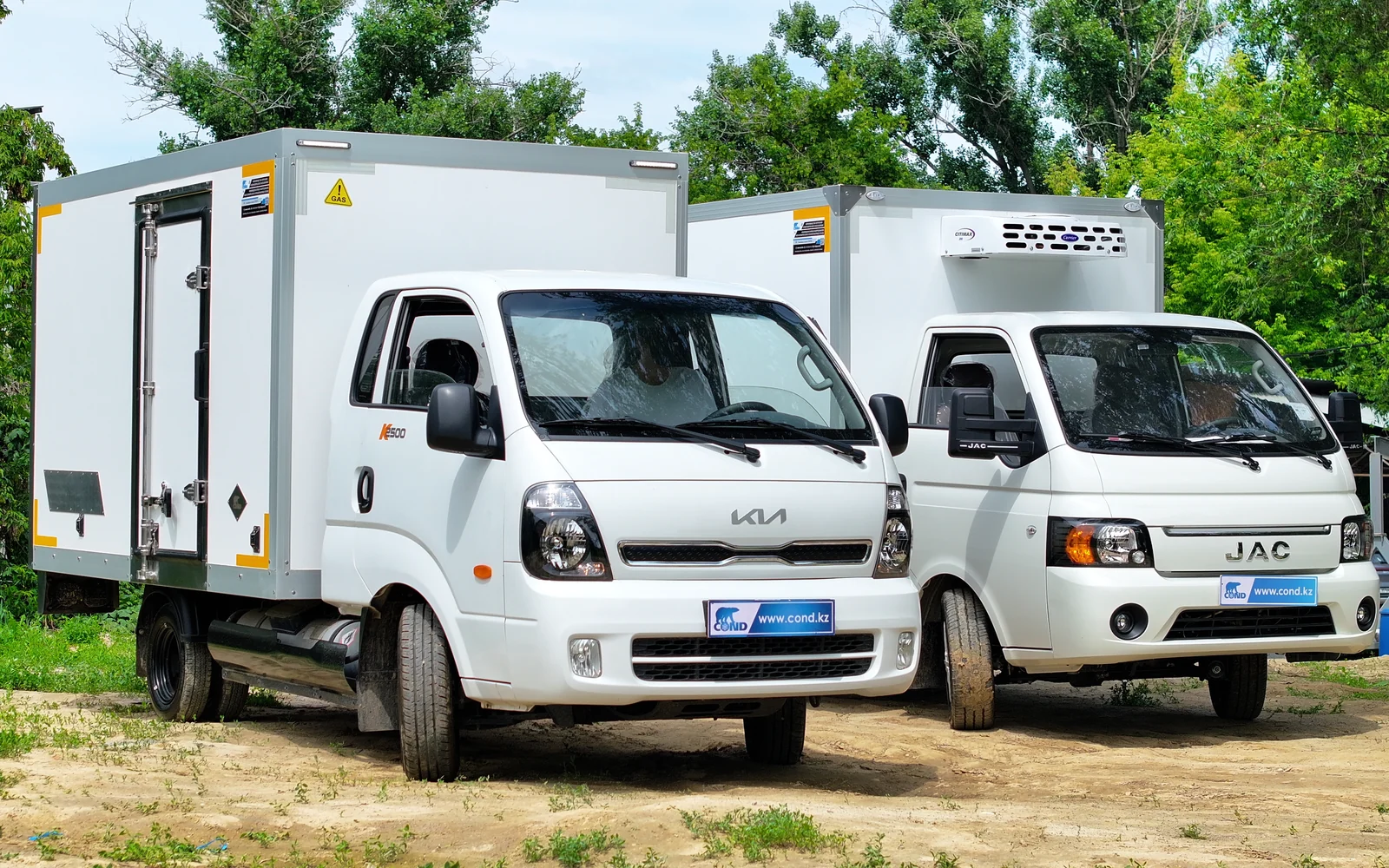
The two most common questions when choosing a delivery truck for our bodies are “which is more reliable” and “which carries more”. Here is the pair people compare most often — the JAC N35 and the Kia Bongo K2500. Both fall under category B and both are the same size, yet they solve different problems.

Quote is based on body, chassis and temperature range.
What they share
Both chassis stay within a 3,500 kg gross weight. That is the main thing: a driver with an ordinary category B licence takes the wheel, and no separate category C employee is needed. For a company putting the truck on a route tomorrow, that often matters more than any engine figure.
The dimensions are close too: a 2,640 mm wheelbase on the JAC against 2,615 mm on the Kia. Both get into yards, underground car parks and stops where a seven-tonner simply will not fit.
A table of differences
| Parameter | JAC N35 | Kia Bongo K2500 |
|---|---|---|
| Engine | HFC4DB2-1D diesel, Common Rail, Euro 5 | 2.5-litre diesel |
| Power | 136 hp | 133 hp |
| Torque | 285 N·m from 2,200 rpm | — |
| Gearbox | manual, 6-speed | manual |
| Gross weight | 3,490 kg | 3,500 kg |
| Chassis payload | 1,900 kg | 1,500 kg |
| Wheelbase | 2,640 mm | 2,615 mm |
| Dimensions | 5,157 × 1,750 × 1,939 mm | — |
| Cab | two-seat | three-seat |
| Licence category | B | B |
A dash marks a figure we do not publish until we have checked it against the papers of the actual vehicle. Data for both chassis comes from the JAC N35 page and the Kia Bongo K2500 card.
Where the JAC N35 wins
Payload. 1,900 kg against 1,500 kg is a 400-kilogram gap at the same licence category. For a reefer that figure decides things: a body with a refrigeration unit already eats into the payload, and 400 kg of headroom is another twenty or thirty boxes on every run.
Low-end torque. 285 N·m from as low as 2,200 rpm. In city traffic with constant pull-aways that is felt far more than a three-horsepower difference.
Where the Kia Bongo wins
Service and parts. The Bongo is one of the most common delivery trucks in Kazakhstan. There is service in every city, parts are on the shelf and mechanics know the vehicle. On a route where downtime costs more than the repair itself, that is a serious argument.
A three-seat cab. If the route needs a driver plus a forwarder plus a loader, the question answers itself.
Residual value. Ubiquity works at resale too: demand on the used market is higher and more predictable.
Which body fits which chassis
There is almost no difference in bodies — both chassis take our whole range:
- Refrigerated van. On both — JAC N35 and Kia Bongo K2500. For the Kia we publish a 12 m³ usable volume and a −20 to +12 °C range; on the JAC the mode is chosen for the load.
- Insulated van. On both as well: N35 and Bongo. The body is lighter than a refrigerated one, so the difference in chassis payload matters less.
- Dry-freight van. The lightest option — there the 400 kg gap is no longer critical.
How to choose in two minutes
Take the JAC N35 if you carry heavy goods below zero: reefer work, water, tinned food — anything where weight is the limit. Take the Kia Bongo K2500 if what matters is service in the regions, three seats in the cab and an easy resale in a couple of years.
If you are unsure, tell us the average weight of a run and the number of stops. We will work out which limit you hit first — body volume or chassis payload. That is the answer.