
How meat is hauled in Kazakhstan — and how it should be: from slaughterhouse to counter
Published:
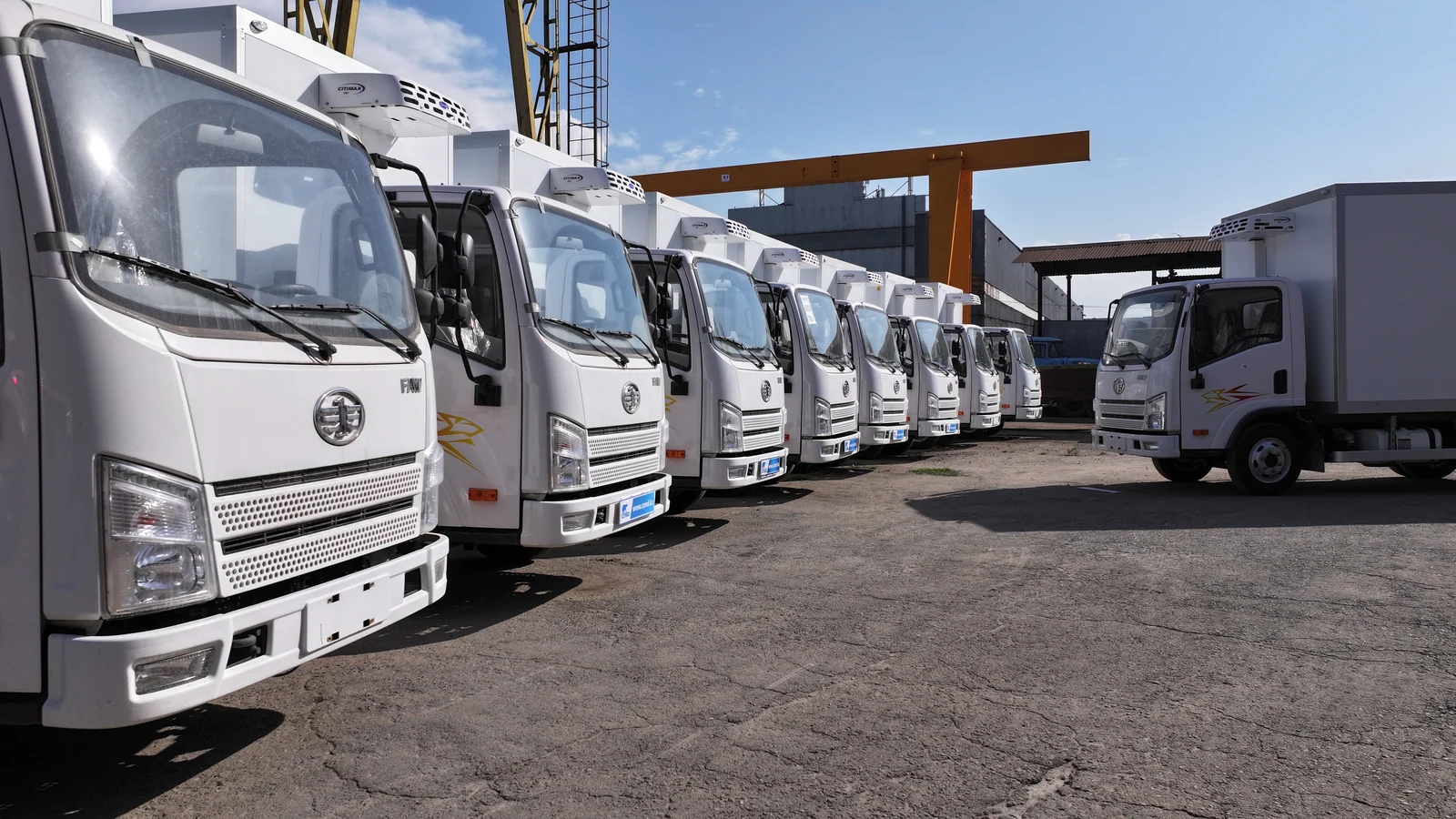
In short. Meat is chilled to spec at the slaughterhouse — not "it'll cool down on the way". A warm carcass in the body loses up to 5% of its weight to cooler shrink, and the cargo owner pays for it. Bacteria in the +4…+60 °C range double every twenty minutes, and a refrigerated truck cannot chill — it only holds cold. So the fate of the meat is decided before the truck leaves: at the slaughterhouse and in the choice of body.
Kazakhstan is a meat country: about 80 kilograms per person a year, and we eat twice as much beef as Europeans. People here know how to pick meat, cook it and respect it. Now the awkward question: have you seen HOW that meat travelled to your table? Are you sure it arrived chilled — and that nothing extra grew on its surface along the way?
A scene from any regional market: an open pickup, a half-carcass lying on the bed, an old blanket thrown over it, the thermometer reading +32. The cold chain here is dead before the truck even leaves. Let's take apart why this costs everyone — from farmer to restaurant — what the law demands, and what the vehicle in which meat actually arrives looks like.
Quote is based on body, chassis and temperature range.
"I'll take it warm, it's an hour away"
The most common mistake in meat logistics sounds harmless: pick the carcass up from the slaughterhouse right away, warm and fresh-killed — "an hour on the road, nothing will happen".
Something will happen. The surface of a fresh-killed carcass is around +35 °C, and that is the middle of the "danger zone", as the American FSIS regulator calls it: in the range from +4 to +60 °C bacteria double their numbers every twenty minutes. An hour on the road is three doublings; eight bacteria where there had been one. Surface contamination of a carcass is always present — that is normal for cutting — the only question is whether you let it grow.
The second mistake is subtler: "but I have a reefer, it will chill it". It will not. A van's refrigeration unit is designed to hold the temperature of already-cold cargo, compensating for heat leaking in through the walls. Pulling the heat out of a tonne of fresh-killed meat is beyond it: that is the job of a stationary blast-freezing chamber with many times the capacity. A warm carcass in a reefer does not chill — it slowly spoils while the unit runs.
That is why every regulation in the world starts with the same thing: meat is chilled AT THE SLAUGHTERHOUSE, before loading.
Cooler shrink: how a carcass loses weight at your expense
While a carcass cools, moisture evaporates from it. This is a measured process: over a day of chilling a carcass loses 1.5–3% of its weight, in poor conditions up to 5%. Evaporation peaks in the first hours, while the meat is still warm.
Now tie this to transport. If the carcass sets off warm, the most intense phase of weight loss happens in the body — and the kilograms paid for at the slaughterhouse evaporate on the road. A 120 kg steer half-carcass at three percent is minus 3.6 kg; a truckload of twenty half-carcasses is minus 70 kg of meat per trip. No delivery note will show it: the meat was "just delivered".
Modern slaughterhouses fight for those percentages with spray chilling (it cuts weight loss to 0.2–0.4%). And you can lose everything you saved in a single trip in a warm body.
A case from life: a half-carcass Almaty → Shymkent "overnight"
This summer, in front of me, a guy asked a canteen owner: can you freeze a half-carcass, wrap it and send it from Almaty to Shymkent — without a reefer? The owner answered without hesitation: "No problem. Drive it overnight."
Let's check that answer against physics. Given: ~690 km of road, 8–10 hours by truck; a 120 kg half-carcass out of the freezer at −18 °C; a July night in the south at around +25 °C.
For a clean experiment, let's take IDEAL conditions: an insulated body of class IR (K coefficient = 0.4 W/m²·K, body area ~30 m²) — with no refrigeration unit. Heat ingress at a temperature difference of 43 degrees is about half a kilowatt, continuously, for all nine hours. That totals on the order of 16 MJ of heat that will enter the body with nowhere to go but into the meat.
What it will do to the half-carcass: about 4 MJ go into warming the frozen mass from −18 to zero. The remaining ~12 MJ begin to melt the ice — and the latent heat of fusion of meat is such that this is enough to thaw on the order of 50 kilograms. Almost half the half-carcass. The heat comes in from outside, so it will not thaw as "an even half" but as the entire surface layer: by morning in Shymkent the core is still stone-hard, the surface is +5…+10 °C, and meat juice runs from the bundle.
And this is an ideal insulated body. In reality "wrap it and send it" means a blanket in a tarpaulin-sided body or a car boot, where heat ingress is many times higher.
The trip's outcome: legally — a violation (under technical regulation TR CU 034/2013 frozen meat must be no warmer than −8 °C at any point); commercially — a thawed surface with juice running out that cannot be refrozen; sanitarily — the surface spent its last hours in the bacterial-growth zone, and Shymkent's morning +30 at unloading only speeds the process up. "Drive it overnight" — the intuition is right, heat ingress is lower at night. But the time of day does not repeal thermal physics: without cold in the body, a frozen carcass does not survive such a trip.
"But 2–3 hours in an insulated body without a unit — is that OK?"
This is the most frequent question from buyers of insulated bodies. The honest answer: sometimes yes — and that is exactly why the question is dangerous.
An insulated body does not chill — it slows the warming. If the meat is chilled to spec, the body is pre-cooled, the load is full (a large cold mass is its own thermos), the doors stay shut en route, and the leg really is two hours — the temperature will most likely stay in the corridor. Remove any one of these conditions and the "most likely" disappears. Heat of +35, cargo "almost cold", three drop-off points with doors opening — and the insulated body turns into a slow oven.
Here is what that looks like in money — a real case from this summer. A private hauler took a five-tonner with a 20-cubic-metre insulated body and loaded up with chilled chicken at a large poultry plant. He hauled it to the end customer in the heat — with no refrigeration unit. The customer measured the temperature at intake and rejected the consignment. The driver brought the chicken back to the plant — "the customer refused". At the plant they threw up their hands: what were you thinking, hauling it LIKE THAT? Result: a full body of spoiled poultry, the loss on the hauler. Nobody broke anything except thermal physics.
That hauler was still lucky: his consignment was caught at intake. It is worse when such chicken reaches the kitchen. According to the WHO, 600 million people worldwide suffer from foodborne illness every year, 420 thousand of them fatally; poultry and meat are at the top of the list of sources of salmonellosis and campylobacteriosis. Mass poisonings from broken transport are not a hypothesis but a regular worldwide occurrence. And every time, someone's customers are sitting at that table. Possibly yours. Possibly you.
What the law demands: three jurisdictions, one principle
The European Union (Regulation 853/2004): a carcass is chilled right after slaughter to +7 °C throughout its thickness (offal to +3 °C), and only then loaded; the temperature is held for the whole trip. Hauling under-chilled meat is allowed only by special permit in narrow exceptions. The British regulator issues a separate guide on "meat above temperature" — on the roads this is genuinely checked.
The USA (the FSMA rule + USDA FSIS): fresh meat in transport — no warmer than +4.4 °C. The FDA names outright the two main mistakes in hauling food: "did not chill it properly" and "did not wash the body between trips". Both apply to our market too.
Kazakhstan and the EAEU (TR CU 034/2013 "On the safety of meat and meat products"): chilled meat — from −1.5 to +4 °C at any measurement point, frozen — no higher than −8 °C at any point. Transport — by a vehicle that maintains these temperatures, with sanitisation.
The principle is the same everywhere: the temperature is reached before loading and demonstrably held until unloading.
Why loose loading is a no: what a carcass carrier is
A carcass carrier is a refrigerated truck in which carcasses and half-carcasses travel not on the floor but on rails: overhead rails are mounted under the roof, hooks run along them, and the meat hangs on the hooks. Some call it a beef rail truck.
The point of hanging is air. A chilled carcass lying in a stack does not shed heat: at the contact points the temperature evens out slowly, warm pockets form between carcasses, and the middle of the stack lives its own life under any unit. A hanging carcass is bathed in cold air on all sides and touches neither the walls, nor the floor, nor its neighbours — this is required both by European practice and by the world guides on meat transport.
The construction behind this:
- overhead rails of two types — a round galvanised-steel tube or a U-shaped aluminium profile;
- stainless-steel euro-hooks — removable, washed separately;
- arrangement and fixing: carcasses are hung with gaps and distributed along the length of the body — half a tonne of meat wandering along the rails rocks the vehicle in a turn (professionals call this carcass shift);
- load capacity: the overhead rail transfers the cargo's weight to the roof frame. A tonne of meat on the ceiling is an engineering calculation for the body maker; a tube welded on by amateurs in an ordinary van tears the roof off at the first pothole.
The answer to the frequent question "how much can you load into a carcass carrier": as much as the rails and frame reinforcement of that specific body are rated for — a figure from the body's data sheet, not "until it fits".
Materials: what the body that outlives the meat is made of
The world standard for a meat carrier's surfaces (the STDF/WHO guide on meat transport): light-coloured, impermeable, corrosion-resistant, non-toxic, easy to wash, with the ability to drain. Behind each word is a specific material:
- Walls and ceiling — FRP fibreglass: a smooth seamless gel-coat with no pores, where bacteria have nothing to cling to and the wash has nothing to miss.
- Floor — chequer-plate aluminium: keeps footwear grip during wet cleaning, does not rust, withstands trolleys.
- Contact elements — food-grade stainless steel (AISI 304): hooks, rails, edging. Non-porous, resistant to cleaning chemicals.
A separate enemy of the body is blood. It is protein and salts: seeping into non-sealed joints and under the floor decking, it does not wash out, it rots on its own and rots everything within reach around it — from plywood to the frame's mild steel. A "meat" body is therefore assembled with sealed seams and drain holes with plugs: at the wash the plugs are open and the water drains completely, on the trip they are closed to hold the temperature and not sow along the road what should be handed over for sanitisation.
How to treat the body when transporting meat
Washing between trips is a requirement of every regulation, and it has a correct sequence:
- Remove everything physical — remnants, trimmings, packaging.
- Rinse with cold water. Cold specifically: hot water coagulates the blood protein and "cooks" it onto the surface — after that you cannot scrape it off.
- Alkaline detergent — it breaks down fats and proteins. Leave it per the instructions, work the seams, rails and hooks with a brush.
- Rinse off.
- Disinfection with an approved agent — strictly with the contact time from the label. A detail almost no one knows: most disinfectants do not work in a cold body — it is warmed up before treatment.
- Dry with the doors open: moisture is a friend to bacteria.
- Record it in the wash log. For the sanitary inspector and the auditor, a wash without a record never happened.
Hooks and removable equipment are washed separately; the frequency of the whole cycle is between trips, not "on Fridays".
Documents and trip control
Transporting meat without veterinary accompanying documents is an administrative offence with confiscation on the table; a roadside check asks for them first. The second part of the evidence base is the trip temperature: a recorder with a printout that the driver hands over together with the delivery note, or telematics with an archive. How this control is set up — from the temperature recorder to remote monitoring — is taken apart in the article on the cold chain and transport validation.
Intake checklist: how a restaurant or a shop protects itself
Poisoning a customer with meat is a catastrophe after which the establishment may never reopen. Protection starts at the side of the truck, five checks in two minutes:
- a probe into the core — chilled: from −1.5 to +4 °C; frozen: no higher than −8 °C;
- carcasses hang, not lie, and do not touch each other or the walls;
- the body is clean and odourless — a smell of old blood means there was no wash;
- the drain plugs are in place, no puddles of juice on the floor;
- there is a temperature printout of the trip or monitoring data — plus the veterinary documents for the consignment.
Any point failed — there is a lawful basis to refuse the cargo. A supplier who passes all five is the one worth working with.
A meat body: how it is done at the factory
The upshot of the whole analysis fits into a short list of requirements for the vehicle:
- an insulated body of sandwich panels with sealed seams and margin in the K coefficient;
- a refrigeration unit with capacity margin — to hold −18 in the Shymkent summer, not "on paper";
- overhead rails on calculated roof reinforcement, stainless-steel euro-hooks;
- a chequer-plate aluminium floor, drain holes with plugs;
- sleeves for temperature sensors and a recorder.
The COND factory in Almaty builds refrigerated bodies to this scheme and has delivered carcass-carrier projects with overhead rails — here the frame reinforcement for the suspension is calculated at the design stage, not welded on in place. To order a meat body — from a delivery reefer to a carcass carrier: custom van body manufacturing; ready vehicles and completed reefers — in the catalogue, volume sizing — in the body calculator.
FAQ
What temperature is required when transporting meat? Under technical regulation TR CU 034/2013: chilled meat — from −1.5 to +4 °C at any point, frozen — no higher than −8 °C. The European norm for carcasses is no higher than +7 °C throughout the thickness, before loading.
Can meat be transported in an ordinary van? On a short leg — only chilled, in an insulated body and with sanitisation; in summer and intercity — no: without a refrigeration unit the temperature leaves the corridor, as the Almaty–Shymkent trip analysis above shows.
Is an insulated body without a unit enough for 2–3 hours? Only with all the conditions at once: the cargo chilled to spec, the body pre-cooled, the load full, the doors not opened en route, no heat outside. Break any one and the insulated body only slows the spoilage: the case of the body of chicken that was rejected after a single hot trip is exactly about this.
A carcass carrier — what is it? A refrigerated truck with overhead rails under the roof: carcasses and half-carcasses travel on hooks, touching neither the floor, the walls, nor each other — air flows around each one. Hanging is a practical requirement for chilled carcasses: loaded loose, they do not chill evenly.
How do you transport meat over a long distance? Chill (or freeze) it to spec BEFORE loading, haul it in a refrigerated truck with the unit running and the temperature recorded, carcasses on the rails. Wrapping in blankets and "driving overnight" does not fool physics.
How much meat can be loaded into a carcass carrier? As much as the overhead rails and reinforced frame of the specific body can bear — this is a data-sheet figure for the body. Overloading the rails is dangerous not because of a fine but because of the load collapsing in a turn.
What documents are needed to transport meat? Veterinary accompanying documents for the consignment plus proof of the trip's temperature regime (a recorder printout or monitoring data). Without veterinary documents, transport is an administrative offence.