Insulated van body (termobudka): what it is, how it differs from a refrigerated van and what it costs
Published:
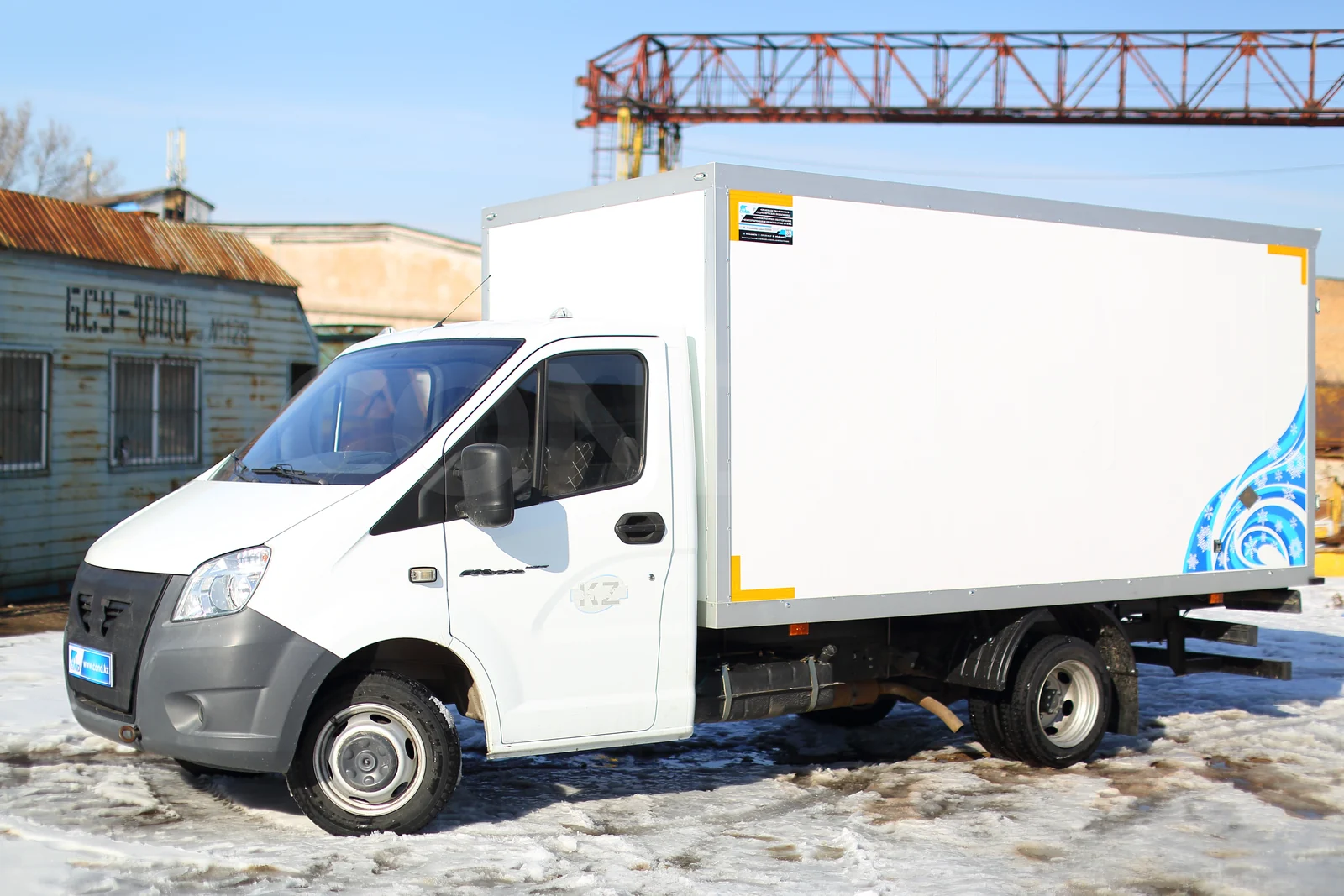
In brief. A termobudka is the everyday Russian name for an insulated van body: a box built from 50, 80 or 100 mm sandwich panel. It slows down how fast the load warms up or cools down, but it produces no cold of its own — a minus temperature needs a refrigeration unit. The body is mounted on a chassis instead of a flatbed: from 2,400,000 ₸, built from 14 working days.
The word “termobudka” appears in no document. The registration certificate says “insulated van”, the invoice says “insulated body”, a classified ad says “thermo van” or “thermo box”. It is one and the same product: a closed body with insulated walls. In conversation and in search, “termobudka” wins — it is shorter and clearer.
Below: what is inside such a body, how it differs from a refrigerated van and from a dry freight van, how long it really holds temperature, and what the price is made of.
Quote is based on body, chassis and temperature range.
What an insulated van body is
An insulated body is a thermos on wheels. The wall is a sandwich panel: two skins with a layer of polyurethane foam between them. The foam does not let heat through, the skin holds the shape and takes knocks, and the body is tied together around the perimeter with aluminium profile.
The main thing to understand about this body: it cools nothing. There is no compressor and no refrigeration circuit inside. The body only slows heat exchange with the outside — a load put in cold stays cold longer, and a load put in warm arrives warm.
Hence a simple rule: an insulated body works where the cargo has already been brought to the right temperature and the run is short. Bread from the bakery, drinks from the warehouse, appliances, furniture, building materials, parcels — this body is enough for them.
How it differs from a refrigerated van
The difference is exactly one thing: the refrigeration and heating unit. The body is the same for both — same panels, same frame, same doors. A refrigerated van adds a unit on the front wall or the roof that actively removes heat and holds the set mode, usually between −20 and +12 °C.
| Insulated body (termobudka) | Refrigerated body | |
|---|---|---|
| Refrigeration unit | none | fitted |
| What it does to temperature | slows warming and cooling | creates and holds the set temperature |
| Typical cargo | dry goods, bread, drinks, chilled food on short runs | meat, fish, dairy, pharma, frozen food |
| Price of the body | from 2,400,000 ₸ | from 4,090,000 ₸ |
| Fuel use | as on an ordinary van | plus the unit running |
The third neighbour in the range is the dry freight van. Its wall is thin, 25 mm, with no real insulation: it is simply a closed box against rain and dust. From the outside you tell an insulated body from a dry freight van by the panel thickness in the door opening.
How long it holds temperature
The honest answer: it depends on the panel thickness, the difference between outside and inside temperature, how full the body is and how often the doors are opened.
The reference figure is the heat transfer of the wall. On a COND body it is no higher than 0.4 W/(m·°C), and that is the level at which a unit fitted later will reach a minus mode. The arithmetic after that is simple: the thicker the panel, the less heat enters per hour.
In practice it looks like this. A 50 mm panel is for short city runs where the cargo is already cold and there are two or three drops. An 80 mm panel is for a longer leg, summer heat and more drops. A 100 mm panel is the same thickness as on a refrigerated body: it is ready for a minus mode, and a refrigeration unit can be fitted later without rebuilding anything.
What an insulated body cannot do: cool a warm load, hold frozen cargo through a long summer run, or make up for half an hour of open doors at the dock.
Which chassis it is mounted on
The body is designed around the wheelbase and the permitted axle loads of a particular chassis, so there is no “universal” insulated body. The practical range runs from light trucks to medium-duty ones:
- FAW 1027 (T80), Shineray T30 and T50, JAC M3 — light city delivery trucks, category B;
- GAZelle Business and GAZelle NEXT — 3 and 4 metre bodies, the most common size in Kazakhstan;
- JAC N56, N90, Foton Aumark S80, Kia Bongo K4000 — medium-duty trucks, where the body starts at 5 metres.
Usable volume is measured inside, not outside: the panel takes its own thickness off every dimension, floor and roof included. A 4,200 × 2,200 × 2,400 mm body with a 100 mm panel leaves 4,000 × 2,000 × 2,200 mm inside — that is 17.6 m³ and six Euro pallets in one tier.
What an insulated van body costs
The price of the body without the chassis: an insulated van body on a FAW 1027 (T80) is from 2,400,000 ₸, on a 3 m GAZelle Business or NEXT from 3,000,000 ₸, on a 4 m one from 3,500,000 ₸, on a JAC N90 from 4,000,000 ₸. For comparison, the same body with a refrigeration unit — a refrigerated body — starts at 4,090,000 ₸.
What makes up the difference inside that range:
- body size — the panel area and the length of the profile grow with the dimensions;
- panel thickness — 50, 80 or 100 mm;
- skin — galvanised sheet is cheaper, FRP fibreglass costs more and washes down more easily;
- floor — plywood or chequered aluminium that can be hosed down;
- doors and fittings — a side door, a folding ladder, lashing rails, lighting.
Lead time is from 14 working days, the warranty on the body is 2 years. The final sum is fixed in the invoice after the chassis is measured and the options agreed.
A new insulated body or a used one
Classified ads price a used insulated body well below a new one, and that is its only advantage. Three things are worth checking.
First, the state of the panel. Over the years polyurethane foam takes up moisture through micro-cracks and leaking seams: the body gets heavier and the insulation gets worse. It looks intact and holds temperature like a curtain-sided body.
Second, the geometry of the door opening. If the body has been running with a twisted door, the seal does not sit tight and warm air keeps coming in around the perimeter.
Third, which chassis it was built for. A body with the wrong wheelbase does not sit on the frame where it should, and the axle loads go beyond what is allowed.
Repairing an insulated body
The body is repairable: a panel is replaced in sections, a door is brought back to geometry, seals and fittings are replaced completely. The most frequent jobs are replacing the seal around the doors, repairing hinges and locks, restoring the corner profile after a brush with a dock, and replacing a panel locally after an impact.
Repair makes sense because, over its service life, the body is worth more than the chassis: the panel outlives the truck under it and is usually moved onto the next chassis.
Turning an insulated body into a refrigerated one
This is a standard scenario when the panel is 100 mm and the body is airtight. A refrigeration unit — Carrier, Elinge or Kaida — is mounted on the front wall or the roof, and the model is chosen by body volume and the required mode. Usable volume barely changes: the evaporator takes the top of the front section.
What to check before ordering a unit: the panel thickness and the condition of the seals and seams. On an uninsulated or leaky body the unit will not reach its duty, and in that case the unit warranty does not apply.
After the conversion the design of the vehicle changes, and that is documented: the plant issues the paperwork for the entry in the vehicle passport.
FAQ
Are a termobudka and an insulated van body the same thing? Yes. “Termobudka” is the everyday name; in documents the same product is called an insulated van or an insulated body. “Thermo van” and “thermo box” are also used.
Does an insulated body freeze the cargo? No. It has no cold of its own, it only slows the load warming up or cooling down. A minus mode needs a refrigeration unit — then the body becomes a refrigerated one.
What does an insulated van body cost? The body without the chassis starts at 2,400,000 ₸ for a light truck and 3,000,000 ₸ for a 3 metre GAZelle. The exact sum is calculated after the chassis is measured and the panel thickness, skin and fittings are chosen.
Which panel thickness should I choose? 50 mm for short city runs with cargo that is already cold, 80 mm for a longer leg and hot weather, 100 mm if a refrigeration unit is to be fitted later.
How long does it take to build? From 14 working days once the specification is agreed. The lead time is fixed in the contract together with the price and the equipment list.
Can an insulated body be mounted on my own chassis? Yes, that is the main scenario: the body is designed around the wheelbase and the permitted axle loads of your truck, and the factory warranty on the chassis stays valid.