How cold does a refrigeration unit go: the limits of Carrier, Elinj and Kaida
Published:
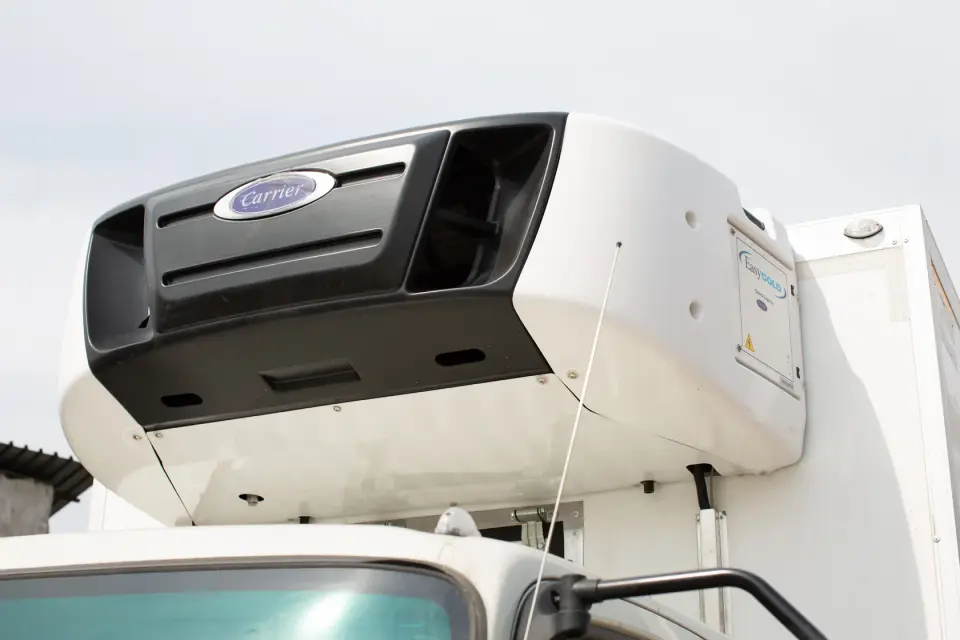
“How cold does it go?” is the first question anyone asks about a refrigeration unit. The answer “down to −20 °C” is almost always incomplete: the same unit holds −20 °C in one body and will not manage it in a body twice the size. Here is how to read the data sheet and what the limits of the ranges we work with really are.
Quote is based on body, chassis and temperature range.
“−20 °C” is always a pair: temperature plus volume
Manufacturers state the limit not as one figure but as a pair: this temperature in that body volume. With Elinj it is spelt out in the data sheet — for example, “−20 °C in 30 m³ or 0 °C in 43 m³”. One and the same unit: if you want the minus, the volume shrinks by nearly half again.
The logic is simple. A unit delivers a fixed cooling capacity in watts. The bigger the body, the larger the wall area and the more heat leaks in from outside. The lower the temperature you ask for, the bigger the gap with the street and the faster that heat leaks in. So “deep freeze” and “large volume” are competing demands, and the data sheet always records which of them you chose.
The second thing worth knowing: the published figures are measured to the ATP standard at an outside temperature of +30 °C and for a well-insulated body. An Almaty summer in full sun is hotter than that, and a body with a thin panel lets more heat through — which is why our selections take volume with a margin rather than right at the data-sheet ceiling.
Carrier: Citimax and Supra
Product line Carrier range covers everything from a delivery “little one” to a trailer. Citimax units are driven by the vehicle engine: the compressor turns off the standard engine, so there is cold as long as the truck is running. Supra units are self-powered: their own diesel generator plus 380 V mains while parked, so the cold does not depend on whether the truck is running.
Below is the body volume in which each model holds −20 °C. For chilled duty (0…+5 °C) the volume is noticeably larger.
| Model | Body at −20 °C | Typical application |
|---|---|---|
| CITIMAX 280 | up to 9 m³ | GAZelle Next, Hyundai Porter |
| CITIMAX 350 | up to 16 m³ | GAZelle Next, JAC N56 |
| CITIMAX 400 | up to 18 m³ | GAZon Next, Hyundai Mighty |
| CITIMAX 500 / D5 | up to 20 m³ | GAZon Next, JAC N90 |
| CITIMAX D6 | up to 24 m³ | JAC N90, Isuzu |
| CITIMAX D7 | up to 28 m³ | JAC N120, Isuzu |
| CITIMAX 1000 | up to 38 m³ | KamAZ, Iveco, Hino |
| Supra 850 | up to 43 m³ | trailers and heavy-duty bodies |
| Supra 1050 | up to 50 m³ | trailers and heavy-duty bodies |
A practical guide: Citimax 280–350 covers urban 1.5-tonners, 400–500 medium-duty trucks such as the JAC N90, D6–D7 the seven-tonners and the JAC N120, and 1000 the KamAZ and Hino. Supra begins where a body outgrows what direct drive can do.
Elinj: from S07 to S5 max
Elinge are Russian engine-driven units built as a split system: the condenser above the cab, the evaporator inside the body. Each model is specified in two modes: freezing in the smaller volume or chilling in the larger one.
| Model | −20 °C in a body of | 0 °C in a body of |
|---|---|---|
| S07 | 6 m³ | 8 m³ |
| С1 | 8 m³ | 12 m³ |
| С2 | 11 m³ | 16 m³ |
| С3 | 16 m³ | 20 m³ |
| С4 | 20 m³ | 30 m³ |
| С5 | 30 m³ | 43 m³ |
| S5 max | 40 m³ | 50 m³ |
The “Heat” version adds electric heating for winter routes where the load must not be overcooled. It is the Elinj S5T max that works on our JAC N120 refrigerated van with its 6.2 m body.
Kaida and Yide: down to −18
All six models in the Kaida (Yide) range are freezer units with a −18 °C limit. They differ not in duty but in the body volume they can handle and in the compressor drive.
| Model | Limit | Body | Power |
|---|---|---|---|
| YD-300E | down to −18 °C | up to 8 m³ | electric, for EVs |
| YD-318E | down to −18 °C | up to 10 m³ | electric, for EVs |
| Kaida V-360 | down to −18 °C | up to 12 m³ | 12 / 24 V |
| YD-400 | down to −18 °C | up to 16 m³ | 12 / 24 V |
| Kaida V-560 | down to −18 °C | up to 18 m³ | 12 / 24 V |
| YD-480 | down to −18 °C | up to 22 m³ | 12 / 24 V |
The YD-300E and YD-318E stand apart: their compressors are electrically driven and powered from the traction battery — units for electric trucks, with no tie to a combustion engine.
Thermo King
We service Thermo King and supply it to order. Among the engine-driven V-series, the smaller models (V-100…V-300) are rated for bodies of roughly 5–17 m³ frozen and 12–28 m³ chilled, and the larger ones (V-500, V-600, V-800) for 13–42 m³ frozen and 30–54 m³ chilled. For deep freeze there are MAX versions. The self-powered series covers semi-trailers, but for a delivery truck that is already more than you need.
What actually keeps a unit from reaching its mode
The data sheet is a ceiling under ideal conditions. On the route it is missed for five reasons, and almost none of them lie in the unit:
- Panel thickness. 50–60 mm is chilled duty. For −18 °C you need 80–100 mm, and for eutectic bodies 120–140 mm. A unit run at its limit inside a thin body will work non-stop and still never catch up.
- A warm load. Installation holds cold rather than creating it. Load a product at +25 and the unit will run for hours to no purpose — this is the most common complaint.
- Frequent opening. Every opening of the rear doors on a delivery round lets warm air in all at once. A side door and a sensible route are the cure.
- Heat of +40. The condenser has to dump its heat somewhere. When it is ten degrees hotter outside than in the test conditions, real capacity drops.
- Airflow. A load pressed against the evaporator or stacked to the ceiling blocks circulation: the thermometer at the unit reads normal while the far corner of the body is above zero.
How to choose a unit for your body
The order is: the temperature of the load first, then the body volume, then the model. We calculate for the worst case — summer heat, a full load, a dozen openings per shift — and take the model one step up the range. Paying for that margin comes back because the unit is not running flat out around the clock: less compressor wear, less fuel, longer life.
If you carry mixed goods — part of the route below zero, part above — look at a multi-temperature body with a bulkhead instead of one unit for the whole volume.
FAQ
Why does a data sheet give two volumes for one unit?
Will a unit rated to −18 °C do for ice cream?
What makes a self-powered unit better than an engine-driven one?
Can a more powerful unit than the volume calls for be fitted?
How do I tell which unit is on my truck?
The compressor itself:Compressors for refrigeration units