
Charging a refrigerator with refrigerant and leaks: 7 signs and how it's done right
Published:
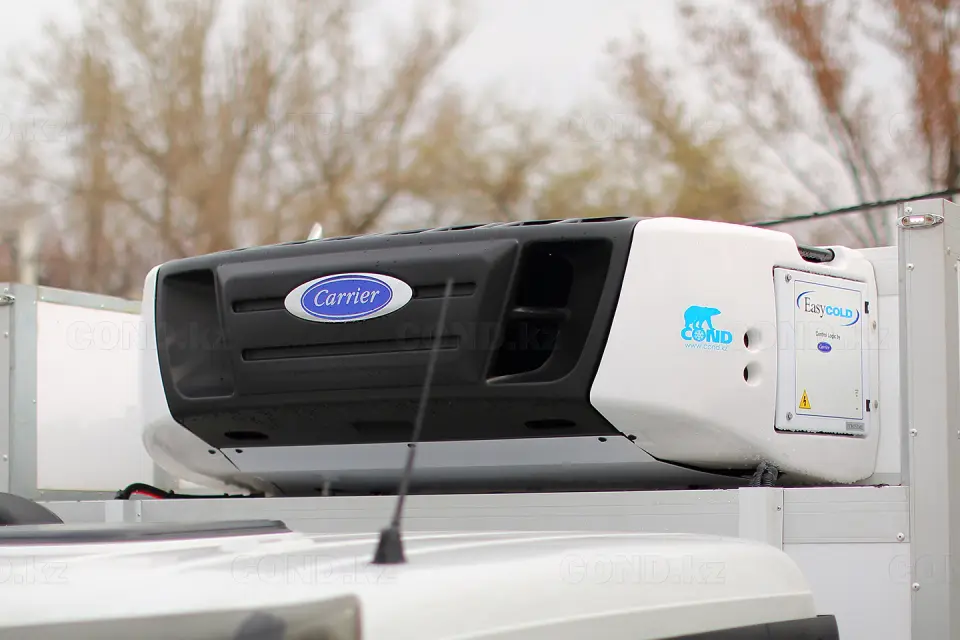
Refrigerant is the 'blood' of a refrigeration unit, and its shortage is cause No. 1 why a reefer stops cooling. We break down the signs of a leak, modern refrigerants and why 'top up and go' doesn't work.
Quote is based on body, chassis and temperature range.
Why the refrigerant shouldn't escape at all
In a sound refrigeration unit the refrigerant is not consumed — it circulates endlessly through a sealed closed loop: compressed by the compressor, giving off heat in the condenser, evaporating in the evaporator and taking heat from the body. If there's less refrigerant, it's always a leak, not 'normal consumption'. So charging a refrigerator is not a scheduled 'refuelling' but a consequence of a fixed leak.
What refrigerant is in modern refrigerators
For a long time the standard of transport refrigeration was R-404A. Because of its high global-warming potential it's being replaced by R-452A — with almost half the climate impact and similar operating characteristics. This matters for service for two reasons:
- R-452A — a zeotropic blend with a temperature glide: it must be charged only in the liquid phase and strictly by weight, otherwise the composition changes;
- with a partial leak the blend's composition is already off — a simple top-up won't restore capacity, a full recharge is required.
Why you can't just 'top up and go'
The most common mistake is to top up the refrigerant by the gauge and release the vehicle. First, the leak hasn't gone anywhere — the refrigerant will escape again, and the money on the top-up is spent. Second, for zeotropic blends topping up after a leak distorts the composition and cooling capacity. A competent service works differently: finds and fixes the leak, recovers the remainder, evacuates the system and recharges it by the weight specified for the particular unit.
7 signs it's time for service
- the unit runs non-stop but the temperature doesn't drop;
- the reefer takes a long time to reach its mode or doesn't reach the set temperature;
- oil traces on the tubes and joints (oil escapes with the refrigerant);
- frost or ice on the suction line in an unexpected place;
- the compressor has become noisier or goes into protection more often;
- fuel consumption has risen sharply — the unit is running itself into the ground;
- more than a season has passed without maintenance under intensive use.
Charge amounts for Elinge series and Carrier Citimax models and the procedure — refrigerant charging.
How and with what a leak is found
Professional diagnostics is not 'by eye':
- a visual inspection for oil traces in typical places (flare joints, Schrader valves, compressor shaft);
- pressure-testing the loop with nitrogen while monitoring the drop;
- an electronic halogen leak detector;
- a UV dye tracer that's injected into the system and lit with a UV lamp;
- soapy solution on suspect joints.
How a proper charge is done
The order of work at the service: fixing the found leak → recovering the refrigerant remainder → evacuating the system (removing moisture and air to a deep vacuum) → charging with new refrigerant strictly by weight → checking pressures and reaching the mode. Charging 'by gauge pressure' for zeotropic blends is inadmissible — only by scales.
What delay threatens
Running with a refrigerant shortage overloads and under-lubricates the compressor (oil circulates with the refrigerant). What is solved by fixing the leak and charging turns, if delayed, into replacing the compressor — the unit's most expensive component. Plus under-cooled cargo in the heat means direct losses and spoiled product.
Compressor seizure: why you can't just fit a new one
The worst scenario is mechanical seizure of the compressor. When it seizes, metal shavings and a characteristic black deposit form inside (products of oil overheating and part wear). Along with the refrigerant and oil flow, this dirt spreads through the whole system: settling in the condenser and evaporator, clogging the filter-drier and the thermal expansion valve (TXV).
That's why simply replacing the compressor becomes a lottery. The clearances between pistons and cylinders in the compressor are minimal, and old shavings left in the lines seize the already new compressor — it fails after a few minutes of running or after a few days. To prevent this, when replacing the compressor you must flush the whole system, change the filter-drier (often adding an extra filter on the suction line), blow out the lines, then evacuate and charge. Saving on flushing the system = a second burnt-out compressor.
Prevention
- off-season maintenance once a year before summer;
- cleaning the condenser of fluff and dirt;
- checking for oil traces at every inspection;
- checking door seals and the defrost mode.
All this is included in refrigeration unit service and repair at our service in Almaty — from finding the leak to a full recharge. We service and repair only refrigeration units of our own supply and installation (Carrier, Elinge, Kaida).
Scheduled maintenance to the factory schedule — SO-0, SO-1, SO-2 — is provided under contract: refrigeration unit maintenance.
FAQ
How often does a refrigerator need charging with refrigerant?
What refrigerant are transport refrigerators charged with?
Can you top up refrigerant without finding the leak?
We fitted a new compressor and it failed again — why?
The compressor itself:Compressors for refrigeration units — models and specifications