
Transporting ice cream: why a eutectic van needs −35 °C when the law asks for −18
Published:
In short. Ice cream is the only cargo that spoils without ever warming above zero: a few degrees upward is enough for the product to turn grainy and sink, and re-freezing does not undo it. Laws the world over name a single figure — no warmer than −18 °C — and allow a three-degree tolerance in transit, while eight European countries have taken ice cream out of their frozen-food rules altogether as a colder cargo. That is why an ice-cream van is built on eutectic plates running at −33…−35 °C: an ordinary refrigerated van tops out at −20 and has no reserve left for unloading stops.
— Arrive with minus twenty in the body already. Otherwise you'll be waiting at the gate. — distribution-centre intake, from a drivers' conversation on an industry forum
I used to think that ice cream with "sand" on the tongue was ice cream with a poor recipe: if you taste grit instead of cream, it must contain more substitutes and less milk. Once I had worked out how ice cream is transported, I realised the recipe had nothing to do with it. Sand on the tongue appears when the temperature was not held in storage or in transit. And what do you do with ice cream you did not like? Exactly — you never buy it again.
A corner shop, a chest freezer by the till. A customer picks up a cup with a transparent lid and sees through it what they should not see: the ice cream has sunk by a third, there is a crust of ice on top, coarse crystals along the walls. Next to it, a tub of Mövenpick for the price of a good lunch — you can lift the lid and look: the same picture. This is what ice cream looks like after it half-thawed on the road and froze again. While it was soft, the air that makes it fluffy escaped — hence the sinking. The water that had been held in the mass as tiny ice particles ran down and towards the walls and froze again in large pieces — hence the crust and the crystals. On the tongue this is that very "sand": ice on its own, sweet mass on its own. The product is not past its date, the chest is holding an honest −18, there is nothing dangerous in it — and still nobody will buy it a second time. That is dead stock: a safe product that cannot be sold.
Let's take apart what happens to ice cream on the road, what the laws of fifteen countries say about it, why a separate class of bodies is built for it, and which piece of paper settles the dispute at the gate in Kazakhstan.
An ice-cream van is sized to the route: stops per shift, leg length, a 380 V socket at the depot and the payload you need.
What spoils here is not the product but its texture
Milk, meat and fish share one enemy — bacteria: as soon as the temperature rises, they multiply and the product becomes dangerous. With ice cream this mechanism does not apply. At −12 °C microbiology is asleep, the product is safe — and already ruined. What destroys it is physics.
Inside well-made ice cream are millions of ice crystals about 40 µm in size. The tongue cannot tell them apart, so the texture reads as creamy. When the temperature in the body rises from −18 to −10 and comes back, the small crystals partly melt, and on refreezing the water builds up on the large ones. The process is called migratory recrystallisation; in the trade — heat shock. In 2022 the Journal of Food Engineering showed crystal growth from nothing more than the automatic defrost cycles of freezer equipment; over 140 days of storage with fluctuations the average crystal grows from 40 to 70 µm. The threshold is known: crystals larger than 50 µm in noticeable numbers give "sand".
Heat shock accumulates and is never reversed. Crystals do not shrink on refreezing; every break in the chain — loading under the sun, an hour by an open door, a weak chest freezer by the till — adds microns. On a drivers' forum this is put without the science: "sat in a warm body — separated, can't sell it".
The shelf-life figures make the gap visible. By the recommendations of the International Institute of Refrigeration (IIR), ice cream keeps for about two years at −24 °C, six months at −18 °C and one month at −12 °C. The University of Minnesota's sensory trials (1998) are harsher still: about a week at −10, ten weeks at −20, forty weeks at −25. Between −20 and −25 lie five degrees and a fourfold difference in how long the product stays tasty.
Eight European countries have taken ice cream out of their frozen-food rules
You would think −18 °C is a universal figure. It really is everywhere, but its role differs.
Kazakhstan and the EAEU. TR CU 033/2013 (clause 5) built the temperature into the definition of the product: hardened ice cream is "ice cream subjected to freezing to a temperature not above minus 18 °C … and maintaining the said temperature during its storage, transport and sale". Plombir that has warmed to −15 in the body no longer matches its own name. Russia lives under the same regulation; GOST 31457-2012 repeats the formula and adds a shelf life — six months at −18.
The European Union. Directive 89/108/EEC (Article 5) requires −18 °C "at all points of the product" for quick-frozen foodstuffs, with brief upward fluctuations of no more than 3 °C in transit. But then it gets interesting: when transposing the directive into national law, one country after another wrote that ice cream is not a frozen food.
| Country | Act | Wording on ice cream |
|---|---|---|
| United Kingdom | Quick-frozen Foodstuffs Regs 2007, reg. 2 | "does not include ice-cream or any other edible ice" |
| Germany | TLMV, § 1 Abs. 2 | "Speiseeis unterliegt nicht den Vorschriften dieser Verordnung" |
| Netherlands | Warenwetregeling, art. 1 b | "andere dan consumptie-ijs" |
| Sweden | LIVSFS 2006:12, 1 § | "gäller inte glass och glassvaror" |
| Switzerland | HyV, Art. 4 Abs. 7 | "mit Ausnahme von Speiseeis" |
| Denmark | BEK 1355/2015, § 6 stk. 2 | the "dybfrossen" label — "gælder ikke for konsumis" |
| Italy | D.Lgs. 110/1992, art. 1 | "i gelati non sono da considerarsi surgelati" |
| Finland | MMMa 1367/2011, § 10 | ice cream moved to a separate act |
The reason is explained by the British industry guide to frozen foods: the QFF rules do not apply to ice cream because "the temperatures at which ice cream should be stored are generally colder than those suitable for frozen foods". France settled the same question differently — it kept ice cream in the general table and gave it −18 °C, with −12 for other frozen goods. In 2022 Turkey adopted a separate ice-cream regulation (Tebliğ 2022/13, Madde 13): no warmer than −18 °C in transport, storage and sale, brief rises of no more than 3 °C.
Outside Europe the figure blurs. China (GB 2759-2015) sets the warehouse at no warmer than −18 and the display cabinet at no warmer than −15; transport is described without degrees. Japan has no law on ice-cream transport temperature; the industry holds −18 and on that basis puts no best-before date on the packaging at all. The USA and Australia write the same thing and give no figure: frozen food "shall be maintained frozen" (FDA Food Code, § 3-501.11). For international journeys there is the ATP — the 1970 Geneva agreement, which Kazakhstan joined in 1995: in its tables ice cream stands at −20 °C, stricter than other frozen goods.
The outcome across fifteen jurisdictions fits in one line. −18 °C is the boundary beyond which the product still counts as normal, not a setting for the trip. Not one standard in the world names −18 as the working regime for transporting ice cream.
The penalty in Kazakhstan is Article 425 of the Code of Administrative Offences of the Republic of Kazakhstan, for violating technical regulations: an individual 20 MCI (86,500 KZT), a small business 160 MCI (692,000 KZT), a medium one 210 MCI (908,250 KZT), a large one 1,600 MCI (6,920,000 KZT); where health is harmed — up to 2,000 MCI with confiscation. But the main loss is rarely the fine. More often it is the return of the whole consignment and the supplier's quiet disappearance from the chain's purchasing plan.
The piece of paper that settles the dispute at the gate
Back to the tub with the crystals. Until someone opens it, the dispute between shop, supplier and carrier is conducted on paper, and in Kazakhstan it has a documentary answer, written into the Rules for the carriage of goods by road of the Republic of Kazakhstan (Правила перевозок грузов автомобильным транспортом; as amended by Order No. 184 of the Minister of Transport of 17.07.2026).
Clause 76 requires perishable goods to be carried with the temperature regime observed. Clause 86 says how that is proven: the temperature of the goods before loading, the temperature in the body when the vehicle is presented and the temperature on arrival at the consignee are entered in the checklist sheet (Appendix 3 to the Rules) and in the consignment note. Three readings, two signatures — shipper and carrier at loading, carrier and consignee at unloading.
Without this sheet the dispute turns into an argument about recorders "of the wrong brand". With it — into a comparison of three figures. European Regulation 37/2005 adds an equipment requirement to the same mechanism: transport of frozen foods is fitted with an air-temperature recorder, and the records are kept for at least a year; for local delivery a single clearly visible thermometer is enough.
Lawyers in cargo disputes describe the consignee's typical mistake with one driver's phrase: "Sign now, we'll sort it out later." A consignment note signed without remarks closes the matter in the carrier's favour, even if the boxes are at plus eight the next morning. The correct entry is "accepted with a temperature-regime violation" — plus a photograph of the recorder's screen for the whole trip before the doors were opened. The advice to the carrier is the mirror image: keep the checklist sheet on every trip, not only when the intake is strict.
The ladder of cold
Let's put the standards, the practice and the equipment on one scale.
| Temperature | What sits on this step | Basis |
|---|---|---|
| −35…−25 °C | hardening at the factory in the tunnel | technology |
| −33 °C | freezing point of the eutectic-plate solution | plate manufacturers |
| −33…−35 °C | working regime of a COND ice-cream van on the road | the plant (01.11.2026); Russian colleagues write "from −32" |
| −25 °C | air in the body at American distributors; 40 weeks of sensory shelf life | industry practice; University of Minnesota, 1998 |
| −24 °C | about two years of storage | IIR |
| −20 °C | ATP for ice cream; ceiling of most compressor units; 10 weeks | ATP; catalogues; University of Minnesota, 1998 |
| −18 °C | legal minimum: EAEU, EU, Russia, France, Turkey; 6 months | TR CU 033 and others; IIR |
| −15 °C | tolerance limit in transit in the United Kingdom, the Netherlands, Sweden, Switzerland; display cabinet in China | standards |
| −12 °C | display cabinets in the United Kingdom; other frozen goods in France; 1 month | standards; IIR |
| −10 °C | about a week | University of Minnesota, 1998 |
The gap between the third and seventh rows — fourteen degrees — is the subject of this article. It is the reserve that gets spent at unloading stops: every open door lets in summer air, and the lower the temperature in the body, the longer the product stays within spec while the boxes are carried into the shop. A vehicle set to exactly −18 uses up the legal three-degree tolerance at the very first stop.
Transporting ice cream in an ordinary refrigerated van: why −20 is not enough
The natural question: why not simply set the reefer to −30?
Because it was not built for that. The delivery refrigeration units of the largest manufacturers are rated in their tables for the range "from −20 to +30 °C": at Carrier these are the Citimax, Xarios, Pulsor and Supra series, at Elinge all models from С07 to С5 Max ("cooling to −20 °C"), at Kingtec and Zanotti −20 is the working regime and −25 a reservation for special models. The words "мороженое" and "ice cream" do not appear on their pages. The German "Tiefkühlung" in insulated-van catalogues means −20. Line-haul semi-trailers from European plants describe freezing as ATP class FRC — again without degrees below −20. Of the mass-market ranges only Thermo King claims −32, and only in the MAX version on R-452A refrigerant.
A reefer's deep freeze ends where ice cream's reserve begins.
The second reason is the very principle of air cooling. A compressor unit holds the cold in the air of the body, and when the doors open, the air is the first thing to go. In a bench test on a refrigerated truck (International Journal of Refrigeration, 2002) the mean air temperature in the body rose from −10 to +14 °C over two minutes of an open door with no curtain. In a field measurement on urban delivery (Ciência e Tecnologia de Alimentos, 2010) a freezer compartment with a −18 °C setpoint warmed to +9 °C over a day with 28 stops of 4–5 minutes each, and the unit never managed to recover the setpoint between stops: after one long unloading even 34 minutes were not enough. The authors say it outright: the unit has no capacity to recover between deliveries. In those minutes the ice cream by the doors has time to warm and partly melt — and then the physics from the first section takes over: the water gathers into large crystals, and renewed cold will no longer fix the product. Eutectic plates store the cold in the substance itself: open the door, the air changes, close it — and the plates cool the new air on their own, with no compressor and no long pull-down.
This explains why a separate class of equipment for ice cream exists all over the world: in Europe and Russia — vans on eutectic plates running at −33 °C with 125–155 mm panels; in the USA the same principle is called cold plate or holdover. The name differs, the physics is the same.
How an ice-cream van works
A eutectic is a solution that freezes and melts at one fixed temperature. In ice-cream-van plates that is −33 °C. The plates sit along the walls and ceiling of the body; at night they are charged from a 380 V three-phase supply — on COND vehicles this takes 8–10 hours, on European equivalents 10–12, and the first charge of a new vehicle lasts up to 20 hours until the solution has frozen right through. During the day the plates release the cold, and the body holds about −32 °C for the whole trip with the unit switched off. By the end of the shift the temperature rises towards −20 — that is the normal curve, not a fault.
Hence four properties for which an ice-cream van is chosen over a reefer:
- it does not "chase" the temperature after every stop — the cold is already stored in the plates and is released on its own as the air warms;
- it does not care about engine speed — an engine-driven compressor unit loses capacity in a traffic jam; the plates are indifferent;
- it makes no noise — there is no compressor, so night-time unloading in residential courtyards draws no complaints;
- there is nothing to break on the road — no belts, clutches or engine hours; makers of eutectic systems put maintenance 60 % below that of air systems.
This comes at a price, and it should be known before buying.
Weight. One eutectic plate from European suppliers weighs about 85 kg, the charging unit another 140–145; a typical set of three or four plates with the unit is 400–480 kg of cooling system alone, not counting the heavier insulation. On a chassis with a gross weight of 3.5 tonnes, where an ordinary refrigerated van leaves about 900–1,100 kg of payload, an ice-cream van carries noticeably less. Plates under the ceiling also raise the centre of gravity. This is the price of autonomy, and it is calculated for the specific chassis.
The socket. The plates charge only when parked and only from the mains. No three-phase socket at the depot — no ice-cream van. The plates do not charge on the move.
Frost. The most common driver error, according to cold-plate suppliers: frost on the plates is taken as a sign of cold. The opposite is true — frost insulates the plate from the air in the body. Before charging, the body is defrosted and dried.
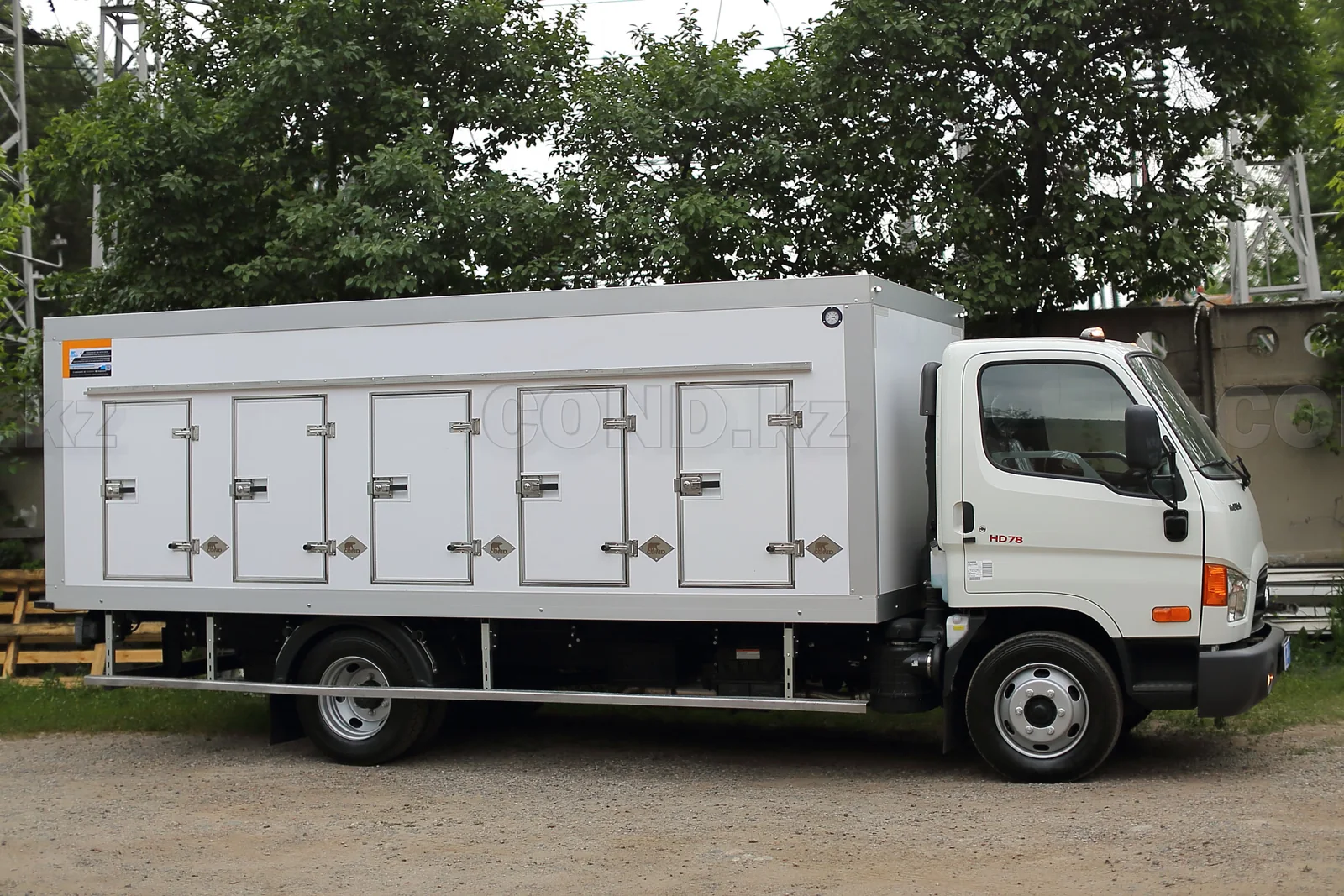
Doors. Ice-cream-van bodies are built in sections: at COND, any number from 3 to 6 per side; at European plants, up to 10–12. The driver opens only the section the goods come out of; the rest of the volume loses no cold. American body builders size the number of doors by a "doors per day" figure — how many times a shift the vehicle opens: up to ten, up to twenty, more than twenty. A good question to raise with the plant.
How to carry ice cream properly: the trip checklist
- Plates fully charged; body defrosted and dried before charging.
- Product from the warehouse no warmer than −18 °C; the reading entered in the consignment note.
- Checklist sheet filled in at loading and at the consignee (clause 86 of the Rules for the carriage of goods).
- Route built from the farthest stop to the nearest; only the section needed is opened.
- No fish or other odorous cargo in the body: the fat in ice cream absorbs odours even when frozen (Article 17 of TR CU 021).
How fast ice cream melts in the body
Ice cream does not have to reach zero to lose its looks. A display cabinet for scoop sales holds −12…−14 °C — at that temperature it is already being scooped with a spoon. Between the legal −18 and "soft" lie four to six degrees.
The speed at which a body covers them has been measured. The air in an open refrigerated van with no curtain warms from −10 to +14 °C in two minutes (International Journal of Refrigeration, 2002). The product warms more slowly than the air: first the surface of a cup in the top row by the door, last the middle of the pallet. That is why the driver sees a normal box at unloading, and the shop a day later sees a sunken cup. In air at +28 °C an unwrapped cone keeps its shape for about 40 minutes (Nottingham Trent University data); at +18 °C a portion runs completely in an hour and a half (University of Leicester measurement). In a body in summer the count is the same: an hour with the cooling off or with the doors open for unloading — and the top rows have already passed through −10, where "sand" begins.
Frozen goods, pelmeni and semi-finished products: same body, different thresholds
The question "how to transport frozen food properly" is asked most often by those who carry pelmeni (dumplings), cutlets, dough and vegetables together with ice cream. The rules for them are softer. GOST 33394-2015 for frozen pelmeni (clause 7.2) allows transport at a temperature not above minus 10 °C, and recommends a six-month shelf life only at −18 (clause 7.3.3); at −10 — a month. Under TR CU 021/2011 (Article 17) the storage and transport regime is set by the manufacturer on the label, and for most frozen goods that is −18 °C.
For frozen goods like these an ordinary refrigerated van with a unit set to −20 will do: it has a reserve up to the threshold, and a pack of pelmeni that has risen to −10 is still within GOST. Proper transport of frozen goods is the same five checklist points: cold loading, a recorded reading, short door openings, no odorous neighbours. The difference is in the cost of a mistake. Pelmeni that have thawed to −5 and refrozen stick together in the pack and crack when boiled — the goods go out at a discount. Ice cream after the same cycle does not sell at all. So on a mixed trip of "frozen goods plus ice cream" the regime is set by the ice cream: −18 at unloading at the last stop, which means a reserve in the body from the morning. On carrying it together with meat and fish — see the page on transporting meat and fish; on separate compartments — the article on the multi-temperature van.
What COND makes of all this
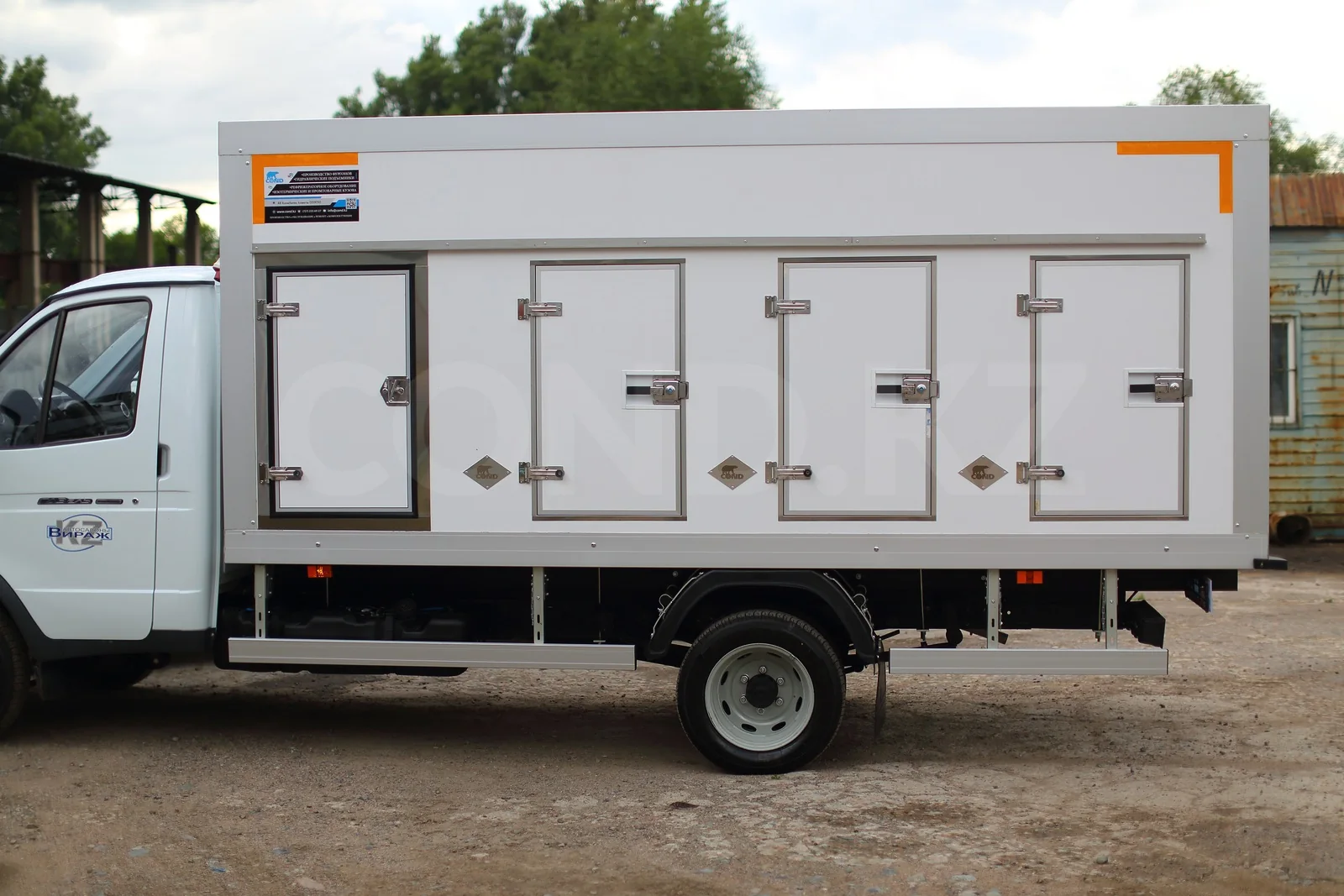
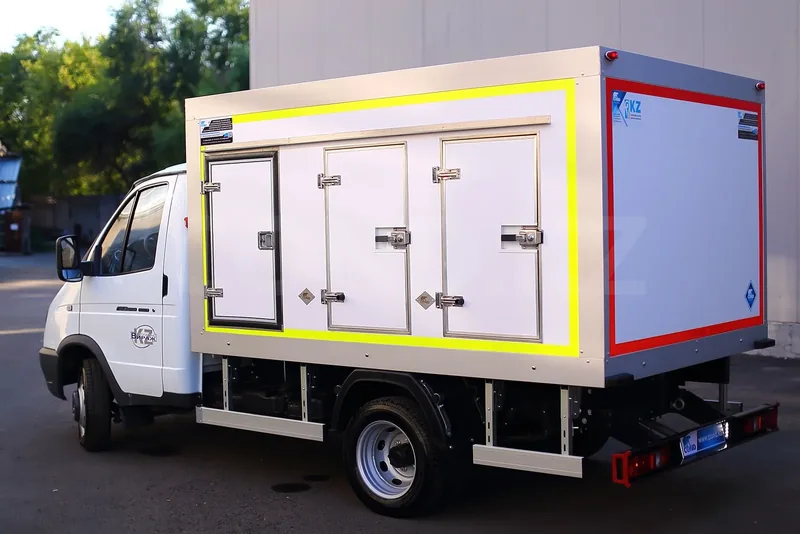
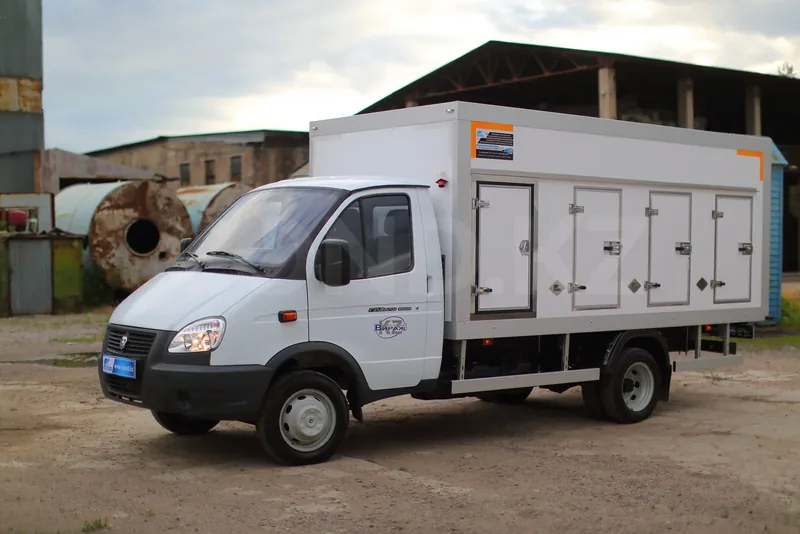
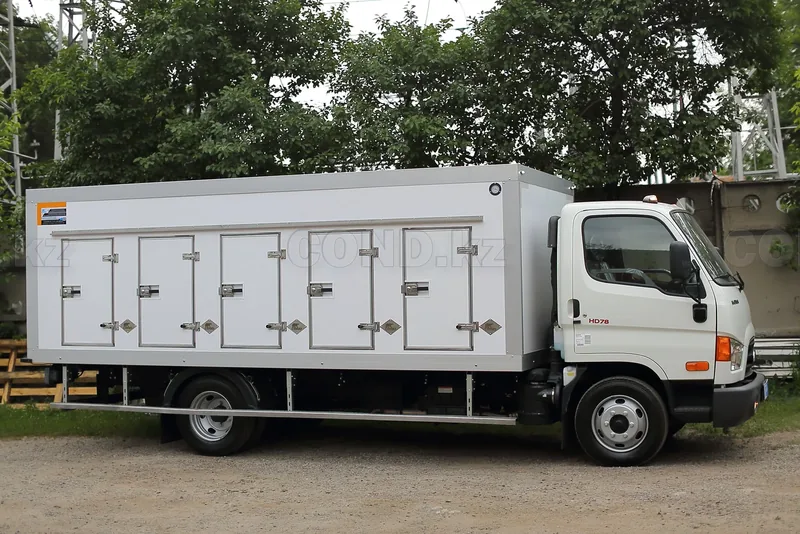
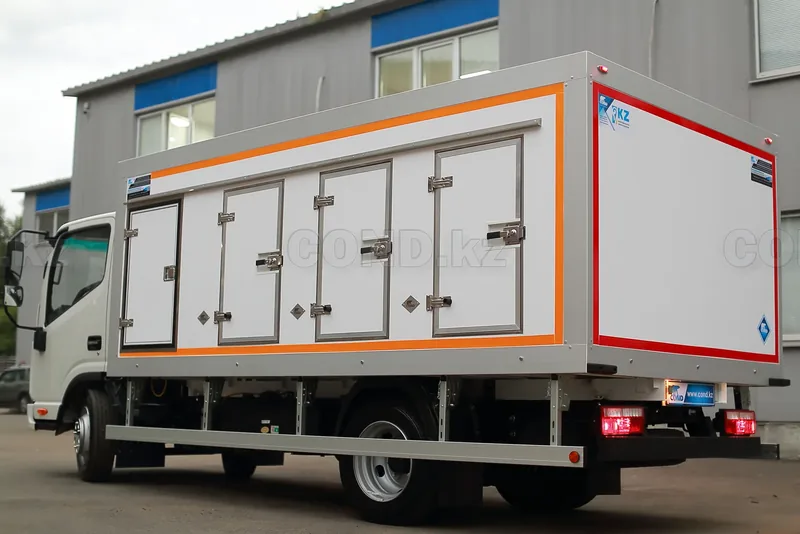
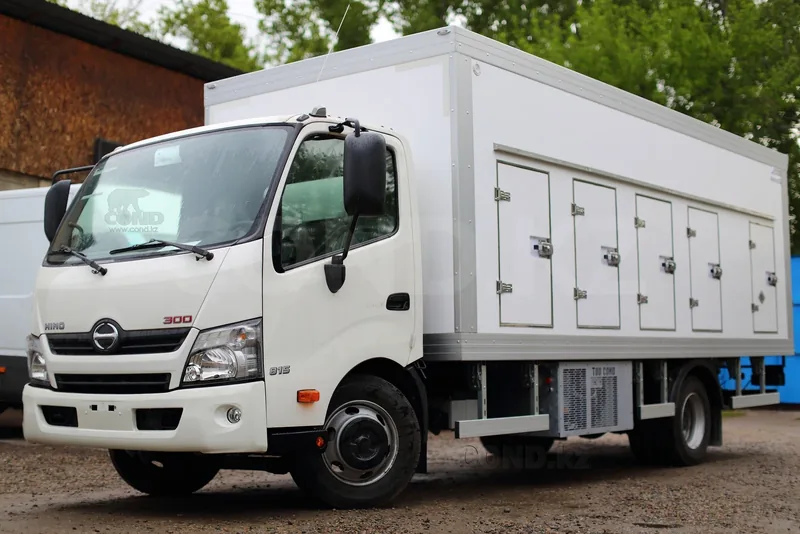
The COND plant in Almaty builds ice-cream vans on eutectic plates with a working regime of −33…−35 °C on the road. Charging is from a 380 V supply in 8–10 hours while parked. The body is sectional, from 3 to 6 doors per side at the customer's choice, length from 3,200 to 6,200 mm, with an interior lining of reinforced fibreglass, which meets the requirement of Article 17 of TR CU 021 for washable surfaces.
Such vehicles have been built on six chassis. Cards of completed projects — with photographs, specifications and video:

All the plant's ice-cream vans and the configurations open to order are on the ice-cream van page. Three reviews from the COND channel:
 Ice-cream van on a GAZelle Business 3302 base by COND
 JAC N56 eutectic ice-cream van built by COND
 Deep-freeze van down to −35 °C on a JAC N90 — body built by COND
Eutectic plates on their own. COND also supplies the plates without a body: to retrofit an existing insulated van for ice cream, or to replace plates that have reached the end of their life. The number of plates, their placement along the walls and ceiling and the capacity of the charging unit are calculated by the plant from the body volume, the number of stops per shift and the summer temperature on the route. Enquiries — on WhatsApp or via the form at the bottom of the page: give the internal dimensions of the body and the route.
For line-haul legs and mixed trips, where eutectics fall short on autonomy, the plant builds low-temperature refrigerated vans with 100 mm sandwich panels and units running at −20 °C and below.
Every body comes with a manufacturer's document package — it is needed for the conversion entry in the vehicle registration certificate, without which the vehicle may not be operated (details in the article on conversion and the registration certificate). Before the inspection the vehicle must have side underrun protection and reflective tape fitted — there is a separate article on that.
If you carry chilled dairy or meat, the regimes and requirements there are different — they are covered in the articles on transporting dairy products and transporting meat; for pharmaceuticals — cold-chain validation.
An ice-cream van is calculated for the route: the number of stops per shift, the length of the leg, whether there is a socket at the depot and the payload wanted determine the number of plates, sections and the chassis. Those are the four figures to bring to the plant.
In the end, the most expensive part of an ice-cream van turns out to be neither the cold nor the plates. It is the three-phase socket at the depot and the habit of filling in the checklist sheet — two things that are not sold with the body.
FAQ
What is the transport temperature for ice cream in a refrigerated van? The law requires no warmer than −18 °C all the way — this is part of the definition of hardened ice cream in TR CU 033/2013. The transit tolerance in Europe is 3 °C. It is carried with a reserve: the working regime of an ice-cream van on eutectic plates is −33…−35 °C; ordinary compressor units stop at −20.
A eutectic van with side doors — what is it? A body with eutectic plates and sectional doors along the sides (at COND — from 3 to 6 per side). The driver opens one section at a stop; the rest of the volume stays closed and loses no cold. The number of doors is chosen by the number of stops per shift.
Eutectic plates — what are they and where to buy them? Panels with a solution that freezes at −33 °C. At night they are charged from a 380 V supply in 8–10 hours; during the day they release the cold and hold −33…−35 °C with no unit running. The plates can be bought from the COND plant in Almaty — together with a body or separately, to retrofit an existing insulated van; the quantity and layout are calculated by the plant from the body volume and the route.
How long does a eutectic van hold without recharging? A working shift of urban delivery with doors opening; by evening the temperature rises towards −20 °C. The exact figure depends on the number of stops, the outside temperature and the body length — no manufacturer in the world publishes it as a single line.
Why did the ice cream arrive as "sand" if the unit held the temperature? Heat shock accumulates along the whole chain: loading, unloading stops, a weak chest freezer in the shop. The tongue feels crystals larger than 50 µm as sand, and refreezing does not shrink them. Who is to blame is shown by the three readings in the checklist sheet — at loading, when the vehicle is presented and at the consignee.
The consignee says "soft", but the unit held all the way. Who is right? Whoever has the records. In Kazakhstan, under clause 86 of the Rules for the carriage of goods, the temperature at loading and at unloading is entered in the checklist sheet and the consignment note; without them the dispute cannot be settled. A consignment note with a violation is signed with the remark "accepted with a temperature-regime violation".
The van was on charge all night — why don't the plates hold until evening? Three typical reasons: frost on the plates (it insulates them from the air — the body is defrosted and dried before charging), warm loading (the plates are not designed to cool the product, only to hold it), too many door openings on the route for the given number of plates.
How should ice cream be carried properly? In the body at no warmer than −18 °C all the way and with a reserve for unloading stops: an ice-cream van on eutectics holds −33…−35, a refrigerated van for line haul −25 and below. Load only cold product, enter the reading in the consignment note and the checklist sheet, open the doors by section and briefly, no odorous neighbours. The full checklist is in the section on the ice-cream van.
Can ice cream be carried in an ordinary refrigerated van? On a short leg with no door openings — yes, if the unit holds −20 and the product was loaded at −18 or colder. On a delivery round with ten or more stops — no: an air unit loses cold at every door and cannot recover it; by lunchtime the body is living warmer than −18. The measurements are in the section on the refrigerated van.
How fast does ice cream melt in a vehicle? The air in an open body goes from −10 to +14 °C in two minutes; a portion in +28 air loses its shape in 40 minutes. But ice cream does not need to melt: at −10…−12 it is already soft and the crystals are growing. An hour without cold in summer — and the top rows of the pallet are ruined.
How should frozen foods, pelmeni and semi-finished products be transported properly? By the manufacturer's regime on the label, as a rule −18 °C; GOST 33394-2015 for pelmeni allows −10 in transit. An ordinary refrigerated van at −20 is suitable. On a mixed trip with ice cream, the ice cream sets the regime.
What is the shelf life of ice cream? By the IIR — about two years at −24 °C, six months at −18 °C, a month at −12 °C. The date on the packaging is set by the manufacturer, and it is valid only if the regime is kept all the way.
Can frozen foods be carried together with ice cream? General frozen goods — pelmeni, vegetables, semi-finished products — travel at −18 °C, so the regime is compatible. Fish and other odorous cargo must not be added: the fat in ice cream absorbs odours (Article 17, clause 2 of TR CU 021).
Buying an ice-cream van in Kazakhstan — what to choose? For the city with drop-by-drop delivery — an ice-cream van on eutectic plates with sectional doors; for a line-haul leg — a low-temperature refrigerated van with a unit at −20 °C and below. COND in Almaty builds both on your chassis.
Source legislation
Full texts in the official Kazakh legal database Adilet:
- ТР ТС 033/2013 «О безопасности молока и молочной продукции», п. 5 (определения закалённого и мягкого мороженого): https://adilet.zan.kz/rus/docs/H13EV000067
- Правила перевозок грузов автомобильным транспортом РК, п. 10, 76, 86, 390–393 (ред. приказа Министра транспорта РК от 17.07.2026 № 184): https://adilet.zan.kz/rus/docs/V1500012463
- ТР ТС 021/2011 «О безопасности пищевой продукции», ст. 17: https://adilet.zan.kz/rus/docs/H11T0000880
- Кодекс РК об административных правонарушениях, ст. 425: https://adilet.zan.kz/rus/docs/K1400000235