
Hanging Meat Truck: Design, Standards and How to Choose a Carcass Transport Truck
Published:
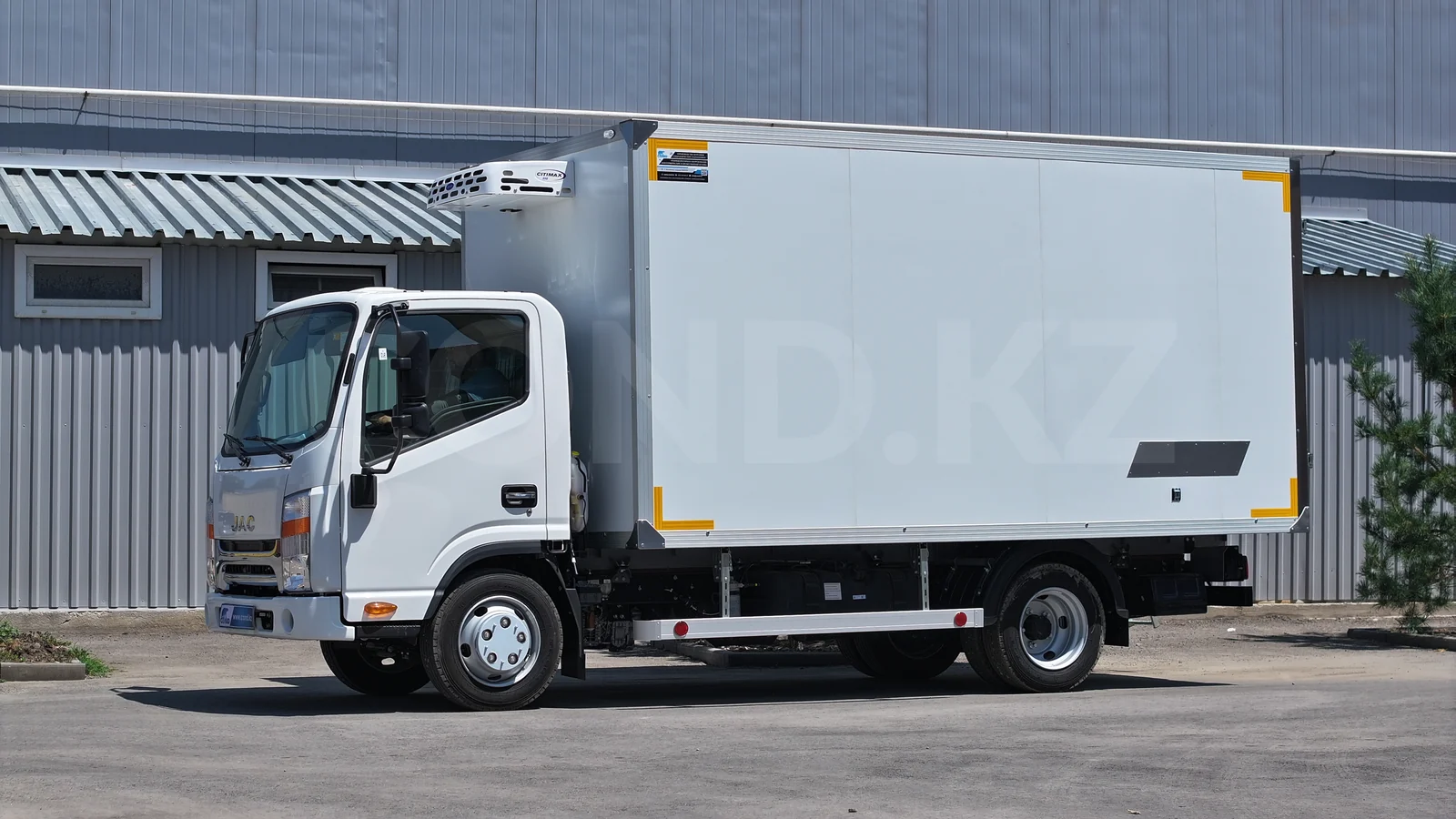
In short. A hanging meat truck (Russian: «тушевоз») is a vehicle for hauling meat as whole carcasses: a refrigerated truck or an insulated van with overhead meat rails under the roof. Carcasses, half-carcasses and quarters ride upright on hooks. They touch neither the floor, nor the walls, nor each other. In Kazakhstan and across the whole EAEU, the technical regulation TR CU 034/2013 (section IX, clause 98) requires chilled meat to be hauled this way, so a refrigerated body with pallets does not suit carcasses. The whole load of a hanging meat truck hangs from the roof. So the design of such a truck starts with the roof frame, the rails and the body height, and the refrigeration unit comes after. COND builds a hanging meat truck to order in Kazakhstan: stainless steel meat rails, a reinforced frame, a washable floor with drains and a refrigeration unit matched to the load.
— Drive it like a tanker. No hard braking, and go slowly on roundabouts. — advice from a meat-truck driver on a British trucker forum
In 1868, the first cars with beef carcasses hanging on racks above ice entered service in Detroit. A few months later the cars were pulled from the line. On curves the load swung to the side and the cars heeled over. Several times it ended in a derailment. Ten years later the meatpacker Gustavus Swift ordered a car built differently: ice at the top, cold air flowing down, the load packed tight and low.
A century and a half has passed, and the task of the hanging meat truck is the same. Hundreds of kilograms of meat hang in the body on one swing axis. On the road they behave like a pendulum, and their whole mass is carried by the ceiling.
Below: what a hanging meat truck is and how it differs from an ordinary refrigerated truck, what the standards of Kazakhstan and other countries require, where the weight of a carcass goes, how many carcasses fit in the body, why the truck sways, and how to choose a hanging meat truck for your carcasses.
Quote is based on body, chassis and temperature range.
Hanging Meat Truck: What It Is and How It Differs from a Refrigerated Truck
A hanging meat truck (also called a refrigerated carcass truck, a ref carcass truck, a meat truck or a refrigerated truck with meat hooks) is a truck with an insulated or refrigerated body. Overhead meat rails run under the ceiling inside it. Hooks hang on the rails, and carcasses, half-carcasses or quarters hang on the hooks. The floor stays free: the meat does not touch it at any point.
From the outside, a hanging meat truck is almost the same as a refrigerated truck. The difference is inside and in the structure:
| What to compare | Refrigerated truck for boxes and pallets | Hanging meat truck |
|---|---|---|
| Where the load sits | on the floor | on hooks under the ceiling |
| What carries the weight | floor and subframe | roof frame, wall posts, then the subframe |
| Center of gravity of the load | low | high |
| Load behavior in transit | secured with rails and straps | swings if not restrained |
| Internal height | sized for the pallet height | sized for the carcass length plus the clearance to the floor |
| Floor | flat, for a trolley | washable, with drains: carcasses drip |
| Material of everything that touches the meat | any food-grade material | stainless steel, aluminum, fiberglass |
A refrigerated body without carcass rails is hard to convert. The roof of an ordinary van is not designed to carry hundreds of kilograms at the hanging points. A sagging sandwich panel cannot be repaired and is replaced whole. So the reinforcement for the rails is built in when the body is assembled. British workshops that fit rails into finished vans first reinforce the walls and the ceiling, and only then hang the rails.
Carcass Transport: Why Only Hanging
The rule is old and common to many countries: a chilled carcass travels hanging, so that air flows around it on all sides and nothing touches the meat surface.
- EAEU, including Kazakhstan. TR CU 034/2013 "On the Safety of Meat and Meat Products", section IX, clause 98: carcasses, half-carcasses and quarters are hauled in a vertical hanging position that prevents them from touching. Frozen carcasses may be stacked if their surface does not become contaminated. The same section requires the vehicle to record temperature and not to be used after hauling live animals (clause 99). It forbids hauling meat loose without packaging (clause 100) and requires treating the body after a trip (clause 101).
- Codex Alimentarius (from Latin, "food code"). This is a set of international standards and rules on food safety. It is maintained by the Codex Alimentarius Commission, which two UN organizations created in 1963: the FAO (food and agriculture) and the WHO (health). The commission has about 190 member countries, and Kazakhstan has been a member since 2003. The Codex standards are not binding in themselves. Countries take them as the basis of their laws, and the WTO treats them as the benchmark in trade disputes over food safety. For carcass transport the key document is CAC/RCP 58-2005 "Code of Hygienic Practice for Meat", clause 8.9: transport for unpackaged meat is built so that the meat does not touch the floor. The section on transport covers temperature control in transit.
- China. National standard GB 20799-2016, clause 4.8: fresh half-carcasses are hauled on hanging devices with a distance left between them, and the meat does not touch the floor of the body. Another standard, GB 12694-2016, separates packaged and unpackaged meat into different vehicles or compartments. Since 2020, pork carcasses may be hauled between provinces only in refrigerated trucks with meat hooks, and open trucks are banned.
- European Union. Regulation (EC) No 853/2004 (Annex III, Section I, Chapter VII) requires meat to be chilled to the required temperature before loading and open meat to be hauled apart from packaged meat. It has no separate clause on hanging. In its 1992 rules, the United Kingdom stated directly that carcasses, half-carcasses and quarters hang the whole way on corrosion-resistant fittings and at a height where they do not reach the floor.
- Australia. The National Heavy Vehicle Regulator requires hanging meat to be loaded tightly or secured so that it does not move in transit.
No standard gives one figure: what clearance to leave between the carcass and the floor in the body. TR CU 034/2013 gives 8–10 cm from the floor and 30 cm from the walls only for storage chambers (clause 93). For a vehicle the standard says "preventing contact", and the clearance is calculated from the length of the longest carcass that the hanging meat truck will carry.
One line is the main one.
A hanging meat truck is judged not by the refrigerator, but by whether the meat touches anything at all.
Transport Temperature of Chilled Meat in a Hanging Meat Truck
| Meat condition | Temperature in the core | Document |
|---|---|---|
| Warm (fresh from slaughter) | not below +35 °C at any point | TR CU 034/2013, terms |
| Chilled | from −1.5 to +4 °C at any point | TR CU 034/2013, terms |
| Frozen | not above −8 °C | TR CU 034/2013, terms |
| Air temperature fluctuation in transit | not more than 2 °C | TR CU 034/2013, clause 96 |
| Meat (EU) | not above +7 °C, offal not above +3 °C | Reg. 853/2004, Annex III, Section I, Chapter VII |
| Chilled / frozen (China) | 0…+4 °C / not above −15 °C | GB 20799-2016, clauses 4.3–4.4 |
Before loading, the body is cooled to the temperature of the load. For refrigerated trucks with meat hooks, China requires at least 30 minutes of unit operation before loading and a mandatory defrost function.
This gives two modes for a hanging meat truck. For chilled carcasses the refrigeration unit holds about 0…+4 °C and, most important, holds it steady: fluctuations within two degrees. For frozen carcasses it holds −18 °C, and then the carcasses may be stacked. So one truck with rails hauls both: chilled carcasses on hooks, frozen carcasses in a stack. A unit with a range of about −18 to +12 °C covers both modes in one truck.
Warm meat fresh from slaughter is a separate matter. A carcass leaves the slaughterhouse with a core temperature above +35 °C and gives off heat and moisture. The refrigeration unit of a hanging meat truck is sized to maintain cold. Removing heat from a warm load is the job of the chilling room at the slaughterhouse. Why a warm carcass in the body loses mass and money, we covered in the article on meat transport.
Since 2017 the EU has an exception for carcasses that have not cooled to +7 °C in the core. Regulation 2017/1981 allows them to be dispatched earlier if the veterinary service has issued written permission and the conditions in the table are met:
| Trip | Meat | Carcass surface at loading | Carcass core | Air in the body |
|---|---|---|---|---|
| up to 6 h | lamb, beef, pork | not above +7 °C | — | not above +6 °C |
| up to 30 h | pork | not above +7 °C | not above +15 °C | not above +6 °C |
| up to 60 h | lamb, beef | not above +4 °C | not above +15 °C | not above +3 °C |
The other conditions concern the vehicle. A recorder logs the air temperature in the body. On one trip the carcasses come from only one slaughterhouse. Warm carcasses ride in the same compartment as chilled ones only if their core is not above +15 °C. For a hanging meat truck this means one thing: the unit must hold +3…+6 °C in the body while the load is still giving off heat, so the cooling capacity is taken with a margin. TR CU 034/2013 has no such table.
Where the Weight of a Carcass Goes
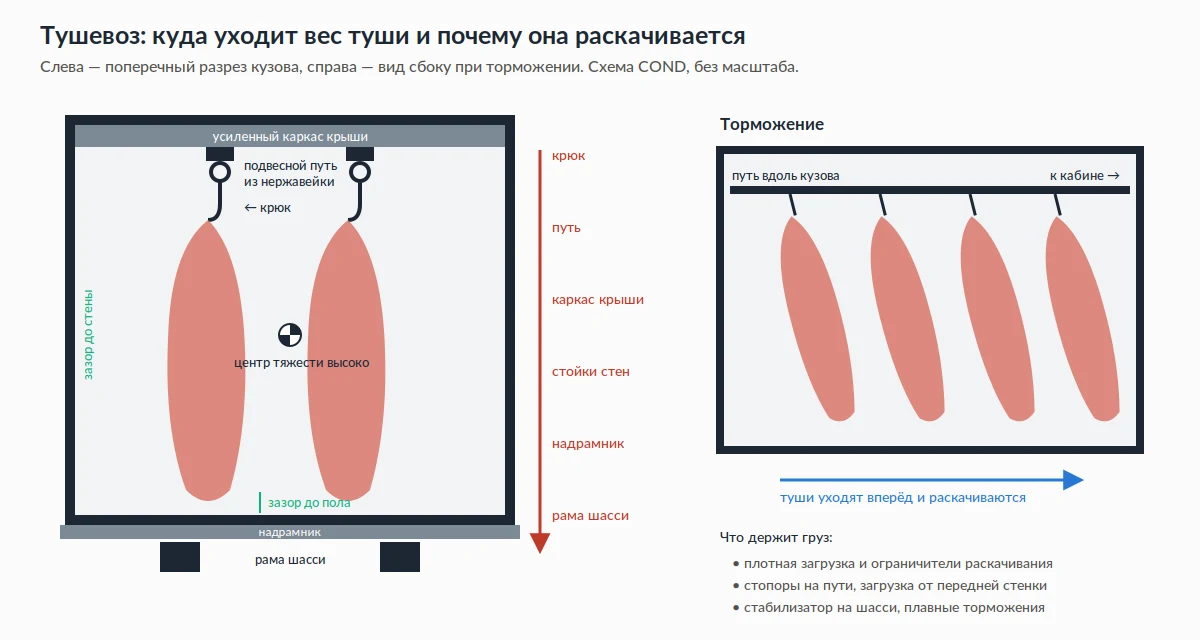
In a van with pallets, the load presses on the floor, and the floor rests on the subframe. In a hanging meat truck the path is longer:
- Hook. The carcass hangs on it. The hook is stainless steel and smooth, with no pits where dirt can collect.
- Meat rail. A tube or profile along the body. In a typical body kit for a hanging meat truck on a five-ton chassis there are four rows of stainless steel tubes, 60 mm in diameter, with 460 mm between rows. For a narrow body on a 3.5–5 t chassis two rows are enough, and wide bodies get three to five. Rail makers state a load of 100 to 250 kg per hook and up to 285 kg per running meter of the guide. This is the upper limit from which the layout of the carcasses is calculated.
- Brackets. They hold the rail under the ceiling. The same kit has aluminum brackets every 600 mm.
- Roof frame. This is the main difference from an ordinary van. The roof panel of a hanging meat truck is made with embedded reinforcements under the rails, and the frame is calculated for the carcass mass with a margin. In COND hanging meat trucks the body frame is calculated with a margin over the rated load: for example, for 1,500 kg with a carcass load of up to 1,200 kg.
- Wall posts and subframe. The load goes from the roof down the walls to the subframe and the chassis frame.
So the body of a hanging meat truck is made framed and reinforced. The wall posts and the roof cross-members are joined into one rigid frame, and the frame rests on the subframe along its whole length. This way the weight of the carcasses spreads over the subframe evenly and does not press on the chassis frame at a few points. In a typical body kit for a hanging meat truck, the subframe is a welded steel frame with a yield strength of 420 N/mm² and 6 mm side members. It distributes the load onto the chassis and keeps the body rigid. The body is fixed to the chassis frame with brackets that have elastic links and mounting plates, so that the chassis frame can twist without breaking the body. A sandwich panel without a frame does not give this rigidity. Chinese reference books describe the difference with a figure: the pitch of the internal frames is about 0.45 m in a refrigerated truck with meat hooks and about 1.2 m in an ordinary refrigerated truck, and the body is heavier by about 100 kg for each meter of length.
A separate question for the manufacturer is the embedded parts for the rails. A steel embedded part that passes through the insulation becomes a cold bridge, and condensation forms on it. Ask how the embedded parts are isolated from the cold side of the panel.
If any link in this chain is weaker than the rest, it fails first. Under braking the carcasses swing and the rail takes a shock. A hanging meat truck whose rails are screwed to the roof panel without a frame will work for some time on a good road. On the first hard braking it will tear the embedded parts out. So the hanging system is calculated for the load in advance, before the body is assembled, and not added to a finished refrigerated truck.
How Many Carcasses Fit in a Hanging Meat Truck
The calculation starts with the carcass. Three numbers define everything else: the mass of one carcass, its length when hanging, and how many carcasses the trip will carry.
| Meat | Carcass mass | Source |
|---|---|---|
| Horse meat, Kazakh horse of the zhabe type | 197–240 kg carcass (half-carcass about 100–120 kg) | study of Kazakh horses, Vestnik OshGU, 2024 |
| Mutton, Kazakh fat-tailed sheep | 18–20.5 kg carcass | research on meat productivity |
| Beef, Kazakh white-headed steers, 18 months | 276–287 kg carcass (half-carcass about 140 kg, quarter about 70 kg), carcass length 202–209 cm | control slaughter, Vestnik OshGU, 2024; Vestnik of Altai State Agrarian University, 2011 |
Then it is simple arithmetic:
- The number of rail rows is set by the body width. A narrow body on a light-duty chassis has two rows, a five-ton chassis has four, and a long body on a large chassis has five.
- The number of carcasses per row is set by the body length and the pitch. Half-carcasses must not touch each other (TR CU 034/2013, clause 98), so few fit per running meter of rail.
- The internal height is the length of the longest carcass plus the hook plus the clearance to the floor. The hanging gear takes from 180 to 370 mm of height from the ceiling to the bottom of the hook. Makers give different figures for track and tube systems. A body about 1.8 m high suits lamb carcasses, pork half-carcasses and beef quarters. For hanging beef and horse half-carcasses, take a greater internal height: a steer carcass is longer than two meters by measurement.
- The mass of the trip is checked against the payload of the chassis after subtracting the body, the rails, the refrigeration unit and the hooks.
The last point is often skipped, and a hanging meat truck has its own rule from practice here: a hanging meat truck loses about a third of its payload. Calculate it like this:
- Take the payload of the chassis, for example a five-ton one.
- Subtract the mass of the van and the refrigeration unit. The result is the actual payload.
- Subtract another third from the actual payload. The remainder is the mass of carcasses to plan for the trip.
The third is a reserve for the hanging load. A carcass on a hook swings, hits the rails under braking and raises the center of gravity of the truck, and the whole load goes through the roof and the frame. So the full payload is not filled with carcasses. The second step is also heavier for a hanging meat truck than for a refrigerated truck with pallets: a body kit with four rows of rails for a five-ton chassis weighs about 1.65 t without the refrigeration unit and hooks. The hooks and the tail lift, if fitted, are subtracted in the second step together with the van.
The rule agrees with figures from other countries. Sellers of hanging equipment in Russia count that a truck that takes 5 t on the floor will carry 3–3.5 t on hooks. Chinese reference books write that a refrigerated truck with meat hooks takes about 1 t less than the same refrigerated truck without the hanging system.
Kazakhstan has its own detail: horse meat and mutton. A horse carcass is ten times heavier than a mutton carcass, and butchers sometimes carry both in one trip. For a mixed load, the rails are made with stops by section, so that heavy carcasses stand at the front wall over the axles and light ones nearer the doors.
Why a Hanging Meat Truck Sways and How to Stop It
A carcass on a hook is a pendulum. Under braking it moves forward, in a turn it moves sideways, and the whole load does it at once. The center of gravity of a hanging meat truck is higher than that of a van with pallets, and the swing of the load adds a side force to it.
Researchers of transport dynamics name load movement inside an articulated vehicle as the most dangerous factor for an accident. Cases are known: in 2026 in Germany a truck with beef half-carcasses "started to sway" after an overtake and rolled onto its side. French inspectors stopped entering semi-trailers with hanging meat after an injury from a falling carcass.
What is done about the swing:
- Swing limiters. Aluminum profiles above and below along the rails, and telescopic spacer bars across the body: the carcasses press against them and do not hit each other. Several bars are fitted, one for each loading section.
- Spacer frame in a lashing rail. A lashing rail (a profile with cells) is fitted on the body walls, for example at a height of 900–1,100 mm. A spacer frame snaps into its cells from both sides: two horizontal beams joined by posts, with adjustable length. The frame stands across the body between groups of carcasses and presses them. The carcasses rest against the frame and do not swing, and a gap remains between neighboring carcasses, as TR CU 034/2013 (clause 98) requires. The frame is moved between the cells for each load and washed together with the body, since it touches the meat. On a trip with pallets, the same frame holds the stack.
- Stops on the rails. They lock the hooks by section, so that the whole load does not slide to the front wall on the first braking.
- Tight loading from the front wall. The Australian regulator requires this too: hanging meat is loaded tightly or secured.
- Rails closer to the walls. In a narrow body of a light-duty truck, British workshops fit the rails near the walls: the carcass rests on the wall and swings less.
- Anti-roll bar on the chassis. Makers of body kits for hanging meat trucks write directly: for bodies with a high center of mass, which includes hook suspension, the chassis is fitted with an anti-roll bar. When working with a trailer, the frame is additionally reinforced with diagonal braces.
- Driving style. Smooth acceleration, smooth braking, slow on roundabouts and ramps. Drivers of hanging meat trucks compare the work to driving a tanker.
How a Carcass Gets into the Body
At a meat plant, carcasses travel on the overhead rail of the shop. It is good when this rail continues into the rail of the truck without taking the carcass off the hook. For this, transfer terminals are fitted at the rear of the body: the shop rail is brought up to them, and the hook with the carcass rolls into the body on the rail. The height of the truck rails is agreed with the height of the rail in the customer's shop.
Without such a transfer, the carcass is taken off the shop hook and hung on the truck hook by hand, which means holding it in the arms. A half-carcass of horse meat is a job for two people. At unloading at a shop or a market where there is no rail, a pull-out ladder at the doors and removable hooks help.
Hanging meat trucks often have a tail lift. The carcass is taken off the hook onto the platform and lowered to the ground, and the loaders do not have to take it from the height of the body floor. For beef and horse half-carcasses this noticeably eases unloading where the receiver has no rail and no ramp. The capacity of the tail lift is chosen for the heaviest carcass together with the loader.
If the truck carries carcasses at times and boxes at other times, the rails are made folding or removable by section: folded, they go up to the ceiling and free the floor for pallets.
Tube or track system. Tube rails are convenient when carcasses go into the body directly from the shop rail through a transfer terminal. A track system in a closed profile is chosen when carcasses are hung inside the body: the profile is lower, and the roller of the hook cannot fall out of it. The system is chosen to match the rails at the sender and at the receiver. The pitch between rows in typical kits is from 415 to 460 mm.
How this is built by European makers:
- Tube — 48 or 60 mm in diameter, more often 60 mm in Europe. The hook rolls along it on a roller, and the tube is lubricated.
- Double profile — made of aluminum or stainless steel. The hook runs on plastic rollers with bearings, and no lubrication is needed.
- C-profile under the roof — about 50 mm high, with mushroom-shaped hooks. It is the lowest, but it does not join with slaughterhouse rails: the carcasses are rehung by hand.
- Hook fall-out protection and a locking latch at the ends of the rails, so that the hook does not jump off during loading or at a jolt on the road.
- Transfer plate on the rear post of the body — the shop rail is brought up to it.
Japanese body builders make hanging meat trucks with a sliding roof — the carcass is lowered into the body by a crane from above. In Australia and the United Kingdom, a loading boom with a hoist and a folding ramp at the rear doors are fitted.
Floor, Walls and Washing
Carcasses drip: blood, condensate, water after washing. So a hanging meat truck has a special floor:
- Tray. The floor is a fully welded sheet of checker-plate aluminum or stainless steel with edges around the perimeter, without gaps where liquid collects.
- Drains. Openings with taps in the front part of the floor, so that the truck can be washed and the water drained. On carcass semi-trailers in Europe a stainless steel drain collector of 160 L is fitted.
- Walls. A smooth lining that withstands washing and disinfection: fiberglass or food-grade plastic. At the bottom of the walls is a bump rail of anodized aluminum at least 200 mm high: trolleys and loaders' feet hit it. Painted steel and materials that absorb water are not suitable in contact with meat.
- Everything that touches the meat — hooks, rails, door-opening fittings — is stainless steel.
After each trip the body is washed and disinfected. TR CU 034/2013 (clause 101) requires this, and in Kazakhstan the veterinary rules for transport that has hauled products of animal origin require it too.
Standards by Country: One Table
| Country | Document | Hanging of carcasses | Temperature | Washing |
|---|---|---|---|---|
| Kazakhstan and EAEU | TR CU 034/2013, clauses 96–101 | mandatory, without contact; frozen meat may be stacked | chilled −1.5…+4 °C, frozen ≤ −8 °C, fluctuation ≤ 2 °C | after each trip |
| Codex Alimentarius (FAO/WHO, international) | CAC/RCP 58-2005, clause 8.9 | unpackaged meat does not touch the floor | control in transit | — |
| China | GB 20799-2016, clause 4.8; GB 12694-2016 | hanging devices for half-carcasses, distance between them | 0…+4 °C / ≤ −15 °C | before and after the trip |
| European Union | Reg. 853/2004, 852/2004; 2017/1981 | no separate clause; open meat apart from packaged | meat ≤ +7 °C, offal ≤ +3 °C; warm carcasses by permission and the table of 2017/1981 | cleaning between trips |
| United Kingdom (1992 rules) | SI 1992/2037, Sch. 17 | the whole way, on corrosion-resistant fittings, without touching the floor | carcasses ≤ +7 °C, offal ≤ +3 °C, frozen ≤ −12 °C | cleaning and disinfection before loading |
| Australia | rules of the heavy vehicle regulator | tight loading or securing | — | — |
The most direct requirement for hanging is in the EAEU and China. The most detailed requirement for the vehicle itself is in China: hanging, distance between carcasses, separate transport of packaged and unpackaged meat.
How Carcasses Were Hauled Before
- 1857, USA. The first dressed beef from Chicago was hauled in ordinary cars with ice. The meat touched the ice and darkened.
- 1868, Detroit. Cars with carcasses on racks above ice: the load heeled over on curves, the cars derailed, and they were pulled from the line.
- 1878–1880. The car for Gustavus Swift was designed anew: ice at the top, cold air flowing down, the load low and tight. From these cars grew the first large network of refrigerated meat transport.
- 1926, USSR. Serial production of insulated cars; from the 1950s, refrigerated trains.
- 1934, Kazakhstan. The Semipalatinsk meat plant started work, one of the largest meat plants of the republic. During the war years it produced more than 100 thousand tons of meat.
Today the hanging meat truck is a motor vehicle: carcasses ride from the slaughterhouse to the shop without transfer, and a refrigeration unit with a temperature recorder works in place of ice.
How to Choose and Buy a Hanging Meat Truck
Before ordering a hanging meat truck, answer five questions:
- Which carcasses. Beef, horse meat, mutton, pork — this sets the carcass length and the body height.
- Mass of one trip. From it come the number of rail rows, the reinforcement of the frame and the class of the chassis.
- Chilled or frozen. From this come the mode of the refrigeration unit and whether mixed loading is needed.
- From where to where. Whether there is a rail in the sender's shop and at the receiver: whether a transfer terminal, a tail lift, a ladder or removable hooks are needed.
- What else the truck will carry. Carcasses only, or boxes and pallets too: then folding or removable rails.
As a guide for the chassis: for lamb carcasses and quarters in the city, a 3.5–5 t chassis with a body of about 4 m and two rows of rails is enough. For beef and horse half-carcasses and intercity trips, take a medium-duty chassis with a body of 6 m or more and four to five rows of rails. Most often a hanging meat truck is sought on the Isuzu 5 t chassis, the Hyundai HD78 and the KAMAZ. For long trips with large batches, a carcass semi-trailer for a tractor unit is taken, while a carcass transport truck is more convenient for distribution, where there are several unloading points. The recycling fee depends on where the chassis was imported from, and this is worth checking before the purchase.
COND Hanging Meat Truck to Order
A COND hanging meat truck is calculated for your carcasses and your route. There is no catalog model: the number of rows, the body height and the refrigeration unit depend on the answers to the five questions above.
- Chassis. Light-duty and medium-duty: JAC N56, FOTON Aumark S35, Isuzu, Hino, HOWO and others — the customer's own or selected together.
- Body. Refrigerated body of sandwich panels with fiberglass outside and inside: walls and roof 100 mm, floor 120 mm.
- Hanging system. Longitudinal stainless steel meat rails, the load spread along the whole length of the body; the frame and subframe are reinforced for the carcass weight with a margin.
- Unloading. A tail lift for unloading carcasses where the receiver has no overhead rail.
- Floor. A fully welded tray of 3 mm checker-plate aluminum with drain openings and taps.
- Fittings. Stainless steel hinges, locks and door-opening lining.
- Refrigeration. A front-mounted unit for the range from −18 to +12 °C — for example, Carrier Citimax 500 on a light-duty chassis.
- Documents. The body maker's documents for vehicle registration and the mark in the registration certificate. The body warranty is 2 years.
Other vans for meat and fish are on the page of vans for meat transport. How to haul chilled meat correctly, we covered in the article on meat transport, and about cold in general in the article on the cold chain.
Write which carcasses you haul, how many per trip, and from where to where. We will calculate the rail rows, the body height and the chassis, and offer a hanging meat truck for your trip. Send a request through the form on the website or by WhatsApp.
A hanging meat truck is tested on the first braking: everything done right is simply unnoticeable at that moment.
FAQ
What is a hanging meat truck? A hanging meat truck is a truck with an insulated or refrigerated van, inside which overhead meat rails with hooks run under the ceiling. Carcasses, half-carcasses and quarters ride on them upright and touch neither the floor, nor the walls, nor each other.
Can carcass meat be hauled in an ordinary refrigerated truck? Chilled carcasses, no: TR CU 034/2013 (section IX, clause 98) requires carcasses, half-carcasses and quarters to be hauled in a vertical hanging position without contact. Frozen carcasses may be hauled stacked if their surface does not become contaminated.
At what temperature is carcass meat hauled? By TR CU 034/2013, chilled meat has from −1.5 to +4 °C in the core and frozen meat not above −8 °C. Temperature fluctuation in the body is not more than 2 °C. In practice a hanging meat truck holds 0…+4 °C for chilled carcasses and −18 °C for frozen ones.
How many carcasses fit in a hanging meat truck? It depends on the body length, the number of rail rows and the carcass mass: a narrow body on a light-duty chassis has two rows, a five-ton chassis has four. The limit is the payload of the chassis after subtracting the body and the refrigeration unit, and about a third more in reserve for the hanging load. Carcasses must not touch each other.
What carcass hook is needed in a hanging meat truck? Hooks for a hanging meat truck are stainless steel, smooth, without pits and weld build-up, sized to the rail. If the truck works with a shop through a transfer terminal, the carcass rides into the body on the same carcass hook on which it hung in the chamber. Makers state a load of 100 to 250 kg per hook. The number and type of hooks (fixed or on rollers) are chosen for the carcasses and for whether the sender's shop has a rail.
Single or double hook: which is better for a hanging meat truck? A single hook sits closer together on the rail — according to hook makers, up to 40 % more hooks per the same meter — and it is chosen for whole carcasses and half-carcasses. A double hook holds the load at two points and turns less. It is taken for quarters and cuts on long trips. The material is AISI 304 or 316 stainless steel; 316 withstands chlorine-containing detergents better.
Can carcasses that have not cooled to +7 °C be hauled? In the EU, yes, but as an exception: Regulation 2017/1981 allows carcasses to be dispatched earlier with written permission of the veterinary service, if the carcass surface is not above +7 °C, the air in the body is not above +6 °C and the trip is not longer than 6 hours (for longer trips the conditions are stricter). The body must have a temperature recorder. TR CU 034/2013 has no such table: the requirements for chilled and frozen meat are in the temperature table above.
What meat rails are fitted in a hanging meat truck? A tube of 48 or 60 mm diameter, a double profile of aluminum or stainless steel on rollers without lubrication, or a low C-profile under the roof. The tube and the double profile join with the slaughterhouse rail through a transfer plate, and the C-profile does not.
Why does a hanging meat truck sway? Carcasses on hooks act as a pendulum: under braking they move forward, in a turn they move sideways, and the center of gravity of a hanging meat truck is high. Swing limiters, stops on the rails, tight loading from the front wall, an anti-roll bar on the chassis and smooth driving help.
Which chassis to choose for a hanging meat truck? For lamb carcasses and quarters in the city — a 3.5–5 t chassis with a body of about 4 m. For beef and horse half-carcasses and intercity trips — a medium-duty chassis with a body of 6 m or more, with an anti-roll bar.
What to wash a hanging meat truck with and how often? After each trip: TR CU 034/2013 (clause 101) requires sanitary treatment of the body after hauling. The tray floor with drains, smooth fiberglass walls and stainless steel rails allow the truck to be washed with pressurized water and disinfected.
How may carcasses, half-carcasses and quarters be hauled frozen? TR CU 034/2013 (clause 98) allows frozen carcasses, half-carcasses and quarters to be hauled stacked if contamination of their surface is excluded. Chilled carcasses are hauled only in a vertical hanging position that prevents them from touching.
What to choose: a hanging meat truck or a hanging meat semi-trailer? A refrigerated semi-trailer for carcasses takes a large batch on a long trip, but needs a tractor unit. A hanging meat truck on a 3.5–12 t chassis works in the city and the region, calls at markets and shops, and is more often fitted with a tail lift. The one-third payload rule applies to both.
Tube or track system: which to choose for a hanging meat truck? Tube, if carcasses are loaded directly from the overhead rail of the shop through a transfer terminal. Track in a closed profile, if carcasses are hung inside the body: it is lower, and the roller of the hook does not fall out of it. The rails at the sender and the receiver decide.
What documents are needed to haul carcasses? A veterinary accompanying document for the load, confirmation of the sanitary treatment of the body and a record of the temperature in transit from the recorder. Which veterinary document is needed for a given route is clarified at the territorial veterinary inspection.
What recycling fee is paid for a hanging meat truck in Kazakhstan? The recycling fee is paid once before the first registration: 50 MCI (monthly calculation indices) multiplied by a coefficient from the Methodology for Calculating the Recycling Payment (order of the Ministry of Ecology of Kazakhstan No. 54 of 20.03.2026). For trucks assembled in Kazakhstan and imported from countries other than Russia and Belarus, the coefficient is 10.5 for 12–20 t and 20.5 for 20–50 t. For those imported from Russia and Belarus it is 164 at any mass from 2.5 t. The methodology names no separate payment for a van mounted on a chassis.
Where to buy a hanging meat truck in Kazakhstan? Few ready-made hanging meat trucks are in stock: the truck is calculated for the carcasses, the trip mass and the route. COND (Almaty) builds a hanging meat truck to order in Kazakhstan — on the customer's chassis or one selected together.
Source legislation
Full texts in the official Kazakh legal database Adilet:
- Order of the Minister of Ecology and Natural Resources of the Republic of Kazakhstan of 20.03.2026 No. 54 on amendments to the Methodology for Calculating the Recycling Payment: https://adilet.zan.kz/rus/docs/V2600038306