
Chick transport truck for day-old chicks: design, standards in different countries, and ordering in Kazakhstan
Published:
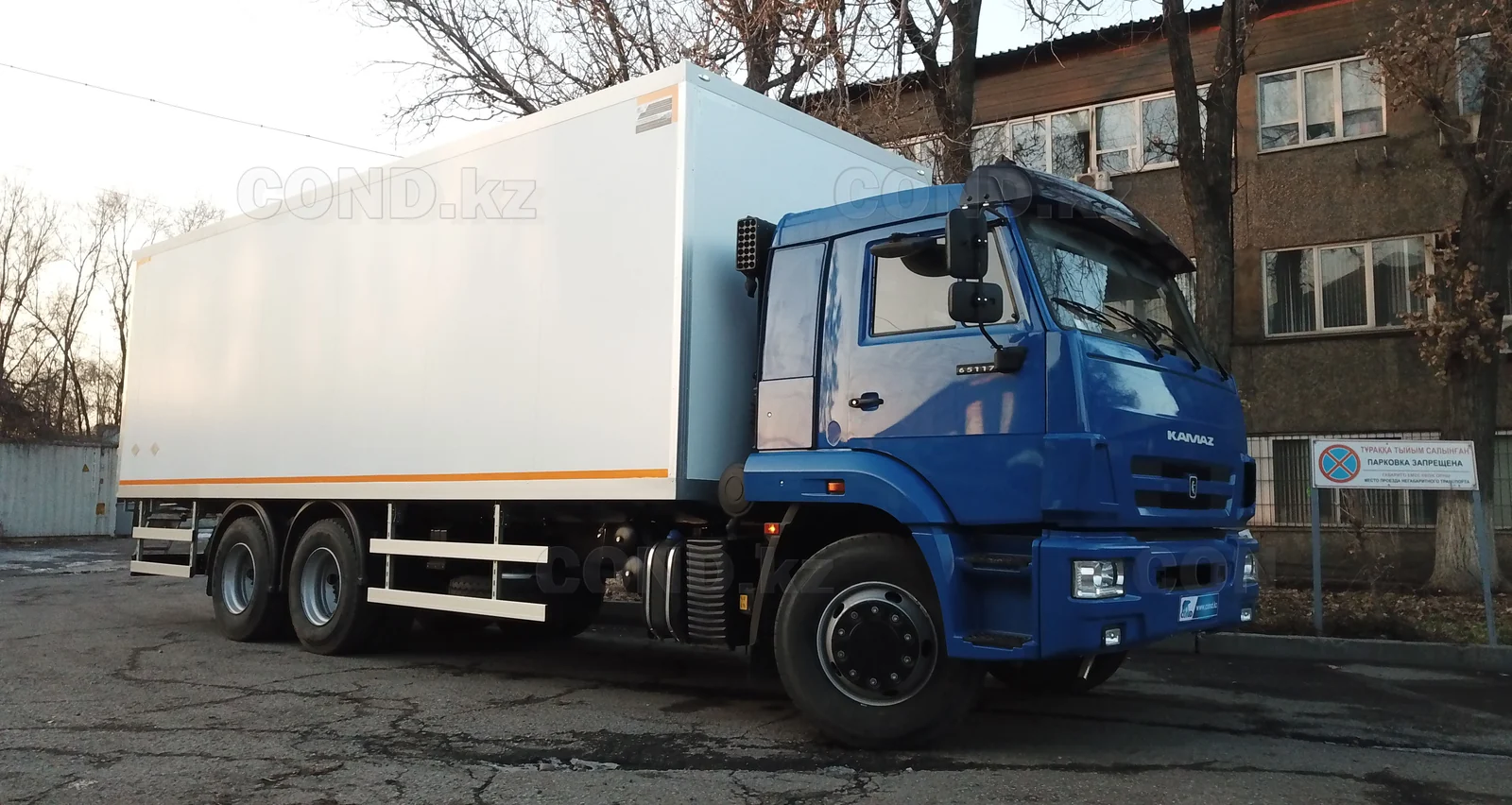
In short. A poultry company hauls two different cargoes: hatching eggs and day-old chicks. Eggs travel cool, at +8…+25 °C, and their main enemies are impact and condensation on the shell. Chicks travel alive and warm: in the box they need 30–35 °C, while the air in the body is held at 20–28 °C, because forty thousand chicks heat their own boxes by 6–12 degrees. So above all, a chick transport truck (chick truck) pushes air through every box and holds the climate at any stop. Standards differ between countries in hours and degrees, and the Kazakhstan rules give no numbers at all. You can buy a chick transport truck in Kazakhstan to order from COND: the vehicle is sized for the number of birds, the crates and the longest route of the poultry company, on the customer's chassis or one selected together.
— A 2,500 km trip with no food or water just won't work. — A question on a farmers' forum, 2022. There are no answers under it.
The forum gave no answer. Poultry people answered that question with a six-page technical specification. It came to us for a chick transport truck for runs of the same 2,000–2,500 km, and the ventilation section in it is marked "critical section". Heating gets half a page, cooling the same. Air gets two pages: how many cubic metres per hour, through which ducts, how many sensors and where. Separately: a stop of up to twelve hours at customs at +40…+50 °C, and non-stop operation for up to two days.
The reason is clear from simple arithmetic. Almost forty thousand living creatures with a body temperature of 40 °C ride in the body. They breathe and give off heat, moisture and carbon dioxide. After a few minutes without air movement it is a steam room.
Below: how hauling chicks differs from hauling eggs, how long a day-old chick can travel, how chicks were carried a hundred years ago and how they are carried now in different countries, which temperature is the right one and why it is measured in three places, how much air is needed per thousand birds, and what kind of body withstands daily pressure washing.
Quote is based on body, chassis and temperature range.
The egg and the chick are two different cargoes
A hatching egg and a day-old chick leave the same hatchery, often in the same vehicle, but they are carried under different rules. The Russian industry standard OST 10 331-2003 describes both cargoes in one document and separates them into different sections: section 3 for eggs, section 4 for chicks.
| What to compare | Hatching eggs | Day-old chicks |
|---|---|---|
| Air in the vehicle | +8…+25 °C, humidity 40–80% (cl. 3.11) | +20…+28 °C, humidity 55–75% (cl. 4.12) |
| Inside the packaging | — | +27…+33 °C, CO₂ no more than 1.5% (cl. 4.12) |
| Air speed | up to 1.5 m/s between stacks (cl. 3.11) | up to 2 m/s (cl. 4.12) |
| Packaging | pimpled trays of 30 eggs, pointed end down, cardboard boxes used only once (cl. 3.2, 3.4) | boxes with compartments and 10–15 mm holes in the walls (cl. 4.4) |
| Loading | no higher than 4 rows, 30 cm from the floor, 10 cm between stacks (cl. 3.7) | 9 boxes per trolley, 15 cm between stacks (cl. 4.11) |
| Time on the road | the standard sets no limit | no more than 24 hours from loading (cl. 4.13) |
| Permitted losses | breakage and damage no more than 1% (cl. 5.1) | survival at least 99.8% (cl. 5.2) |
The vehicle speed is the same for both cargoes: up to 80 km/h on asphalt and up to 30 km/h on dirt roads (cl. 3.10).
The main difference is not in the numbers. Before incubation an egg gives off almost no heat; it must be kept even and cool. The mistake with an egg is a crack from impact or condensation: if a cold egg from storage lands in warm, humid air, the shell sweats, and breeding companies warn about this separately in their hatchery manuals. A chick is a source of heat, moisture and carbon dioxide, and the vehicle must carry all of that out of the body.
That is why one body carries about twice as many eggs as chicks. A Belarusian chick transport truck on a five-tonne MAZ took 28 thousand day-old chicks or 55 thousand hatching eggs. If the vehicle carries both cargoes, the climate has two modes: for eggs, steady coolness without condensation; for chicks, warmth in the boxes and an airflow through them. The rest of the article is about chicks.
The chick travels on its yolk — and on the clock
Before hatching, the chick draws the remainder of the yolk into its belly — the yolk sac. This is its supply of food and water for the first days. The breeding company Aviagen estimates this remainder at 4–5 grams and writes that it lasts about 72 hours, provided the surrounding environment is right. In trials on a real chick truck, chicks after trips of 60–72 hours gave the same first-week mortality as after a short drive.
So there is no need to feed or water them on the road. What is needed is something else: that the chick does not burn its yolk fighting heat or cold. Spanish researchers fitted sensors to a production chick truck and recorded 66 trips from May to November 2017. The average weight loss per trip was 2.96%. It grew with trip length and with air humidity. The temperature in the body differed near the cab, in the middle and near the doors, and also on the upper and lower tiers. The same trip ran in a different climate for different trolleys.
How many hours is "right" each country decides in its own way, and the figures in the standards cannot be compared directly: they are counted from different events.
- From hatching. EU Regulation No. 1/2005 allows chicks to be carried without feed and water for less than 24 hours, if the trip is completed within 72 hours after hatching (Annex I, ch. V, cl. 2.1). Canada requires that feed, water and rest for newly hatched birds come within the same 72 hours (Health of Animals Regulations, s. 152.2). Germany is stricter for domestic transport: the chicks must be at the recipient no later than 60 hours after hatching (TierSchTrV, § 11).
- From the first chick. The EFSA scientific panel in 2022 proposed counting from the hatching of the first chick in a batch to the first feed of the last one — and no more than 48 hours. This count includes the hatchery, sorting, loading and unloading.
- From loading. The Russian industry standard OST 10 331-2003 limits time on the road to 24 hours from the moment the vehicle is loaded (cl. 4.13).
- From the start of the trip. Sweden and Switzerland limit the transport of animals in general: 8 hours in the Swedish rules. Such countries haul chicks over short legs.
A chick that arrives light and dehydrated starts worse at the grow-out site. The poultry company finds out a week later — from mortality and weight gain. At unloading it cannot be seen.
How chicks were carried a hundred years ago
The oldest mass method of transporting day-old chicks is the post. The US Postal Service has accepted live day-old chicks since 1918 and still does. The rules have hardly changed in meaning: the chick must be no more than 24 hours old at dispatch, the box is the hatchery's original box with ventilation holes, the date and hour of hatching are written on the address side, and delivery is within 72 hours of hatching (USPS Publication 52, s. 526.3). The post relies on the same yolk as a modern chick truck.
The weak spot of the post is also the same: the environment around the box. The American farm press in 2024–2026 wrote about boxes that sat over a weekend on a loading dock or went to the wrong city, and that they arrived entirely dead. "A quiet box is a dead box," a Missouri farmer explained to NPR journalists. Live chicks in a box peep.
Trucks for chicks appeared when poultry companies grew to tens of thousands of birds at a time. In August 1966 the British magazine Commercial Motor ran a note, "More than 30,000 chicks in one trip". At the front of that van stood heat exchangers that warmed the intake air. The engineers of those years fought cold above all.
In the Soviet Union and after it they long made do with simpler means. Belarusian engineers describe Russian-built vans on the GAZ-53 chassis that carried chicks at agricultural combines: they had only heating and air purging, no air conditioning. Their conclusion is short: the microclimate, especially in summer, was practically uncontrollable.
When a chick transport truck on a five-tonne MAZ was built in Belarus, it got what is now considered the baseline: a refrigeration unit on the roof, liquid heating, 16 trolleys with boxes of 80 birds each, a tail lift, temperature and humidity sensors recording every 15 minutes, and six hours of climate operation on batteries if the engine fails. One order from the same work shows the difference well. An agricultural combine needed to deliver 70 thousand chicks. The new vehicle took 34 thousand. For the rest, three old vans of 12 thousand each were needed.
In Russia in 2002 poultry companies began to look for chick trucks inside the country, because imported ones were expensive. Researchers of the St. Petersburg Polytechnic University noted then: there are no domestic manufacturers yet.
The aeroplane is a separate story. A parent flock of broilers is carried across continents, and for this airlines and poultry producers have a joint guide (Global Guide, 2018, supplementing the IATA rules for live animals). Chicks are brought to the airport warehouse 3–5 hours before departure, loaded on board last and unloaded first. The hold is kept at 18–24 °C, and ventilation is not switched off either on the ground or at take-off. If a flight is delayed by more than two hours, the boxes are returned to a warm warehouse. The Kazakhstan rules also name day-old chicks among the cargoes carried by air (Order of the Ministry of Agriculture of the Republic of Kazakhstan No. 7-1/496, cl. 28). After the plane a truck still collects the chicks — and the last hundreds of kilometres matter no less than the thousands in the air.
Which temperature is right depends on where you measure
In talk about chicks, three different temperatures come up, and all three are right. The standards of different countries look contradictory precisely because each measures in its own place.
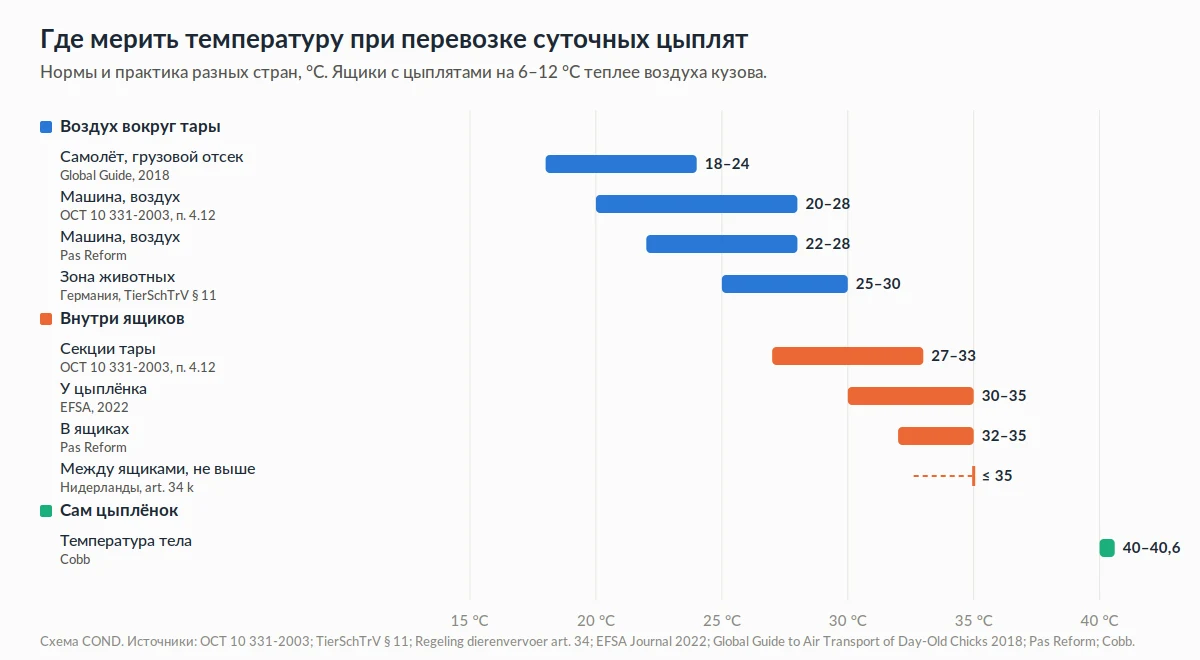
| Where to measure | What is needed | Who writes so |
|---|---|---|
| Chick's body | 40.0–40.6 °C; panting begins at 41 °C | Cobb, care guide for the period between hatching and placement |
| Inside the box, at the chicks | 30–35 °C; below 30 °C — cold stress | EFSA, 2022; incubator manufacturer Pas Reform — 32–35 °C |
| Packaging compartments | +27…+33 °C, humidity 60–70% | OST 10 331-2003, cl. 4.12 (Russia) |
| Between boxes | no higher than 35 °C, reading displayed in the cab | Regeling dierenvervoer, art. 34 (Netherlands) |
| Where the animals are | 25–30 °C | TierSchTrV, § 11 (Germany) |
| Air in the vehicle | +20…+28 °C, humidity 55–75% | OST 10 331-2003, cl. 4.12; Pas Reform — 22–28 °C |
| Aircraft hold | 18–24 °C | Global Guide, 2018 |
The difference between the box and the air is the chicks' own heat. According to Cobb, the boxes are 6–12 °C warmer than the room around them. If you set +32 °C in the body "as the chicks need", the boxes will be at +40.
A thermometer on the wall of the body lies about the chick by 6–12 degrees.
That is why poultry people ask for sensors at three levels of height, at the intake, at the exhaust and at the doors. And they ask for evenness: the difference between the upper and lower tier no more than 1.5 °C at full load. The bottom boxes are heated from the floor, the top ones from the roof in the sun. Cobb separately writes that the floor of a chick truck is insulated more heavily than the walls, otherwise the bottom boxes overheat.
Humidity works both ways. Dry air dehydrates the chick. Humid air keeps it from cooling by breathing: when panting, a chick loses five times more moisture than in normal breathing, and itself raises the humidity around it.
Heat kills faster, cold costs more
Aviagen tested this in trials: chicks were kept in boxes at a comfortable temperature, in cool and in warm conditions, and then first-week mortality at the grow-out site was counted. In the cool group mortality rose 2.7 times against the comfortable group, in the warm group 1.5 times.
This does not mean heat is safer. An overheated chick opens its beak, breathes fast, loses water and at extremes dies right on the road — this is seen at unloading. A chilled chick huddles with its neighbours, spends yolk on warming itself and arrives alive. The bill for cold comes later, at the site, and nobody links it to the vehicle.
Hence a paradox that surprises those coming from refrigerated trucks: a chick transport truck needs cold in winter. Outside is −30 °C, the heating is on, but once the body is fully loaded and the dampers closed, half an hour later the middle of the stack is hot. The climate of a chick truck heats, cools and mixes flows at the same time, and automation runs it from sensors. In the specifications that come to us, heating and cooling capacities stand side by side and are almost equal. The calculation is done for the extreme points of the route: −45 °C in winter in northern Kazakhstan and +50 °C in the sun at a border crossing in summer.
Air decides more than insulation
A chick truck specification has two numbers about air, and they are easy to mix up.
Recirculation is the whole flow that the fans push through the boxes. In a standard configuration for 16 trolleys this is 18,000 m³/h. The air goes from the ceiling duct down through the gaps between trolleys, passes through the boxes and leaves into the floor return duct, and from there to the heat exchangers and filters. For a compartment of about 40 m³ this is hundreds of air changes per hour. The Welsh government specification for poultry vehicles requires a minimum of 30 air changes per hour and a calculation for the worst case — a standing vehicle in heat.
Fresh air is the small share of the flow that comes in from outside and removes CO₂ and moisture. It is counted per thousand birds. The Dutch transport rules require at least 25 m³ per hour per 1,000 chicks with adjustment from the cab (Regeling dierenvervoer, art. 34). For 38,400 chicks that is about 960 m³ per hour — the lower bound. Breeding companies in their manuals set more than the norm, and in summer the intake must be larger still, so the intake fan is chosen with a margin of two to three times. The intake damper opens on a CO₂ sensor: in winter every extra cubic metre of fresh air has to be heated from −30 to +25.
The CO₂ limit also differs. The Russian OST of 2003 allows up to 1.5% in the packaging compartments. Cobb writes of a limit of 0.3%, Pas Reform of 500–600 ppm in the vehicle. A twenty-year-old standard permits five times more carbon dioxide than poultry people themselves allow today.
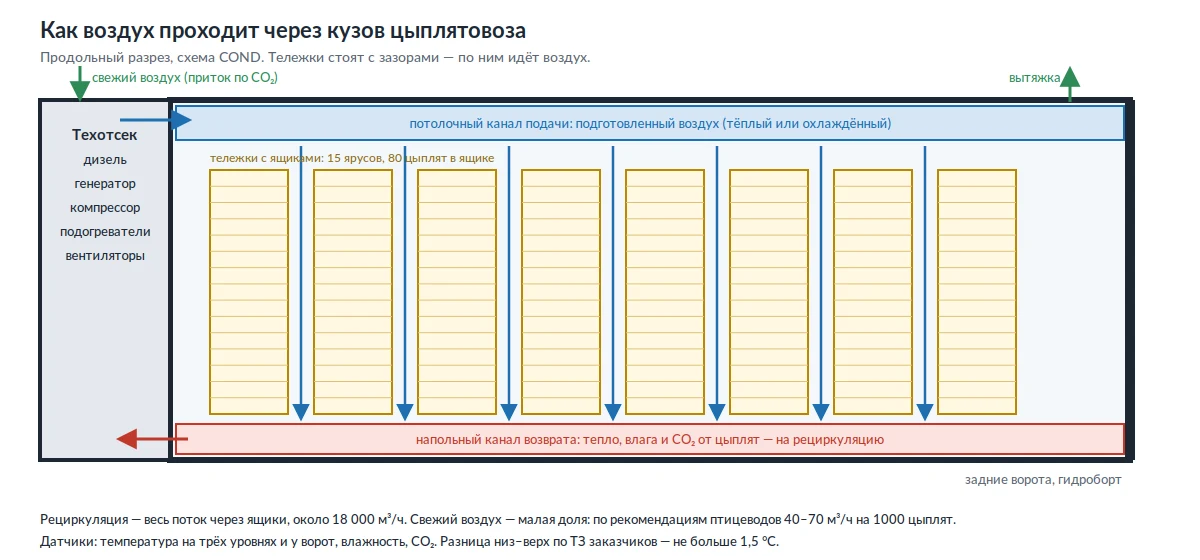
This diagram leads to body requirements that an ordinary insulated van does not have. The Dutch rule writes them straight into the regulations: boxes take up no more than half the volume of the compartment, at least 5 cm between boxes and from the floor, at least 17 cm to the ceiling, the exhaust in the roof or in the upper part of the walls.
- The gaps between trolleys are fixed. The securing system holds the trolleys not only against braking but also at a distance from each other — otherwise the air will go around the boxes. The trolleys are placed in floor guides with slots for the wheels and transverse stops.
- The ducts are demountable. The ceiling and floor air ducts open for washing and disinfection, and pocket filters sit on the return — down and dust from the chicks clog a heat exchanger within a few trips.
- The air flows evenly even with a partial load. The flow must pass through all the boxes not only in a full body but also when there are fewer trolleys. An empty space in the body is a short path for air past the chicks.
A stop at the border is the main exam
On the highway a chick truck lives easily: the engine runs, the generator gives current, the air moves. The dangerous mode is when the vehicle stands. Loading at the hatchery, waiting at the site, a queue at a border crossing. In the specification that came to us this mode is described directly: stops of 8–12 hours at +40…+50 °C and non-stop operation of up to 48 hours.
For comparison: the Turkish animal transport rules require ventilation to work for at least 4 hours without the chassis engine (art. 50). That is a norm for livestock in general. For chicks poultry people ask for twelve times more.
Hence the layout of the chick truck's power system:
- Stand-alone diesel with a generator. The climate system is powered by its own engine in a separate equipment compartment. The chassis gearbox takes no part in this. The chassis can stand with the engine off and the climate keeps working. The stand-alone diesel has its own fuel tank — poultry people ask for 150–180 litres, to survive a day in a queue.
- Triple power supply for ventilation. The fans take current from the climate generator, from the chassis alternator or from separate batteries. If one source fails, the air does not stop.
- Backup heater. Two liquid heaters — a main one and a backup. They work separately or together.
- 220/380 V inlet. At the base the vehicle runs from the mains, so the diesel need not run at night.
- Online monitoring. A GPS tracker sends temperature and alarms to the dispatcher. If power drops at a stop, it is known before the driver wakes up.
The last item concerns people. Poultry people ask for the climate settings to be locked with a password, so that the driver cannot "turn it down a bit" because the ventilation is noisy. The controller records everything — temperature by zone, fan speeds, duct pressure, alarms, generator operation — once a minute and stores it for at least 30 days. At the end of the trip a built-in printer prints a delivery protocol. Signed by the driver and the consignee, it confirms both the fact of delivery and the conditions on the road. The dispute "was it delivered fine or not" is settled by this paper.
How many chicks fit in the body
Chicks are carried in plastic boxes, and the boxes on trolleys. A typical trolley is 1,050 × 606 mm, with 30 boxes in 15 tiers. A 600 × 400 mm box holds 80 chicks. From this comes the count that poultry companies work by:
| Parameter | Value |
|---|---|
| Chicks per box | 80 |
| Boxes per trolley | 30 |
| Chicks per trolley | 2,400 |
| Trolleys in the body | 16 |
| Chicks per trip | 38,400 |
| Live weight of the cargo (about 42 g per chick) | about 1.6 t |
The floor area per chick in such a box is 30 cm². Here too the standards differ:
| Country or document | Area per day-old chick |
|---|---|
| EU Regulation No. 1/2005, Annex I, ch. VII (EU, United Kingdom, Turkey) | 21–25 cm² |
| TierSchTrV, Anlage 1 (Germany) | 25 cm² for chicken chicks; 35 cm² for goslings and turkey poults |
| OST 10 331-2003, cl. 4.6 (Russia) | at least 30 cm²; 60 cm² for turkey poults and ducklings, 75 cm² for goslings |
A box of 80 chicks falls exactly on the Russian minimum and passes the European one with a margin. The same box can also take 100 chicks — that is 24 cm², at the lower bound of the European norm. In summer on a long leg the density is reduced, because the heat from the chicks in the box grows faster than the air can take it away.
Sixteen trolleys fit in a body a little over six metres long. The internal height is 2.3–2.8 m: a trolley with boxes about two metres high plus the ceiling duct and the gap under it. The trolleys are rolled in from a 1,500 kg tail lift with stops against rolling off.
The heaviest part of a chick truck is not the chicks. The body with its thick floor, the equipment compartment with the diesel, generator and compressor, the tail lift and the trolleys weigh several times more than the live cargo. For trips of up to 2,000–2,500 km and stops at the border, poultry people choose a three-axle 6×4 chassis with air suspension: it protects both the cargo and the equipment from shaking. For short runs between the hatchery and the sites a two-axle one is enough.
Pressure washing every day
After every trip the chick truck is washed and disinfected. The Kazakhstan rules for transporting moved objects say directly that transport used for carriage is subject to mandatory disinfection (Order of the Ministry of Agriculture of the Republic of Kazakhstan No. 7-1/496, cl. 4). Practice at poultry companies is stricter than the rule: washing every day, with a 150 bar high-pressure unit, then a disinfectant — Virkon S, glutaraldehyde, quaternary ammonium compounds. Some customers ask for materials that withstand +90 °C during sanitary treatment.
A body built with the technology of an ordinary box van does not survive such a regime. Plywood soaks up water, a welded frame rusts at the seams, the sealant in the joints washes out within a season. For a chick truck the body is built of monolithic panels with a smooth fibreglass skin outside and inside, with no open frame and no cold bridges. The hinges, latches and rear frame are stainless steel. The floor has a non-slip coating and drainage channels, so that water does not stand under the trolleys. Sensors are replaced without removing panels, the air ducts are taken apart by hand.
Transport rules in Kazakhstan — and what follows from them for the body
The Kazakhstan Rules for the Transport of Animals (Order of the Ministry of Ecology, Geology and Natural Resources of the Republic of Kazakhstan No. 164 of 19 May 2022) give not a single figure — no temperature, no area, no hours on the road. They require a veterinary document for the cargo, that the animals' need for air, water and feed be met, and protection from harmful effects; poultry falls under them as a vertebrate animal. The rules for transporting moved objects add that poultry is carried in specially equipped cages with a solid bottom and air circulation (Order No. 7-1/496, cl. 11).
Since there are no figures of their own, the customer writes them into the specification — from the European regulation, the Russian OST and the breeding companies' manuals. A chick truck in Kazakhstan is calculated by foreign standards and by its own route.
For the import of chicks and for movement inside the EAEU, the Uniform Veterinary Requirements apply (Decision of the Customs Union Commission No. 317). Day-old chicks must be clinically healthy, from territories free of infectious diseases, vaccinated against Marek's disease, and hatching eggs and chicks are supplied in single-use packaging. The veterinary certificate for day-old chicks has a separate field "transport conditions (temperature, humidity)". A trip protocol with a stamp from the cab is a ready answer to that question.
For the body, the single-use packaging requirement means a practical thing: the fastening inside must take both trolleys with plastic boxes and stacks of cardboard boxes without blocking their air. Lashing rails along the walls at several heights and straps solve this.
Putting it all in one table
| Country | Document | How long to travel | Temperature | What is said about the vehicle |
|---|---|---|---|---|
| EU countries | Regulation No. 1/2005, Annex I | under 24 h, trip finished within 72 h of hatching | — | — |
| Germany | TierSchTrV, § 11 | to the consignee no later than 60 h from hatching | 25–30 °C where the animals are | — |
| Netherlands | Regeling dierenvervoer, art. 34 | — | between boxes no higher than 35 °C | ventilation from 25 m³/h per 1,000 chicks, adjustment and thermometer in the cab, gaps of 5 and 17 cm |
| Sweden | SJVFS 2019:7, ch. 6, § 31 | general limit for animals — 8 h | — | temperature control and mechanical ventilation of the compartment |
| United Kingdom | Welsh government specification for poultry vehicles | — | — | closed vehicle with climate control, at least 30 air changes per hour |
| Russia | OST 10 331-2003 | no more than 24 h from loading | air +20…+28 °C, packaging +27…+33 °C | specialised clean vehicle, CO₂ in packaging up to 1.5% |
| Turkey | animal welfare in transport rules, 2011, art. 50 | as in the EU | ventilation holds 5–30 °C | at least 4 h of ventilation without the chassis engine |
| Canada | Health of Animals Regulations, s. 152.2 | feed, water and rest within 72 h of hatching | — | — |
| USA | USPS Publication 52, s. 526.3 | dispatch within 24 h of hatching, delivery within 72 h | — | original ventilated hatchery box |
| Kazakhstan | Orders No. 164 and No. 7-1/496 | — | — | cages with a solid bottom and air circulation, disinfection of transport |
| EAEU | CU Commission Decision No. 317 | — | state in the veterinary certificate | single-use packaging on import |
The most detailed requirements for the vehicle itself are written in the Netherlands — the country that makes incubators and climate equipment for the whole world. The most general are in Kazakhstan.
A COND chick transport truck to order
We calculate a chick truck from the poultry company's specification. It has no catalogue model. The first questions are always the same: how many birds per trip, what packaging, what is the longest route and where is the longest stop. The answers give the number of trolleys, the body length, the fresh-air flow and the fuel reserve of the stand-alone diesel.
- Chassis is supplied by the customer or chosen together: three-axle 6×4 for 16 trolleys and long trips, two-axle for short ones. Before buying a chassis it is worth checking where it was imported from: the recycling fee (utilisation fee) coefficient depends on the country of import. We have long worked with long-wheelbase 6×4 — for example, an insulated van on a KAMAZ 65117 8.2 m long. The body is fixed to the frame according to the chassis manufacturer's instructions.
- Body — an insulated van of monolithic panels with a fibreglass skin, a floor insulated thicker than the walls, stainless fittings, drainage in the floor. An example of fibreglass skin — a van on a Mercedes Sprinter.
- Equipment compartment — separate, soundproofed and accessible for service: stand-alone diesel, generator, compressor, heaters.
- Climate — ceiling and floor ducts for the customer's packaging, recirculation with filters, intake by CO₂, temperature sensors by height and zone, humidity and duct pressure sensors. Components are from brands with a worldwide service network: Webasto heaters, Bock compressors, SPAL fans, Belimo damper actuators. They are serviced in any large country along the route.
- Automation — a controller in the cab with a password on the settings, a parameter archive, printing of the delivery protocol, an online tracker with alarm signals.
- Loading — a tail lift for 1,500 kg with stops for the trolleys, rails and straps for single-use packaging.
- Documents — the body builder's documents for registering the vehicle and entries in the registration certificate. Body warranty — 2 years.
Cold for poultry meat is a different task and a different body: how chilled chicken and meat are carried we covered separately, as well as the cold chain as a whole.
If you have a specification, send it. If not, give the number of birds, the packaging and the longest route. We will calculate the trolleys, the air and the chassis and offer a chick truck for your trip. Apply through the form on the site or WhatsApp.
A chick will survive three days without feed. It will not survive ten minutes without air.
FAQ
How to transport day-old chicks over a long distance? In a special vehicle with climate control: the chicks sit in boxes with holes on trolleys, air passes through every box, the boxes hold 30–35 °C, the body 20–28 °C. The climate system is powered by its own diesel, so that it works at stops. No feeding or watering is needed on the road.
At what temperature should day-old chicks be transported? In the box, next to the chicks, 30–35 °C. The air in the body is held at 20–28 °C at 50–75% humidity, because the chicks themselves heat their boxes by 6–12 degrees. You must not set +32 °C in the body — the chicks will overheat.
How many hours can day-old chicks be carried without feed and water? In the EU, under 24 hours on the road, if the trip is finished within 72 hours after hatching. In Germany the chicks must be at the consignee no later than 60 hours after hatching, in Russia under OST 10 331-2003 no more than 24 hours from loading. Aviagen trials show that trips of 60–72 hours do not raise mortality if the temperature in the boxes is right.
Do chicks need to be fed and watered on the road? No. A day-old chick lives on its yolk reserve. The vehicle's task is not to let it spend this reserve fighting heat or cold.
What are the animal transport rules in Kazakhstan? The animal transport rules were approved by Order of the Ministry of Ecology, Geology and Natural Resources of the Republic of Kazakhstan No. 164 of 19 May 2022: a veterinary document is needed, animals are provided with air, water and feed, the transport protects them from injury and harmful effects. There are no figures on temperature and time for chicks in them. After carriage the transport is subject to mandatory disinfection under Order of the Ministry of Agriculture of the Republic of Kazakhstan No. 7-1/496.
How many chicks fit in one box? A standard 600 × 400 mm box usually holds 80 chicks — that is 30 cm² per head. The European norm is 21–25 cm², the Russian OST at least 30 cm². In heat on long trips the density is reduced.
How many chicks does one chick transport truck carry? A typical body with 16 trolleys of 30 boxes carries 38,400 chicks. Semi-trailer vehicles take more than 100 thousand.
How were chicks carried before? By post: in the USA the postal service has accepted day-old chicks since 1918, in hatchery boxes with holes. Later, in insulated vans with heating and air purging, without cooling. Climate-controlled chick trucks with air conditioning, sensors and stand-alone power became the norm in recent decades.
How does transporting hatching eggs differ from transporting chicks? Eggs are carried cool, at +8…+25 °C, and protected from impact and condensation on the shell (OST 10 331-2003, cl. 3.11). Chicks are carried warm: +27…+33 °C in the boxes, +20…+28 °C in the body, with an airflow through every box and no longer than 24 hours from loading (cl. 4.12, 4.13). The same body takes about twice as many eggs as chicks.
How does a chick transport truck differ from a refrigerated truck? A refrigerated truck holds a cold, passive cargo. A chick truck holds a narrow temperature range for a cargo that itself gives off heat, moisture and CO₂, and pushes air through every box. It has heating, cooling, fresh-air intake and power reserve, and the body is designed for daily pressure washing.
Where to buy a chick transport truck in Kazakhstan? Ready-made chick trucks are usually not in stock: the vehicle is calculated for the number of birds, the packaging and the route of the poultry company. COND (Almaty) makes chick transport trucks to order in Kazakhstan — on the customer's chassis or on a chassis selected together.
How much does a chick transport truck cost? The price is made up of the chassis, the insulated body, the climate complex with stand-alone power, the tail lift and the trolleys. The body and climate are calculated for the number of birds, the packaging and the longest stop on the route, so the calculation is made from the poultry company's specification.
What recycling fee (utilisation fee) is paid for a chick transport truck in Kazakhstan? The recycling fee is paid once, before the first registration: 50 MCI (monthly calculation index) multiplied by the coefficient from the Methodology for Calculating the Recycling Payment (Order of the Ministry of Ecology of the Republic of Kazakhstan No. 54 of 20.03.2026). For trucks of Kazakhstan assembly and those imported not from Russia and Belarus, the coefficient depends on the gross weight: 10.5 for 12–20 t and 20.5 for 20–50 t. For trucks imported from Russia and Belarus the coefficient is 164 at any weight from 2.5 t. The methodology names no separate payment for a van mounted on the chassis.
Source legislation
Full texts in the official Kazakh legal database Adilet:
- Order of the Minister of Ecology, Geology and Natural Resources of the Republic of Kazakhstan of 19.05.2022 No. 164 "On approval of the Rules for the Transport of Animals": https://adilet.zan.kz/rus/docs/V2200028139
- Order of the Acting Minister of Agriculture of the Republic of Kazakhstan of 29.05.2015 No. 7-1/496 "Rules for transporting moved (carried) objects": https://adilet.zan.kz/rus/docs/V1500011845
- Order of the Minister of Ecology and Natural Resources of the Republic of Kazakhstan of 20.03.2026 No. 54 on amendments to the Methodology for Calculating the Recycling Payment: https://adilet.zan.kz/rus/docs/V2600038306
- Methodology for Calculating the Recycling Payment (order of 02.11.2021 No. 448): https://adilet.zan.kz/rus/docs/V2100025100