
Types of Motorhomes and Campers: Which RV to Choose in Kazakhstan
Published:
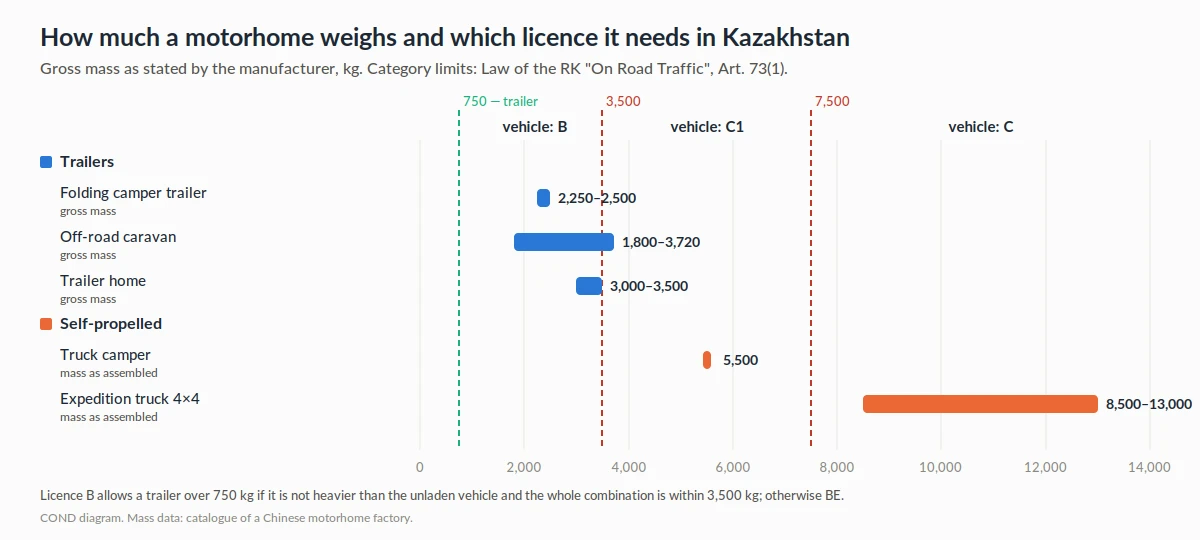
In brief. Motorhomes fall into two families: self-propelled (camper van, over-cab (alcove) motorhome, semi-integrated (low-profile) motorhome, integrated (A-class) motorhome, truck camper / slide-on on a pickup, expedition truck on a 4×4 chassis) and towed (teardrop trailer, folding camper trailer, caravan (travel trailer), off-road caravan, trailer home). In Kazakhstan the type is chosen first of all by driving licence category: with category B a person may drive a vehicle of up to 3,500 kg and tow a trailer under the conditions of Article 73 of the Law "On Road Traffic", and most camper trailers weigh more than 750 kg. COND builds living modules (mobile crew cabins) and KUNG box bodies on truck chassis to order in Kazakhstan.
— I left the upper tank in place. With the first frosts it burst. — camper van owner, motorists' forum, winter 2023
On 25 April 2026, the first official motorhome campsite in Kazakhstan opened in the Zhetysu park in Astana: water, toilets and electricity, free for the first year. The opening coincided with a rally of caravaners. A family from Almaty arrived with three children: they have changed six motorhomes and consider the over-cab model the most convenient. Another couple started with a travel trailer and then bought an integrated motorhome. All these vehicles are called by the same name, "home on wheels". They differ in design and weight, and they require different licence categories.
Below: what types of motorhomes and campers exist, how much they weigh and which licence they need in Kazakhstan, how an over-cab motorhome differs from an integrated one, why a caravan almost never fits within 750 kg, how a home on wheels handles a Kazakhstan winter, and where to park it.
Quote is based on body, chassis and temperature range.
Self-propelled or towed: two families
A motorhome is a self-propelled vehicle with a living space. The European Regulation 2018/858 (Annex I, Part A, item 5.1) classes it as a special-purpose vehicle of category M, the "motor caravan", and requires a minimum: seats and a table, sleeping places, a kitchen and storage space, all fixed in the body.
Camper in Russian is a word without a strict boundary. It is used for a motorhome, a trailer and a pickup module alike. In search suggestions "camper" most often means a trailer.
A towed home on wheels is a caravan, travel trailer or folding camper trailer: it has no engine of its own and is towed by a passenger car or a pickup.
| Type | Built on | Sleeping places | Licence in Kazakhstan | Suits |
|---|---|---|---|---|
| Camper van (Kastenwagen) | all-metal van | 2–4 | usually B | a couple, city use, long asphalt roads |
| Over-cab (alcove) motorhome | cab chassis, bed over the cab | 4–7 | B or C1, depending on gross weight | a family with children |
| Semi-integrated (low-profile) motorhome | cab chassis, body butted against the cab | 2–4 | B or C1 | a couple that wants more space |
| Integrated (A-class) motorhome | chassis without cab, one common body | up to 6–8 | B, C1 or C, depending on gross weight | long journeys, living in the vehicle |
| Truck camper / slide-on | removable module in a pickup bed | 2–4 | by the weight of the pickup with the module | anglers, hunters, dirt roads |
| Expedition truck 4×4 (KUNG) | heavy-duty off-road truck chassis | 2–5 | C1 or C | off-road, the Arctic, desert, winter |
| Teardrop trailer | light single-axle trailer | 2 | B | weekends, two people |
| Folding camper trailer | unfolds at the stop | 4–6 | B or BE | a family, campsites, poor roads |
| Caravan (travel trailer) | single- or twin-axle trailer | 2–6 | B or BE | a holiday in one place |
| Off-road caravan | reinforced trailer with independent suspension | 2–5 | usually BE | dirt tracks and mountains |
| Trailer home | 6–9 m trailer house | 4–6 | BE | a country plot, a base camp, seasonal work |
What these types are called in other countries
In foreign listings and catalogues the same motorhome has different names. Americans divide self-propelled homes into classes A, B and C; Europeans divide them by how the body joins the cab.
| Type | USA | UK | Germany | France | Japan |
|---|---|---|---|---|---|
| Camper van | Class B, camper van | campervan, panel van conversion | Kastenwagen, Campingbus | fourgon aménagé | バンコン (ban-kon) |
| Over-cab (alcove) | Class C | overcab coachbuilt | Alkoven | capucine | キャブコン (kyab-kon) |
| Semi-integrated | — | low-profile coachbuilt | Teilintegriert | profilé | — |
| Integrated | Class A | A-class | Integriert, Liner | intégral | フルコン (furu-kon) |
| Pickup module | truck camper | — | Wohnkabine | — | トラックキャンパー (torakku-kyampa) |
| Caravan (travel trailer) | travel trailer | caravan | Wohnwagen | caravane | キャンピングトレーラー |
Australia has its own set: classic and off-road caravan, pop-top (with a raised roof), camper trailer (folding), slide-on (a pickup module) and fifth wheeler. Japan has a separate niche: campers built on a kei car, a Japanese micro truck or micro van (軽キャンピングカー). Integrated motorhomes are no longer made there: according to a Japanese camper magazine, there is no domestic chassis for them. According to the Japan RV Association (JRVA), 13,435 campers were sold in the country in 2025, and 57% of them were van-based campers (バンコン).
Self-propelled: from camper van to expedition truck
Camper van and Kastenwagen
A camper van is an ordinary all-metal van with a kitchen, a bed and cabinets built inside. From outside it is hard to tell apart from a service minibus. The word "Kastenwagen" comes from German and means a closed panel van.
According to the manufacturer, a van-based motorhome of this type, 5.9 m long and 3 m high, carries two people and holds 120 litres of water. Its advantage is the footprint of a passenger-car parking space and a category B licence. The drawback is the tight space. German magazines divide such vehicles into two kinds. A camping bus under 2 m high fits into an underground car park, but it rarely has a bathroom. A Kastenwagen 5.4 m or longer, more often about 6 m, already holds a full bathroom with a washbasin, toilet and shower.
Over-cab (alcove) motorhome: what it is
An over-cab motorhome is built on a cab chassis, and the living body is set so that it overhangs the cab. The sleeping place is in this projection, the "alcove". Hence the capacity: an alcove with one bed over the cab and a second bed at the back of the body takes a family of four to six.
The over-cab type has the most truck-like silhouette. Above the cab it is taller, its wind load is greater, and its weight often exceeds 3.5 t, in which case the driver needs category C1.
The German automobile club ADAC gives figures. An over-cab motorhome is usually taller than 3.30 m, other types are up to 2.80 m. This is a guide: at Spanish and Italian dealers over-cab models are 3.0–3.2 m and integrated ones 2.95–3.20 m, so the height is checked against the documents of the specific model. Its fuel consumption is 2–3 litres per 100 km higher than that of a motorhome without an alcove. The alcove itself has a height of at least 70 cm, preferably 78 cm. The bed in it is at least 2 m long and about 1.5 m wide. A height of 3.3 m is also a route question: such a motorhome will not pass under low bridges, into car parks or under filling-station canopies.
Semi-integrated and integrated
A semi-integrated motorhome keeps the factory cab, and the living body is attached behind it with no alcove. It is lower and more streamlined than the over-cab type, but has fewer sleeping places. In Denmark, according to the Danish camping union DCU, it is the best-selling type.
The difference in size shows in the figures of the German magazine promobil. A camper van with a bathroom is 5.4–7 m long and 1.95–2.05 m wide. A semi-integrated motorhome is from 6 m long, 2.25–2.35 m wide, and weighs from 3,300 kg. Fuel consumption by Italian data: camper van 8–10 l per 100 km, semi-integrated 11–14 l. A drop-down bed over the living area adds two more sleeping places and 70–100 kg of weight to a semi-integrated motorhome.
An integrated motorhome is built on a chassis without a cab: the coachbuilder makes one common body from the windscreen to the rear wall. The driver sits in the same "room" as the sofa and the kitchen. Americans call such vehicles class A; the biggest of them are built on a bus chassis and weigh more than 10 t.
Truck camper / slide-on
A truck camper is a removable living module placed in the cargo bed of a pickup. The pickup remains a pickup: the module is lowered on its legs and the driver continues without it. In Kazakhstan search suggestions this type is searched as "camper for a pickup in Kazakhstan", "camper for L200", "living module for UAZ Pickup".
The main limit is the payload of the pickup. A module with water, gas and belongings easily uses all of it. For a large American pickup with a 6 m module, the assembled weight reaches, according to the manufacturer, 5.5 t, which is already category C1.
The American magazine RV Life gives the dry weights of modules: from 0.93 t for a 4.7 m module for three people to 1.96 t for a 6.2 m module for 5–6 people. A 5.4 m module for five people needs a "three-quarter-ton" class pickup (F-250/2500) or heavier. Japanese rules treat the module as cargo: a pickup with it remains a truck. European manufacturers make lighter modules: a capsule for a double-cab pickup weighs 400–500 kg and comes off in about 30 minutes.
Expedition vehicle and 4×4 KUNG
An expedition motorhome is a living body-container on a heavy-duty off-road truck chassis. In Soviet vehicles such a body was called a KUNG (a Soviet box body on a truck chassis): the KUNG-1MM was fitted on the ZIL-131 and the KUNG-2M on the GAZ-66. They housed workshops, communication rooms and laboratories.
A modern expedition module 6 m long on a 4×4 chassis weighs, according to the manufacturer, 8.5 to 13 t assembled and holds 4–5 people. This is category C. The walls of such bodies are thicker than those of caravans: expedition modules are made of sandwich panels 50–60 mm thick and more, while European caravans, by automobile club tests, have 30–34 mm.
On Russian and Kazakhstan roads this type grew out of vakhtovkas (crew buses) and living modules (mobile crew cabins) on KAMAZ and Ural chassis. A vakhtovka is a bus for carrying a shift of workers; a living module (wagon-dom) is a body in which people live, with sleeping places, a kitchen, heating and a bathroom.
Towed: from teardrop to trailer home
Teardrop trailer
The lightest type: a single-axle trailer shaped like a drop, with a bed inside and a kitchen under the rear hatch. It is designed for two people and an overnight stay. Teardrops can be light enough to fit within 750 kg, the only type of trailer that a category B holder tows without conditions.
Folding camper trailer
On the road a folding camper trailer is a low box; at the stop it is a tent with beds, a kitchen and an awning. There are versions with a bed that slides out forward and with a double fold to both sides. According to the manufacturer, such trailers weigh 1,600–1,660 kg, the permitted maximum mass is 2,250–2,500 kg, the height in travel position is 1.6–1.7 m, with 4–6 sleeping places and 170–200 l of water.
The low profile is the main advantage: the trailer does not catch the wind, passes under barriers and uses less fuel in the towing vehicle. The price is the canvas: unfolding it, drying the fabric after rain, and cold in the shoulder seasons.
Caravan (travel trailer)
A caravan is a rigid living trailer on one or two axles. In Kazakhstan it is searched as "trailer dacha" (прицеп дача) and "trailer dacha 750 kg". The latter query is understandable: with a category B licence people want to tow such a trailer without extra conditions. But a light caravan is rare. In the catalogue of a Chinese factory that makes trailers for Australia, the lightest rigid caravan weighs 1,345 kg empty, and the gross mass of the trailers ranges from 1,800 to 3,720 kg.
Sellers distinguish a caravan (trailer dacha) from a camper trailer as follows. A camper trailer has the kitchen outside under the rear hatch, the bathroom in a separate tent, a weight within 750 kg, and category B is enough. A caravan has a shower and toilet inside, space for 4–6 people, and almost always needs category BE.
Off-road caravan
An Australian type of trailer for dirt roads: reinforced frame, independent suspension, large wheels, water tanks, outside kitchen. Gravel roads to Charyn are no problem for such trailers. According to the manufacturer, their weight is 1,345–2,890 kg, gross mass 1,800–3,720 kg, water 120–240 l, tow-ball load 105–305 kg, wheels R15–R16.
The tow-ball load deserves separate attention. The tow bar of a passenger car is rated for a certain vertical load, and a trailer with a 300 kg load can exceed it before it exceeds the towed mass.
Fifth-wheel and trailer with a garage
A fifth-wheel is an American type: the trailer couples to a fifth-wheel hitch in the bed of a pickup, and its front part with the bed overhangs the pickup bed. A trailer with a garage (American toy hauler) is a caravan with a rear ramp and a compartment for an ATV or motorcycle. Both types are large and heavy, and are almost never seen in Kazakhstan.
Trailer home
The most "homelike" option is a trailer house 6.5–9 m long with a full kitchen, shower and bedroom. According to the manufacturer, such trailers weigh 2,440–2,880 kg, gross mass 3,000–3,500 kg, water 150–200 l, sleeping places 4–6. This is no longer a vehicle for travel: such a home is placed for a season at a recreation base, by a lake or on a plot of land.
Which licence is needed for a motorhome in Kazakhstan
Licence categories in Kazakhstan are set by Article 73(1) of the Law of the Republic of Kazakhstan "On Road Traffic" No. 194-V:
- B: a vehicle with a permitted maximum mass of up to 3,500 kg and no more than eight passenger seats. With a trailer of up to 750 kg, without conditions. With a trailer heavier than 750 kg, only if the permitted mass of the trailer is not greater than the unladen mass of the vehicle and the whole combination is not heavier than 3,500 kg.
- BE: a category B vehicle with a trailer heavier than 750 kg, if the trailer is heavier than the unladen vehicle or the combination is heavier than 3,500 kg.
- C1: a vehicle from 3,500 to 7,500 kg; with a trailer of up to 750 kg.
- C: a vehicle heavier than 3,500 kg; with a trailer of up to 750 kg.
What follows in practice:
- A camper van and a light semi-integrated motorhome up to 3.5 t: category B.
- An over-cab motorhome, an integrated motorhome, a pickup with a heavy module: check the permitted maximum mass in the vehicle registration certificate; above 3,500 kg C1 is needed.
- An expedition KUNG on a 4×4 truck: C.
- Caravan (trailer dacha). An SUV with an unladen mass of 2,000 kg and a trailer with a gross mass of 1,800 kg make a combination of 3,800 kg, which is already BE, although the trailer is lighter than the vehicle. With category B such a trailer can be towed only behind a light towing vehicle and only if the sum of the permitted masses does not exceed 3,500 kg.
How much can be loaded into a 3.5 t motorhome. Not much. In British calculations the payload of a motorhome with a permitted mass of 3,500 kg is 350–500 kg. This includes people, water, gas, food and belongings. A family of four and a full 100 l water tank use it almost entirely. The reason lies in how the mass in running order is counted: it includes the driver at a standard 75 kg, a fuel tank filled to 90%, usually one gas cylinder, and water in "travel position", 20 l or less. A passenger, a second gas bottle, a full water tank and belongings already count against the payload. The permitted maximum mass from the registration certificate is what gets checked, and the weighbridge figure on the day of purchase does not replace it.
How it is in Europe. The boundary is the same there: 3,500 kg for category B. Germany has an intermediate mark, B96: a combination of up to 4,250 kg after one day of training without an exam. EU Directive 2025/2205 on driving licences (of 22.10.2025; countries adopt their own rules until 26.11.2028 and apply them from 26.11.2029) allows countries to admit category B drivers to motorhomes of up to 4,250 kg, and with a trailer up to 5,000 kg, after training, an exam or both. Countries introduce this rule into their legislation during a transition period. Until it exists, a motorhome of 3,501–4,250 kg requires C1. The directive does not apply to Kazakhstan licences. In the United Kingdom the trailer rules are milder: a driver who received a category B licence after 1 January 1997 may tow a trailer with a permitted mass of up to 3,500 kg if the total mass of the combination is not more than 7,000 kg.
What makes a van a motorhome by law
Kazakhstan and the other EAEU countries have no separate "motorhome" category. The technical regulation TR CU 018/2011 knows "special" and "specialized" vehicles, and the conversion of a vehicle in service is carried out under its own procedures. For the owner this means one thing: a van in which beds, a kitchen and heating have been installed must be registered as converted, with a mark in the registration certificate. Otherwise there will be questions at the technical inspection and at sale.
The Ministry of Internal Affairs of Kazakhstan explained the procedure in more detail in November 2026. A finished motorhome is registered in the general order, like any motor vehicle: there is no separate procedure for motorhomes, and the category is determined by the type approval or the certificate of design safety under TR CU 018/2011. If a motorhome was made from an ordinary vehicle, this is a change of design. It is agreed in advance with the administrative police unit, in person or through eGov, and the changes themselves must comply with TR CU 018/2011 and the national standard ST RK 1418-2018.
In Europe, by contrast, the motorhome is a separate category SA with a list of mandatory equipment (Reg. 2018/858, Annex I, Part A, item 5.1). The living part of motorhomes and caravans is checked against the European standards EN 1646-1 and EN 1645-1. In the USA the requirements for gas, electrics and fire safety of the living part are set by the standard NFPA 1192. In China the official name of a motorhome is 旅居车, "tourist vehicle". Self-propelled ones are divided into classes A, B and C, towed ones into types A–D, and a removable pickup module counts there as towed type D, because it has no wheels of its own. A self-propelled home shorter than 6 m and with no more than 9 seats is driven with a C1 licence; a towed one needs category C6. In 2025 China issued a national standard for safety signs for motorhomes, to be introduced in 2026, and from 1 October 2026 the standard GB/T 47248-2026 on the safety chain for trailers of up to 3.5 t is in force. In the first half of 2026, 12,153 self-propelled homes were registered there, 43.7% of them camper vans.
Winter: what changes by type
The Kazakhstan winter tests a home on wheels harder than the road does. Owners write about the same problems:
- Water. A tank and pipes outside the body freeze first. "With the first frosts it burst," writes a camper van owner about the upper tank. For winter the tank and pipes are moved into the warm zone under the floor of the living compartment.
- Gas. A 4 kW gas heater, by owners' experience, uses a 20-litre cylinder in about three nights, and the cylinder itself loses pressure in frost. For winter a diesel heater fed from the vehicle tank is chosen.
- Insulation. A European caravan with 30–34 mm walls is designed for the shoulder seasons. For −30…−40 °C the walls and floor are made thicker and thermal bridges in the frame are removed. An integrated motorhome is insulated as a whole, together with the cab, so it is more comfortable in winter than a semi-integrated one.
- Windows. A Japanese manufacturer of campers for snowy regions replaces the factory glass with double acrylic windows and adds insulation to the living part.
- Heater. In a Russian motorhome service, one of the most frequent jobs is installing a diesel heater: the gas in a cylinder can run out in the middle of a winter stop.
- Canvas. A folding camper trailer is a tent in winter. Its season is May to September.
The heavier and thicker the body, the easier the winter. For this reason, for year-round living in the vehicle in Kazakhstan, people choose KUNGs and living modules on a truck chassis, and for a summer holiday, trailers and camper vans.
Where to park a motorhome in Kazakhstan
Campsites with water and electricity are still few in Kazakhstan, and this is the main complaint of caravaners. What exists:
- Astana. Since 25 April 2026, a motorhome campsite in the Zhetysu park: only for motorhomes, with water, toilets and electricity; tents, campfires and barbecues are prohibited there.
- Atyrau–Astrakhan road. At the 765th and 889th kilometres there are sites where a motorhome can empty and refill water.
- Charyn and Kolsai. By a resolution of the akimat of Almaty Region, protection zones have been introduced around them from 20 September 2026; the resolution has no separate rules for overnight stays of motorhomes, so the rules are checked on site with the park administration.
Can one sleep in a motorhome. According to the explanation of the Ministry of Internal Affairs of Kazakhstan, the law does not prohibit sleeping in a car or motorhome parked in a permitted place, including a paid car park or a campsite, and the duration does not matter. The offence is the parking itself in the wrong place: on a pavement, lawn, flower bed, children's or sports ground (Article 597 of the Code of Administrative Offences). Outside settlements a motorhome is parked, where possible, off the carriageway. Registering in a motorhome as a place of residence is not possible.
For stand-alone parking, homes on wheels are planned with water, electricity and heating for 2–3 days without a hook-up.
How homes on wheels appeared
- 1885, England. The doctor and writer Gordon Stables ordered the "Wanderer", a wooden van about 5.5 m long with a kitchen and a washbasin, drawn by a horse. He travelled more than 2,000 km in it.
- 1931, USA. Wally Byam began serial production of living trailers; the American caravan dates from them.
- 1951, Germany. A coachbuilder from Wiedenbrück made a removable set with a bed and a table for a minibus, and the camper van appeared.
- 1958, Riga. The RAF-04 trailer for four people, weighing 950 kg, without electricity, lit by a kerosene lamp. It did not go into series production: the Pobeda towed it with difficulty.
- 1970s, USSR. The folding trailer "Skif", weighing 230–260 kg, with a 6 m² tent, cost about a third of the price of a Zaporozhets.
- 1950s–80s, USSR. KUNGs on the ZIL-131 and GAZ-66 and vakhtovkas on the Ural carried geologists and shift workers; today's expedition module grew out of them.
How to choose a home on wheels
Five questions before buying:
- Which licence. B, BE, C1 or C is the first limit, and it decides which types are available at all.
- How many people sleep. Two: camper van, teardrop, pickup module. A family: over-cab, folding camper trailer, caravan.
- Which roads. Asphalt: any type. Dirt and mountains: off-road caravan, pickup, 4×4 KUNG.
- Which seasons. Summer only: canvas and thin walls. All year: thick walls, a diesel heater, water in the warm zone.
- Is the vehicle needed separately. A trailer and a removable module leave the towing vehicle free; a motorhome does not.
A living module and a KUNG from COND to order
COND makes bodies on truck chassis in Almaty, and the homes on wheels in this line are living modules and KUNGs. They are made to order:
- Living module (wagon-dom) on KAMAZ, Ural and other chassis, with sleeping places, a kitchen, heating and a bathroom: 6-berth living module, module with six sleeping places for a crew.
- Vakhtovkas (crew buses) and passenger modules, in the section on crew buses.
- A body of sandwich panels on a steel frame for KAMAZ and other truck chassis, with insulation for the Kazakhstan winter.
- Documents from the body manufacturer for registration and for the mark in the registration certificate. Warranty on the body is 2 years.
The chassis is selected to order or the customer's own chassis is used. The recycling fee depends on where the chassis was imported from, which is worth checking before purchase.
Write to us with the chassis, the number of people the home on wheels is needed for, where it will work and in which season. We will calculate the body, insulation and heating and propose a module for your route. Send a request through the form on the site or by WhatsApp.
A home on wheels is chosen twice: in the showroom, by the layout; at the first frosty stop, by the water in the tank.
FAQ
What types of RVs and homes on wheels are there? Self-propelled: camper van, over-cab (alcove), semi-integrated and integrated motorhome, truck camper on a pickup, and expedition truck on a 4×4 chassis. Towed: teardrop trailer, folding camper trailer, caravan (travel trailer), off-road caravan, fifth-wheel and trailer home.
What is an over-cab (alcove) motorhome? A motorhome on a cab chassis whose living body overhangs the cab, with a sleeping place in this projection, the alcove. It is the roomiest type for a family: usually 4–6 sleeping places, up to 7 in some models.
Which licence is needed for a motorhome in Kazakhstan? Under Article 73 of the Law of the Republic of Kazakhstan "On Road Traffic": a motorhome with a permitted maximum mass of up to 3,500 kg is category B, from 3,500 to 7,500 kg C1, heavier C. The mass is checked in the registration certificate.
What are class A, class B and class C motorhomes? This is the American classification. Class A is an integrated motorhome with one body on a chassis without a cab, 8–14 m long. Class B is a camper van in an all-metal van, 5.5–7.3 m, up to 4 people. Class C is an over-cab motorhome on a cab chassis with a sleeping place above it. Fuel consumption of class A is usually 8–10 miles per gallon, about 24–29 l per 100 km (Canadian RV association CRVA).
How much can be loaded into a 3.5 t motorhome? Usually 350–500 kg, including people, water, gas and belongings. A family of four with a full water tank therefore almost always reaches the 3,500 kg limit.
How high is an over-cab motorhome? According to ADAC, from 3.30 m, while semi-integrated and integrated ones are usually not higher than 2.80 m. The over-cab model uses 2–3 l per 100 km more fuel.
Can a 4.25 t motorhome be driven on a category B licence? In Kazakhstan, no: above 3,500 kg C1 is needed. In the EU, Directive 2025/2205 allows countries to admit category B drivers to motorhomes of up to 4,250 kg after training or an exam; the rule is being introduced gradually.
Can a caravan (trailer dacha) be towed with a category B licence? Yes, if the trailer weighs up to 750 kg. A heavier one only if its permitted mass is not greater than the unladen mass of the vehicle and the whole combination is not heavier than 3,500 kg; in other cases category BE is needed.
Can one live and sleep in a motorhome in Kazakhstan? Sleeping is allowed: the Ministry of Internal Affairs explains that the law does not prohibit sleeping in a motorhome parked in a permitted place, and the duration is not limited. Parking on pavements, lawns, flower beds, children's and sports grounds is prohibited (Article 597 of the Code of Administrative Offences). Registering in a motorhome as a place of residence is not possible.
Does the conversion of a vehicle into a motorhome need approval? Yes. Converting an ordinary vehicle into a motorhome is a change of design: it is agreed in advance with the administrative police (in person or through eGov), and the changes must comply with TR CU 018/2011 and ST RK 1418-2018. A finished motorhome with type approval is registered in the general order.
Is there a caravan (trailer dacha) of up to 750 kg? A caravan with a shower and toilet inside, almost never: rigid caravans and folding camper trailers with a kitchen and water usually weigh 1.3–2.9 t empty. Teardrop trailers and light rigid camper trailers fit within 750 kg: their kitchen is outside under the rear hatch, and the bathroom is moved into a tent. Manufacturers of such camper trailers state a weight from 480–620 kg. There are exceptions: a European manufacturer has a caravan for four sleeping places with a bio-toilet and shower, weighing 712 kg, with a permitted mass of 750 kg.
What is the difference between a camper and a motorhome? A motorhome is a self-propelled vehicle with a living space. "Camper" is used for a motorhome, a trailer and a pickup module; in Kazakhstan search queries "camper" most often means a trailer.
Campervan vs motorhome, or camper trailer vs caravan: what to choose, a motorhome or a trailer? A trailer is cheaper and leaves the car free at the holiday site, but it requires towing skills and often category BE. A motorhome is more convenient on the road and at short stops, but costs more and ties the vehicle to the home.
Can one live in a motorhome in winter in Kazakhstan? Yes, in a body designed for winter: with thick walls and floor, a diesel heater and water in the warm zone. Folding camper trailers and light caravans are designed for the warm season.
Where are the motorhome parking sites in Kazakhstan? Since 25 April 2026, a motorhome campsite has operated in the Zhetysu park in Astana; on the Atyrau–Astrakhan road there are sites for emptying and refilling water at the 765th and 889th kilometres. Campsites with water and electricity are still few in the country.
Where to buy a motorhome or a living module in Kazakhstan? Ready motorhomes and trailers are sold by private sellers and dealers on classified sites. A living module or a KUNG (expedition truck) on a truck chassis to order in Kazakhstan is made by COND (Almaty).
Source legislation
Full texts in the official Kazakh legal database Adilet:
- Law of the Republic of Kazakhstan of 17.04.2014 No. 194-V "On Road Traffic", Article 73(1): https://adilet.zan.kz/rus/docs/Z1400000194