
Horse Truck and Horse Trailer: Sizes, Regulations, Floor, Ramp and Ventilation
Published:
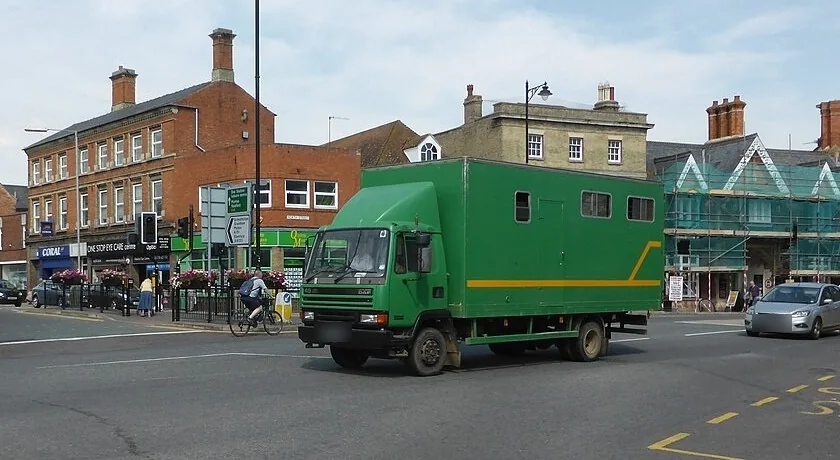
In brief. A horse truck (in the UK, a horsebox) is a body on a truck or van chassis in which each horse travels in its own stall. A horse trailer carries 1–2 horses and is towed by a car or pickup. Choose by the horse: under the European standard an adult horse needs 1.75 m² of floor, and the ceiling of the compartment must be 75 cm above its withers. After that come the floor, the ramp, the air and the payload reserve. The floor and the ramp fail unnoticed, and the injuries that follow are serious. A 3.5 t horse truck holds two horses only if they are light or if there is no mass reserve. And in Kazakhstan the licence category depends on the permitted mass of the whole combination.
Quote is based on body, chassis and temperature range.
Horse Truck and Horse Trailer: Truck or Trailer
A horse truck is usually a vehicle: the body for horses sits on a truck frame or on a large van base. A horse trailer is usually a trailer for one or two horses.
A trailer and a truck have different strengths.
| Horse trailer | Horse truck | |
|---|---|---|
| How many horses | 1–2 | 2 on a van base and on a 7.2 t chassis; 3–4 on a 7.5–12 t chassis; up to 12 on a three-axle 26 t chassis |
| What tows it | a car with enough towing capacity | its own engine |
| Licence in Kazakhstan | B — a trailer up to 750 kg, or a heavier one that is not heavier than the unladen car, with a combination up to 3,500 kg; otherwise BE | B — up to 3,500 kg; C1 — 3,500–7,500 kg; C — over 3,500 kg |
| Tack room, living area | a small tack room or none | from a tack room to a kitchen and sleeping places |
| Where it wins | rare trips of 50–200 km, one horse, cheap storage | frequent trips, 2+ horses, long journeys, multi-day events |
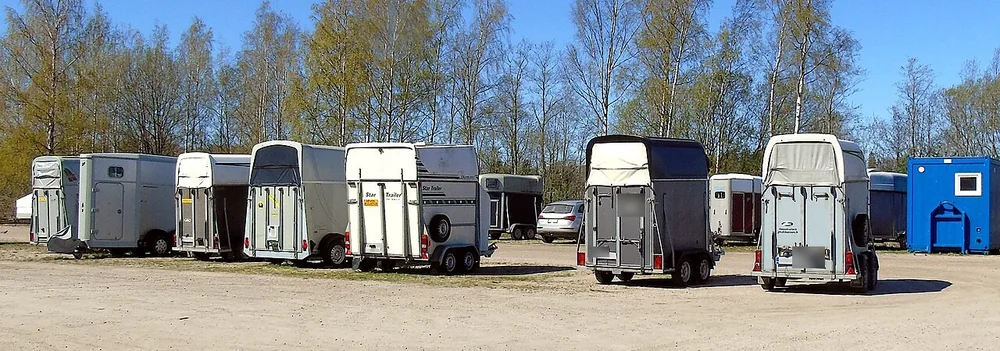
A vehicle for transporting horses and a trailer solve the same task in different ways. A trailer suits those who take a horse out once a month to a nearby show or to the vet. A horse truck for three or more horses is chosen by stables and riders who travel every weekend, carry several horses and stay overnight at competitions.
Kazakhstan has many horses. According to figures cited by Azattyq Rýhy with reference to the FAO, in 2024 the country kept 4.4 million head and ranked fourth in the world after Mexico, Brazil and Mongolia. The Bureau of National Statistics notes herd growth of 13% as of 1 January 2025 and a further 6.7% as of 1 January 2026. By the end of 2025, according to the same data, there were already about 4.6 million head. The horses of riding clubs, kokpar and racing travel to competitions, and they need transport.
How Much Space a Horse Needs: Stall and Height
The European standard gives an adult horse transported by road 1.75 m² of floor — a stall of 0.7 × 2.5 m. This is set out in Council Regulation (EC) No 1/2005 on the protection of animals during transport (Annex I, Chapter VII, Section A). The standard is written for commercial transport in the EU. It is not mandatory in Kazakhstan, but it shows what margin of space manufacturers accept. For other horses the same regulation gives:
| Horse | Area per head | Stall |
|---|---|---|
| Adult | 1.75 m² | 0.7 × 2.5 m |
| Young horse 6–24 months, journey up to 48 h | 1.2 m² | 0.6 × 2.0 m |
| Young horse 6–24 months, journey over 48 h | 2.4 m² | 1.2 × 2.0 m |
| Pony up to 144 cm | 1.0 m² | 0.6 × 1.8 m |
| Foal up to 6 months | 1.4 m² | 1.0 × 1.4 m |
The regulation allows a deviation from these figures of no more than 10% for adult horses and ponies and 20% for young horses and foals. Foals and young horses on a long journey must be able to lie down.
Height matters more than it seems. The regulation requires the internal height of the compartment to be at least 75 cm more than the height at the withers of the tallest horse (Chapter III, point 2.3). A horse raises its head when it is frightened or when it is catching its balance, and it hits the ceiling. For a horse of 165 cm at the withers this means 2.4 m clear.
The Swedish authority Jordbruksverket publishes recommended stall sizes that are wider than the European minimum:
- a large horse — width 0.8 m, length 2.5 m, height to the ceiling 2.1 m;
- a very large horse — 0.9 × 2.75 m, height 2.2 m;
- a pony — height from 1.8 to 2.0 m depending on size.
In England and Australia the height of a horse is measured in hands (hh): one hand is 10.2 cm. The Australian trailer manufacturer Regency Floats gives the compartment height by the height of the horse: for ponies up to 13 hands — 1.9 m, for horses of 14–16 hands — 2.1 m, 16–17 hands — 2.3 m, above 17 hands — 2.45 m.
The Australian standard for livestock transport (Land Transport of Livestock, section B8 on horses) requires at least 2.2 m of vertical clearance from the floor to the upper structures in a body with stalls (a different standard applies to two-horse trailers) and recommends a stall no narrower than 700 mm and no shorter than 2,350 mm for a horse taller than 15 hands (about 152 cm).
Here is what it looks like at a manufacturer. At the German company Böckmann, the Compact horse truck on a Fiat Ducato for two horses has a compartment 3,600 mm long, 2,040 mm wide and 2,400 mm high. The Performance on an Iveco Daily is 5,000 × 2,300 × 2,500 mm for the same two horses, but with a tack room of about 900 mm. The Equipe L on a Mercedes-Benz Atego carries four horses lengthwise in a compartment of 6,450 × 2,440 × 2,450 mm.
Partitions and How a Horse Stands on the Road
Partitions divide the body into stalls and stop horses falling on each other during braking. The German regulation on the protection of animals in transport (TierSchTrV, Annex 2) requires groups of no more than five adult horses to be separated by a solid partition. The partition may reach the floor and have openings above 120 cm. Alternatively, it starts no lower than 60 cm above the floor and is itself at least 60 cm high.
Sweden requires, for a journey of more than 50 km, that partitions can be fitted where horses could fall or trample each other. On a journey longer than 8 hours the partitions must be removable or movable. Stallions are carried separately from mares.
Besides partitions, a horse is held by a breast bar at the front and a bar at the back. On the British Equi-Trek ATOM the breast bar is folding and can be set at two levels — for a large horse and for a pony.
Horses are positioned in three ways:
- facing forward — the classic for trailers and small vans;
- facing backward — this is how Equi-Trek, for example, positions horses;
- herringbone — at an angle to the axis of the body; many British horse trucks of 7.5–18 t are built this way.
Research does not give a clear winner. An American study of 1994 (Smith and co-authors, American Journal of Veterinary Research) found no difference in heart rate between horses that travelled facing forward and facing backward. A review by the University of Connecticut (J. Nadeau) notes that when positioned parallel to the axis, tail first, horses slipped more than facing forward or at an angle of 45°, and that the animals show a slight preference for the 45° angle. It also says that in one study horses facing backward kept their balance better, especially when they could lower their heads freely.
When choosing a horse truck, it matters more whether the horse can lower its head and spread its legs than which direction it faces.
The Kazakhstan order on the transport of moved objects requires something different: large animals are placed head forward and tied securely (order of the Minister of Agriculture No. 7-1/496, point 11). The order describes the transport of horses together with other animals, including in livestock trucks; how to apply it to a particular horse truck should be checked with the district veterinary inspector.
Floor: What Fails Unnoticed
The floor is the most dangerous part of a horse truck. It ages from below and under the rubber, while from above it looks intact.
The British magazine Horse & Hound described two cases nineteen years apart. On 5 July 2007 on the M3, a four-year-old horse put its leg through a floor of metal and wood, the leg went towards the wheels, and the horse was put down on the spot. The driver said that a month earlier the horse truck had passed its annual inspection and the floor had been checked. The horse truck builder George Smith advised in the same article to fit an aluminium floor where possible: under liquid rubber and under the storage boxes the condition of the wood cannot be seen. On 18 July 2026 a thoroughbred gelding, Kevin, put a hind leg through the floor in the same way after his first competition and was also put down. The owners warned that corrosion and rot may be invisible both from below and under the rubber covering.
This is how the floor is built in series-produced horse trucks:
- Böckmann on the Compact model lays rubber, glued and sealed, on a steel sheet. On the Performance — rubber over an aluminium profile on a hot-dip galvanised frame. On the 12 t Equipe S — a plywood platform with liquid rubber on top.
- Other builders fit aluminium, plywood with liquid rubber or steel as the base, with a rubber covering on top.
- Kazakhstan order No. 7-1/496 (point 10) for the transport of horses and cattle speaks of a wooden floor covered with a bedding of sawdust or straw. For a horse truck with an aluminium or rubber floor, the interpretation should be checked with the district veterinary inspector; bedding is needed in any case.
Bedding is needed: urine and manure are absorbed, and the horse does not slip. But wet bedding lies on the floor for hours, and the wood under it rots. That is why the base material matters. Aluminium does not rot; wood and steel need inspection from below and a sealed covering on top.
How to inspect the floor during maintenance — at least once a year and before the travel season:
- From below — corrosion of the cross members and the condition of the sheet or plywood, especially under the stalls and at the ramp.
- From above — bulges and cracks in the rubber, soft spots underfoot.
- The joints of the floor with the walls — urine seeps in there.
- Under the boxes and in the tack room — the floor does not dry there.
Ramp: Rear, Side and Angle of Slope
The ramp is the second place where injuries happen. The European regulation limits the slope of a ramp for horses to 20°, which is 36.4% (Annex I, Chapter III, point 1.4). At a slope of more than 10° the ramp must have battens or footholds for the hooves.
A rear ramp is fitted on almost all of them: it is wide, and the horse walks straight into the stall. A side ramp is convenient when horses stand in a herringbone layout or when one horse has to be led out without unloading the others. Böckmann fits a side ramp on small models and two side ramps on the four-horse Equipe L. The Russian horse truck on the Ford Transit that Ford Sollers showed in 2020 also got a side ramp and rear doors that open 180°.
The ramp surface is rubber with cross battens: this is how Böckmann does it, for example, on the Compact and Equipe L models.
A heavy ramp is lifted by springs, gas struts or hydraulics. On the Horse & Hound forum in 2014 the user ihatework wrote: “Recently my ramp failed and dropped down. The moral: do not relax behind the ramp, whether it is on springs or on hydraulics.” The author of the thread said that a spring on his vehicle had snapped and the ramp had “come down with force”. Another participant noted that when the hydraulics failed, the ramp was lifted by hand by two people.
This gives three rules: do not stand under the ramp or beside it when it is lowered; check the springs and struts like brakes; have a second way out of the compartment for a person.
Ventilation and Temperature
A horse in a closed body gives off a lot of heat and moisture. In summer, without air movement, the compartment overheats quickly.
The European regulation for long journeys (more than 8 hours) requires a ventilation system that keeps the temperature in the body between 5 and 30 °C with a tolerance of ±5 °C. The minimum flow is 60 m³ per hour for each kilonewton of payload, and the system must work for at least 4 hours without the engine (Annex I, Chapter VI, point 3). It also requires temperature sensors with recording and an alarm for the driver. The Australian standard for closed climate-controlled horse trucks requires at least 12 air changes per hour.
On the Horse & Hound forum in July 2014 the owner of an Equi-Trek trailer wrote (here and below, in translation): “I open the ramp and a cloud of steam comes out. I am afraid my horse will get ill from the heat.” Another participant replied: “Roof hatches are fine until you get stuck in a traffic jam. With a fan there is airflow even in a queue.”
That is why manufacturers fit roof hatches, windows with grilles and a fan:
- Theault AERO Master on the Renault Master — 4 windows with grilles, 2 roof hatches, an electric extractor, walls of insulated aluminium panels 30 mm thick;
- Böckmann Compact — a 12 V fan in the roof switched on from the cab, a hatch and three windows;
- Böckmann Performance — windows with grilles, an optional roof air conditioner and a 2,000 W stand-alone heater;
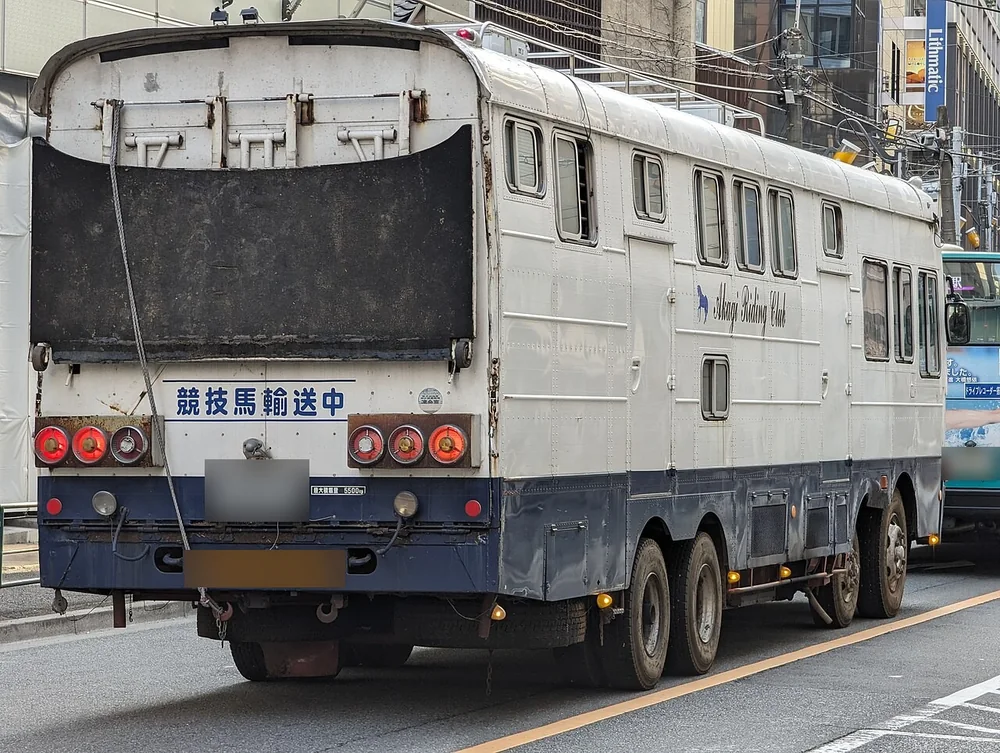
- Japanese JRA horse trucks for racehorses — air conditioning, ventilation windows and cameras through which the driver sees the horses from the cab.
Electric horse trucks have also appeared. The Danish FS Horseboxes showed a demonstration horse truck on the Renault Master EV with a permitted mass of 3,500 kg and called it the first fully electric horse truck in Europe. The range is not stated on the manufacturer’s page.
A light-coloured roof and insulated walls are also among the requirements of the EU regulation for long journeys. A sandwich panel with insulation keeps the compartment cooler in summer and warmer in winter. On the Russian Ford Sollers horse truck the walls are sandwich with 30 mm insulation, fibreglass outside and composite aluminium panels inside.
Mass: Why a 3.5 t Horse Truck Is Tight
An average horse weighs about 600 kg, a person about 80 kg. Horse & Hound gives these figures in a 2024 article on overloaded horse trucks. Two horses, a groom, water, hay, tack and a saddle already make 1.5 t or more.
The weight of a horse depends on its type. The British horse truck builder JJ Horseboxes gives these guidelines in its payload calculator: a pony up to 12.2 hh (about 127 cm) — 150–300 kg, a horse of 14.3–16.2 hh (about 150–168 cm) — 450–650 kg, from 16.3 hh (from 170 cm) — 600–800 kg, a heavy draught horse — 700–1,100 kg. An empty 3.5 t horse truck, according to the same data, weighs 2.2–2.7 t, and about 800 to 1,300 kg is left for the load.
Compare this with the payload on the plate:
| Horse truck | Permitted mass | Payload | Horses |
|---|---|---|---|
| Equi-Trek ATOM, Peugeot (2011 data) | 3,500 kg | 900 kg | 1–2 |
| Böckmann Compact, Fiat Ducato Maxi | 4,250 kg | 1,460 kg | 2 |
| Böckmann Performance, Iveco Daily C70 | 7,200 kg | 2,500 kg | 2 |
| Böckmann Equipe S, Mercedes-Benz Atego | 12,000 kg | 3,870 kg | 3 + living area |
| Böckmann Equipe L 4.12, Atego | 12,000 kg | 3,450 kg | 4 |
| Böckmann Big Equipe S, Mercedes-Benz Actros | 26,000 kg | 10,990 kg | 12 |
For a horse truck of 3.5 t, a payload of 900 kg is one large horse with a reserve or two small ones without a reserve.
At Böckmann the payload is from 29 to 42% of the permitted mass. The heavier the chassis, the larger the share of payload.
Overloading is dangerous not only because of the fine. In the same Horse & Hound article an insurer warns that in an accident involving overloading, the insurance will most likely not pay for repairs. Sellers sometimes weigh a horse truck without partitions and rear doors, and the payload on paper turns out larger than the real one. There is also a second trap — axle load. When the rear horses have already been unloaded and the front one is still standing, the front axle may be overloaded even though the total mass is normal. The publication describes a case in which the police made the owner move a large horse from the front stall to the middle one.
In Great Britain many 3.5 t horse trucks are re-registered at 3.9 t — this gives a mass reserve, but a vehicle heavier than 3.5 t requires a C1 licence. The British Chaigley Horseboxes points out that vehicles heavier than 3.5 t registered after May 2002 must have ABS, and horse trucks heavier than 3.5 t must have a speed limiter at 56 mph (about 90 km/h).
Before buying a horse truck, weigh it empty on a weighbridge — with partitions, doors, full tanks and the spare wheel. The difference between the permitted mass and this figure is your payload.
Which Licence Category Is Needed for a Horse Truck in Kazakhstan
The category is determined by the permitted maximum mass — this is set out in Article 73 of the Law of the Republic of Kazakhstan “On Road Traffic”.
Horse truck (vehicle):
- up to 3,500 kg — category B;
- from 3,500 to 7,500 kg — subcategory C1;
- over 3,500 kg — category C (it also covers the C1 range).
Horse trailer behind a car:
- a trailer with a permitted mass up to 750 kg — category B; there are almost no such trailers for adult horses;
- a trailer heavier than 750 kg — category B, only if its permitted mass is not greater than the unladen mass of the car and the whole combination is not heavier than 3,500 kg by permitted mass;
- in all other cases category BE is needed.
There is also a limit for a trailer behind a horse truck. Under the same Article 73, subcategory C1 allows a trailer no heavier than 750 kg; with a heavier trailer C1E is needed. This rule matches the European one: the Swedish builder Clear Round writes directly to buyers of a C1 horse truck that a heavy trailer behind it requires C1E.
A trailer for two horses with a permitted mass of 2.5–2.7 t behind an SUV of the same unladen mass almost always gives a combination heavier than 3,500 kg. This means BE is needed. Before buying a trailer, add up the permitted mass of the car and the trailer from their registration documents.
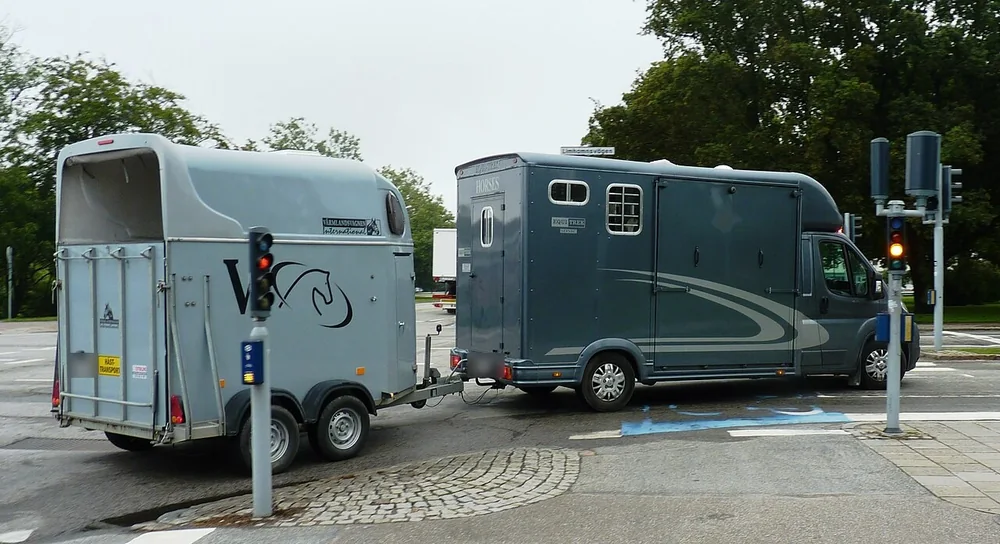
In Germany the logic is similar, but there is an intermediate step. An Auto Zeitung overview explains: category B — a combination up to 3,500 kg, the B96 extension — up to 4,250 kg, heavier — category BE. A horse trailer weighs 600–1,000 kg empty, and with one or two horses already 1,800–2,500 kg. The Australian Regency Floats adds a requirement for brakes: a trailer with a permitted mass of more than 2,000 kg must have a breakaway braking system with a separate power supply that holds the brakes for at least 15 minutes.
In other countries the rules are similar. In Great Britain a horse truck with a permitted mass of more than 3,500 kg requires a heavy goods licence, a tachograph and, for commercial use, an operator’s licence. This is stated on the government page for horse truck owners. In the USA a commercial CDL is needed for commercial transport in a single vehicle with a gross weight of 26,001 pounds (11,794 kg) or more, or in a combination of that weight with a trailer heavier than 10,000 pounds (49 CFR 383.91).
Transporting Horses: What the Regulations of Kazakhstan and Other Countries Require
In Kazakhstan the transport of horses is regulated by the order of the Acting Minister of Agriculture of 29 May 2015 No. 7-1/496 “On Approval of the Rules for Transporting Moved (Transported) Objects”. For horses it states:
- the vehicle is disinfected before and after transport (point 4);
- the consignor provides the animals with water, feed and bedding for the whole journey (point 5);
- for cattle and horses — a vehicle with a wooden floor under a layer of bedding, a side up to 2 m high from the floor of the body, cross and longitudinal beams (point 10);
- the horse stands head forward, is tied securely and is unshod before loading (point 11);
- an attendant travels with the animals — in the cab, or in the body if there is a fenced-off place there (point 12);
- watering on the road at least twice a day in winter and three times in summer (point 13).
Requirements of other countries for the same body:
| Country, document | What it requires |
|---|---|
| EU, Regulation No 1/2005 | 1.75 m² per adult horse; height 75 cm above the withers; ramp not steeper than 20°; horses on the road up to 24 h, watering every 8 h, then 24 h of rest; on long journeys — individual stalls and ventilation 5–30 °C |
| Germany, TierSchTrV, Annex 2 | a partition for every 5 adult horses |
| Sweden, Jordbruksverket | recommendation: stall 0.8 × 2.5 m, ceiling 2.1 m; inspection on the road at least once every 2 h on a journey longer than 50 km; a “live animals” sign at the front and rear |
| Switzerland, BLV | a journey within the country — no more than 8 h, of which in motion — no more than 6 h |
| Great Britain, GOV.UK | certificate of competence for commercial transport over 65 km; vehicle approval for journeys longer than 8 h |
| Finland, Hippos association leaflet | transporter authorisations for journeys up to 8 h and longer than 8 h, valid for 5 years; at least 20 cm above the horse’s head; ramp not steeper than 20°; partition not lower than 60 cm; bar in front of the horse not thinner than 7 cm; a horse transport sign on the vehicle is mandatory; the horse passport always with you |
| Canada, Health of Animals Regulations | horses are not carried in multi-tier bodies (s. 147(2)); the interval for feed, water and rest — no more than 28 h (s. 152.2) |
| Australia, Land Transport of Livestock | no more than 24 h without water, then 12 h of rest; clearance of at least 2.2 m; 12 air changes per hour in a closed body |
| USA, 9 CFR 88 | for commercial transport to slaughter: the horse stands with its head raised, double-deck bodies are prohibited |
One more rule exists almost everywhere: horses are carried on one level only. It is written into the rules of the EU, Canada and the USA.
How Long a Horse Can Travel: Shipping Fever
A long journey is dangerous for a horse not only because of tiredness. The Japan Racing Association (JRA) describes “shipping fever” — an inflammation of the airways that develops on a long road. At the Hidaka stud, the temperature of 32 horses was measured on a 26-hour journey to the Nakayama racecourse. After 18 hours, a temperature of 38.6 °C or higher was found in 10% of the horses, after 24 hours in 20%, and on arrival in 25%.
After these measurements the JRA stopped carrying young horses from Hokkaido to the south in one journey. Previously the 2,600 km route took about 45 hours. Now the horses rest at the Niigata racecourse: the JRA does not recommend carrying a horse for 24 hours or more without a break.
For Kazakhstan this is a direct conclusion. A journey from Almaty to Astana or from Shymkent to Pavlodar easily takes more than a day. On such a route, plan an overnight stop at a stable on the way, as the JRA does.
Which Documents Are Needed to Transport a Horse
In Kazakhstan the transport of animals is regulated by the Rules for the Transport of Animals (order of the Minister of Ecology, Geology and Natural Resources of 19 May 2022 No. 164). Under point 5 of the Rules, the owner of the animal or the responsible person provides during transport a veterinary document for the animal under veterinary legislation, feed, water, air, movement and protection from harmful external influences. The same point states that the volume of space in the vehicle must correspond to the biological, species and individual characteristics of the animals.
The order does not name the exact document needed — it refers to veterinary legislation. Before the journey, check this with the veterinary inspector of the district the horse is leaving. For disinfection of the vehicle and for the attendant, the requirements of order No. 7-1/496 apply — they are covered in the section on regulations.
Horse Truck Options: What Is Fitted and Why
A horse truck is assembled from options. Below is what is found at manufacturers and in advertisements, with the benefit of each option.
For the horse:
- partitions — sliding, removable, with adjustment steps;
- breast and rear bars, padded with soft material;
- rubber lining of the walls — the Australian standard recommends lining from 75 cm above the floor up to back height;
- hay nets at the muzzle. A participant of the prokoni.ru forum advises: “You can (as in many proper horse trucks) hang a hay net in front of her muzzle”;
- tie rings — the Theault AERO Master has eight;
- a camera in the compartment with a screen in the cab;
- air suspension — softer than leaf springs; on the Böckmann Performance it is an option, on the Japanese JRA horse trucks it is standard.
For air and climate:
- roof hatches, windows with grilles, a fan or extractor;
- air conditioning and a stand-alone heater;
- a temperature sensor in the compartment with an alarm for the driver.
For loading:
- a rear and a side ramp, a ramp with gas struts or hydraulics;
- a winch for lifting a heavy ramp (an option on the Böckmann Equipe);
- a fold-down step into the last stall.
For people:
- a tack room for tack and saddles, separated from the horses;
- a living area: sleeping places, a kitchen, a toilet, a water tank; on heavy chassis — a slide-out unit that extends the living part when parked;
- boxes under the body for bedding, buckets and tools.
Every option has weight. A living area on a 7.5 t chassis can take the place of a third horse and hundreds of kilograms of payload. That is why you first count the horses and the mass, and only then choose the comforts.
Chassis for a Horse Truck
On European websites, horse trucks are built on the same families of chassis:
| Class | Chassis | Who builds them (examples) |
|---|---|---|
| up to 3.5 t, van-based horse truck | Renault Master, Mercedes-Benz Sprinter, Peugeot Boxer, Ford Transit | Theault, Stephex, Equi-Trek, Mainline, Ford Sollers |
| 4.25 t | Fiat Ducato Maxi | Böckmann Compact |
| 7.2–7.5 t | Iveco Daily C70, Iveco Eurocargo, MAN TGL, DAF | Böckmann Performance |
| 11–12 t | Mercedes-Benz Atego, Isuzu FRR | Böckmann Equipe; in Australia — a horse truck on an Isuzu FRR 600 for 5 horses |
| 18–26 t | Scania, Volvo FH, Mercedes-Benz Actros and Antos | Stephex, Theault, Böckmann Big Equipe |
On heavy horse trucks the front axle matters: the horses stand behind the cab, and the living area is often at the front too. On the Big Equipe on the Actros the front suspension is rated for 7.5 t.
Accidents and Breakdowns: What Practice Shows
Besides the floor and the ramp, Horse & Hound and the fire services of Great Britain describe three more types of incident:
- wheel. On 17 September 2014 on the M4 a wheel burst on a horse truck; gas cylinders were in the body, and the motorway was closed in both directions;
- fire. On 9 October 2015 on the A14 near Cambridge a horse truck burned out completely, with flames rising about 6 m; the driver and the horse managed to get out;
- rollover. In June 2021 on the M27 a horse truck fell on its side. One horse got out, the second was trapped and died. Hampshire Fire and Rescue freed it with the help of a loader.
From this comes the maintenance of a horse truck: tyres and their age, the gas equipment of the living area, the electrics, the floor from below, the springs and struts of the ramp. For a trailer, the hitch, overrun brakes and bearings are added.
How to Choose a Horse Truck: A Check Before Buying
- How many horses you carry and how tall they are. This sets the stall length and the width and height of the compartment: height at the withers plus 75 cm.
- How far and how often. Over 200 km and every weekend — a truck; rare short trips — a trailer.
- The permitted mass and the real mass of the empty horse truck. The difference must hold the horses, people, water, feed and tack with a reserve.
- The driver’s licence category: B, BE, C1 or C.
- Floor: the base material and the sealing of the covering.
- Ramp: slope, battens, springs or struts, operation without two people.
- Air: hatches, windows, a fan powered without the engine, a temperature sensor.
- Partitions and breast bars: adjustment, padding, no sharp edges or protruding bolts.
- For long trips — a place for the attendant, water, hay nets.
- Vehicle documents: the permitted mass and the body type in the registration certificate match what is on the frame. If the body was fitted to the chassis after the factory, this is a conversion. How it is registered is covered in the article on conversion and the registration certificate.
FAQ
Are a “konevoz” and a “konevozka” the same thing?
Almost. A konevoz (horse truck) is more often a vehicle with a body for horses, a konevozka (horse trailer) is a trailer for 1–2 horses. In conversation both words are used for both variants.
Which is better — a horse trailer or a horse truck?
For one or two horses and rare trips, a trailer is cheaper and simpler if you have a suitable car. For two or more horses, frequent trips and long journeys, a truck is more convenient: it has space for tack, an attendant and belongings, and you do not need to calculate the combination.
Horse truck: which licence category is needed?
In Kazakhstan it depends on the permitted maximum mass (Article 73 of the Law “On Road Traffic”): up to 3,500 kg — B, from 3,500 to 7,500 kg — C1, heavier — C.
Which licence is needed for a horse trailer?
Category B is enough if the trailer is not heavier than 750 kg. It is also enough with a heavier trailer, but then the trailer’s permitted mass must not exceed the unladen mass of the vehicle, and the whole combination must not be heavier than 3,500 kg. A two-horse trailer is almost always heavier, so category BE is more often needed.
Horse trailer for one horse: what sizes are needed?
Under the European standard an adult horse needs a stall of at least 0.7 × 2.5 m, and the height of the compartment must be 75 cm more than its withers. The Swedish authority recommends 0.8 × 2.5 m and a 2.1 m ceiling for a large horse.
How much does a horse truck weigh?
It depends on the class. A horse truck on a 3.5 t van base weighs 2.2–2.7 t empty, leaving 800–1,300 kg for the load. The Böckmann Performance horse truck on the Iveco Daily with a permitted mass of 7,200 kg carries 2,500 kg. Only weighing gives the exact figure.
How many horses fit in a horse truck?
Two — on a van base up to 4.5 t and on a 7.2 t chassis. Three or four — on a 7.5–12 t chassis. Up to twelve — on a three-axle 26 t chassis, as with the Böckmann Big Equipe on the Actros.
How should a horse stand in a horse truck — head forward or backward?
Research has found no difference in heart rate. A horse keeps its balance better when it can lower its head and spread its legs. The rules of Kazakhstan for transport within the country require the horse to stand head forward and be tied.
Which floor is best in a horse truck?
Rubber over an aluminium base does not rot. A wooden base under rubber and bedding must be inspected regularly from below: there are known cases of a horse putting its leg through a rotten floor.
What ramp angle is permitted?
Under the European regulation — no more than 20°. At a slope of more than 10°, battens for the hooves are needed on the ramp.
Which documents are needed to transport a horse?
A veterinary document for the animal — it is required by point 5 of the Rules for the Transport of Animals (order No. 164 of 19.05.2022). The type of document should be checked with the district veterinary inspector before the journey.
How many hours can a horse be carried without stopping?
The Japan Racing Association does not recommend carrying a horse for 24 hours or more without a break: on a 26-hour journey a quarter of the horses had a raised temperature on arrival. The EU regulation permits 24 hours with watering every 8 hours, after which the horse rests for 24 hours.
How often should a horse be watered on the road?
In Kazakhstan — at least twice a day in winter and three times in summer (order No. 7-1/496, point 13). The EU regulation for long journeys — every 8 hours, and after 24 hours of travel, 24 hours of rest.
Does a horse truck need ventilation with a fan?
Yes, if the horse truck is closed and travels in summer. Hatches work only when moving; in a traffic jam and when parked, only a fan moves the air. The EU regulation for long journeys requires ventilation that works for 4 hours without the engine.
Can a horse be taken out of the horse truck on the road?
It depends on the length of the journey. If the journey is shorter than a day, the horse is usually left in its stall: it is watered and fed in the compartment, and at stops the windows are opened and the horse is checked. If the journey is longer than a day, plan a stop at a stable where the horse is unloaded and allowed to rest: the JRA does this, and the EU regulation requires 24 hours of rest after 24 hours of travel.
Source legislation
Full texts in the official Kazakh legal database Adilet:
- Казахстан, Правила перевозки животных (приказ Министра экологии, геологии и природных ресурсов от 19.05.2022 № 164), п. 4–5 — https://old.adilet.zan.kz/rus/docs/V2200028139 (открыт 18.11.2026)