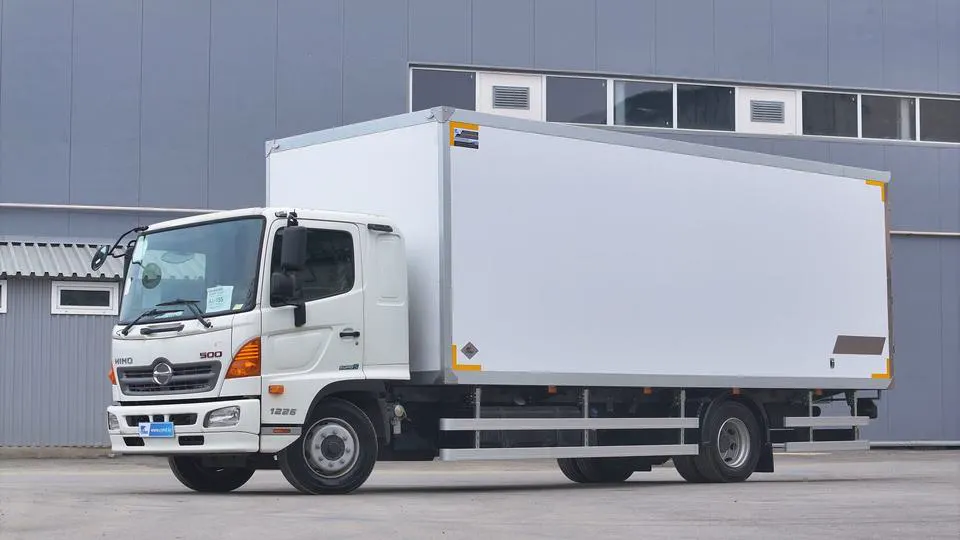
Most medicines and vaccines are transported at +2…+8 °C with documented temperature control along the whole route. A deviation is not just a loss of goods but a risk to patients and to the distributor's licence: the cold chain in pharma is checked more strictly than in food.
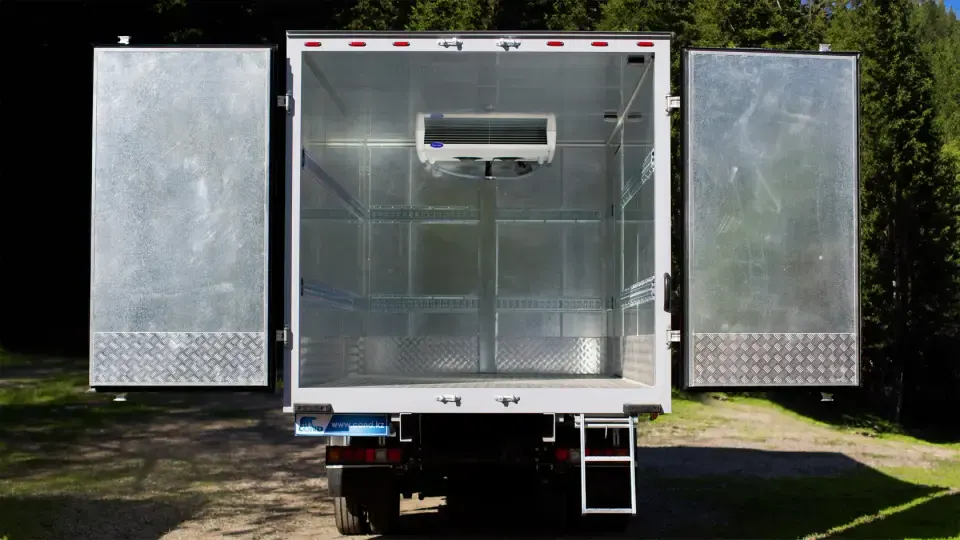
A refrigerator that precisely holds +2…+8 °C with a temperature logger. The body — with reinforced insulation and three-chamber seals: the more stable the passive circuit, the less risk if the unit fails.
An airtight body with low thermal conductivity (no more than 0.4 W/m·°C), installation and service of Carrier units — all in one place, with a warranty of up to 3 years.
With food it is enough that the load arrives cold. In pharmaceuticals you have to prove the range was never breached over the whole journey: a product that has been outside its range cannot be judged by eye, so it is the temperature log that gets checked, not the goods.
Hence the requirements for the vehicle: a temperature recorder with a time log, sensors in the cargo space rather than only at the evaporator, and predictable distribution of cold — so that the reading at the rear door matches the one at the bulkhead.
An 80–100 mm panel: the thicker the envelope, the longer the body holds its temperature with the engine off or the unit failed — that is the margin of time in which a consignment can still be saved.
A duct along the ceiling so the cold passes over the load and returns underneath instead of blowing straight onto the cartons. Smooth washable lining with no gaps. To order — a bulkhead for two temperatures, when one trip carries both +2…+8 °C and room-temperature +15…+25 °C goods.
Each cargo has its own temperature range and its own body fit-out.
For pharmaceuticals what matters is not the average temperature but the absence of deviations, and the Almaty summer tests that: the difference between the street and the body reaches sixty degrees. We fit a unit accurate to ±1 °C and a 100 mm panel. Acceptance is in the workshop in Almaty — you can start the unit and watch it come up to range.
A body for this cargo:A refrigerated van in Almaty
Come to the production site:Van plant in Almaty
Leave your contacts — we'll discuss your task and select a suitable vehicle.
📞PhoneRefrigerated vans — catalogue · Volume and pallet calculator